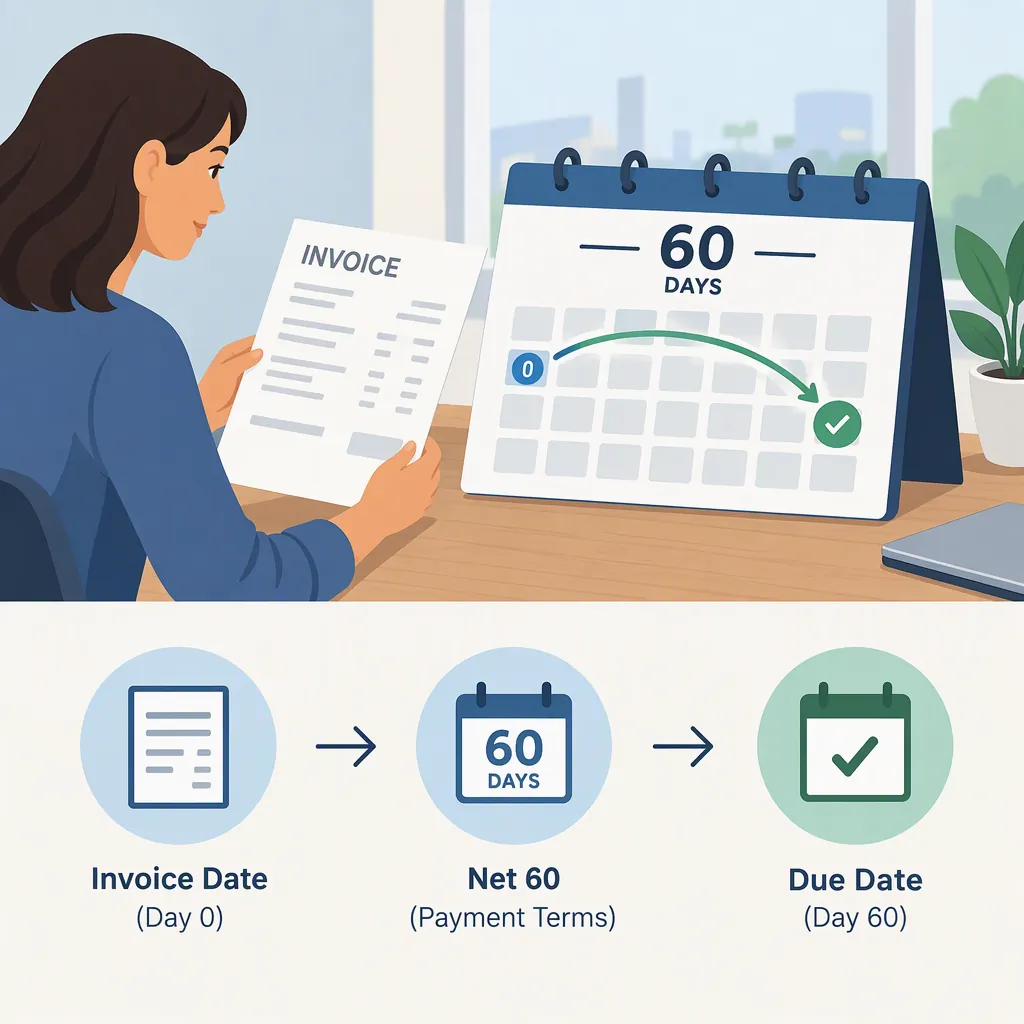
Net 60 Payment Terms: Meaning, Due Dates, and Deal Details
Net 60 payment terms mean the full invoice amount is due within 60 calendar days, usually measured from the invoice date. An agreement may instead specify another starting event, such as delivery or acceptance. For a collaboration, confirm that starting event and the exact due date rather than assuming the countdown begins when work is completed. [c1] [c2]
What Net 60 Means
Net 60 sets a deadline for paying an invoice in full. It gives the buyer time to pay rather than requiring immediate payment. From the seller's perspective, this is a form of short-term credit: the invoiced amount remains outstanding during the payment window. [c3]
The number specifies days, not a percentage. Net 60 does not mean paying 60% of the fee, and it does not by itself describe an installment schedule. Early-payment discounts use additional wording, such as 2/10 net 60. [c1]
For a creator collaboration or other service deal, treat the payment deadline as a separate detail from the delivery schedule. A practical agreement review should identify both when the work is due and when the fee is due. The general sources explain payment terms; they do not establish the terms of any particular collaboration.
How to Calculate the Due Date
For standard invoice-date terms, add 60 calendar days to the invoice date. Calendar days include weekends and holidays; they are not the same as business days. If the agreement specifies a different starting event, use that event when calculating the deadline. [c2]
Illustrative example: An invoice dated July 1 under invoice-date net 60 terms is due August 30. This is a 60-day interval, not simply the same day two months later. [c1]
Before relying on the calculation, check:
- Starting event: Invoice date, invoice receipt, delivery, or acceptance?
- Day convention: Does the agreement explicitly use calendar days or another convention?
- Recorded deadline: Does the invoice show the same due date as the agreement?
- Payment completion: What do the parties mean by payment being made—sent or received?
These are review questions, not assumptions about a buyer's policy. If the deadline falls on a weekend or holiday, clarify the treatment rather than assuming an automatic extension. The provided sources do not establish a universal rule for that adjustment.
Clarify the Clock Before Work Begins
The most useful question is not only “Is this net 60?” but also “Sixty days from what?” altLINE notes that invoice receipt may be relevant in some arrangements, while Universal Funding describes delivery or acceptance as possible contractual starting events. A bare net 60 label does not resolve every timing detail. [c1] [c2]
For a collaboration, consider recording the invoice submission requirements alongside the payment terms. If invoicing depends on acceptance, define how acceptance will be confirmed and discuss a review deadline. This is a suggested drafting safeguard, not a claim that every collaboration follows that process.
Clear billing details also matter. Universal Funding recommends documenting payment terms before work starts and including the purchase order number, contact name, and billing details needed by accounts payable. [c2]
The worksheet below is a planning aid, not a complete contract or legal advice.
Net 60 Deal Review Worksheet
- Agreed fee and currency: __________
- Deliverable or milestone covered by this invoice: __________
- Earliest agreed invoice submission date or event: __________
- Invoice recipient and submission method: __________
- Required purchase order or billing reference, if any: __________
- Event that starts the 60-day period: __________
- Calendar-day or other agreed counting convention: __________
- Exact payment due date once the starting event occurs: __________
- Meaning of payment completion: __________
- Acceptance process and review deadline, if applicable: __________
- Early-payment discount, if any: __________
- Agreed procedure for disputed or overdue amounts: __________
Compare Net 60 with Shorter Terms
Net 30 requires full payment within 30 days of the invoice date; net 60 extends that standard window to 60 days. When both use the same starting event, net 60 allows 30 additional days before payment is due. [c3]
That extra time can help a buyer manage cash flow, but it also leaves the seller waiting longer for cash. Expenses incurred before collection still need to be covered, and payment may arrive late despite the stated deadline. [c1] [c2]
Before accepting net 60, a useful planning exercise is to list expenses falling due between the start of work and the expected payment date. Include any period before the invoice can be submitted, not just the 60-day payment window. Consider a delayed-payment scenario as well as on-time payment.
If the gap is difficult to carry, possible negotiation proposals include a shorter term, an upfront portion, or milestone payments. These are options to discuss, not rights created by the phrase net 60 or guarantees that the other party will agree.
Understand Discounts and Overdue Payments
2/10 net 60 means the buyer can take a 2% discount by paying within 10 days; otherwise, the full amount is due within 60 days. 1/10 net 60 follows the same structure with a 1% discount. Confirm the event from which both windows are measured. [c1]
Hypothetical calculation: On a $1,000 invoice with an agreed 2/10 net 60 discount, eligible early payment would be $980. Without the discount, the amount due remains $1,000. A plain net 60 invoice does not include that discount automatically. [c1]
Once an invoice passes its agreed deadline without payment, an overdue-payment process may include reminders and escalation. Late fees are not a universal consequence of the words net 60: the sources describe them as subject to contractual permission and applicable rules. Confirm the policy and obtain appropriate legal or accounting advice before applying a fee. [c2] [c3]
FAQ
Does Net 60 Mean Calendar Days or Business Days?
Standard net terms count calendar days, including weekends and holidays. Check the agreement for any different counting convention or deadline adjustment; do not silently substitute 60 business days. [c2]
Does Net 60 Start When the Work Is Finished?
Usually, the countdown starts on the invoice date, not automatically on completion of the work. A contract can specify delivery or acceptance instead. Identify the agreed starting event and any conditions for submitting the invoice. [c1] [c2]
Can a Buyer Pay Before Day 60?
Yes. Net 60 sets the payment deadline rather than requiring the buyer to wait until day 60. An early-payment discount applies only if additional discount terms have been agreed. [c1]
Does Net 60 Automatically Include a Late Fee?
No. Net 60 specifies the payment window. A late-fee policy needs separate clarity in the agreement, and applicable limits should be checked with a qualified professional. The provided sources do not establish a fee rate for any particular deal. [c2] [c3]