Net 45 Day Payment Terms: Meaning, Timing, and Examples
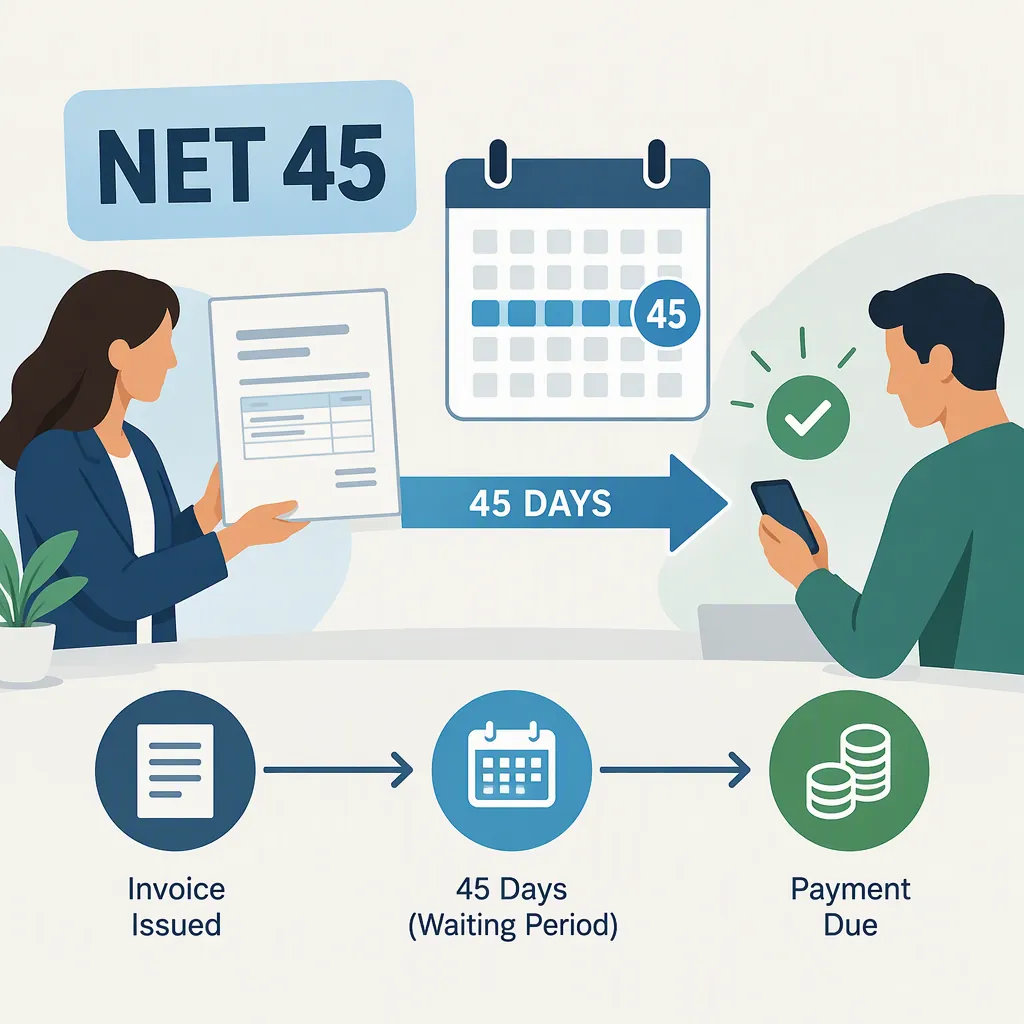
Net 45 means the full invoice amount is due within 45 days of the agreed starting date, typically the invoice date. For a clear calendar-day agreement, an invoice dated May 1, 2026, would be due June 15, 2026. Specify the start event, calendar or business days, and exact due date rather than relying on “net 45” alone. [stripe] [ecapital] [sage]
What Net 45 Means
The number in a net payment term identifies the payment window. Stripe lists net 30, net 45, and net 60 as terms under which payment is due within the specified number of days after the invoice date. eCapital explains that “net” means the full amount is due. Together, these definitions make net 45 a 45-day deadline for full payment—not a requirement to pay only on the final day. [stripe] [ecapital]
Net 45 alone does not specify an early-payment discount or a staged payment schedule. Discounts, deposits, and installments are additional conditions that should be stated separately. [stripe]
For a creator collaboration, keep the payment schedule distinct from the delivery schedule. A suggested agreement should identify when content is due, when an invoice may be issued, and which event starts the payment window.
When the 45-Day Clock Starts
The invoice date is a common starting point, but the agreement matters. Sage explains that a net payment window may instead begin on shipment, delivery, or buyer acceptance when the parties choose a different trigger. That discussion concerns net 30; the useful drafting principle for net 45 is to state the trigger explicitly. [sage]
The provided sources are not perfectly consistent about invoice date versus receipt: Stripe defines net terms using the invoice date, then describes its net 30 example using invoice receipt. This is another reason to avoid leaving the starting event implicit. [stripe]
Suggested questions for a collaboration agreement:
- Does the clock begin on the invoice date, documented invoice receipt, or acceptance of the deliverables?
- If acceptance starts the clock, what counts as acceptance and what is the review deadline?
- Where should the invoice be submitted, and what information must it include?
- Does payment need to be initiated or received by the due date?
These are drafting checks, not assumptions about a particular client's process.
How to Calculate a Net 45 Due Date
For an agreement that specifies calendar days, use:
Due date = agreed starting date + 45 calendar days.
Illustrative calculation, not a customer transaction:
| Item | Example |
|---|---|
| Agreed trigger | Invoice date |
| Invoice date | May 1, 2026 |
| Payment window | 45 calendar days |
| Due date | June 15, 2026 |
This calculation treats May 2 as the first elapsed day. It adds 45 days; it does not count May 1 as day one.
Sage describes standard net 30 timing as calendar days, including weekends and bank holidays unless otherwise stated. Its article does not establish a universal rule for every net 45 contract. Specify calendar days or business days in your own agreement, and clarify how a due date falling on a nonworking day will be handled. [sage]
Writing the exact due date on the invoice helps make the expected deadline clear. Sage recommends including both the due date and the relevant payment terms. [sage]
Due-Date Verification Checklist
- Record the agreed starting event and its date.
- Confirm whether the agreement uses calendar days or business days.
- For calendar-day terms, add 45 days to the starting date.
- Apply any expressly agreed weekend or holiday adjustment.
- Put the resulting due date on the invoice.
- Check that the invoice wording matches the agreement.
Suggested Wording for a Collaboration
Put the agreed payment terms in writing before work begins, then use matching wording on the invoice. Stripe recommends documenting negotiated terms in a contract or invoice; Sage recommends clearly stating the terms in both. [stripe] [sage]
The sample below deliberately uses the invoice date as the trigger. It is an illustrative drafting aid, not a complete contract or legal advice. If the parties prefer receipt or acceptance, replace the trigger and define how its date will be established.
For a creator deal, a suggested companion checklist should cover deliverables, review deadlines, the permitted invoicing milestone, invoice submission details, payment method, and any separately agreed deposit. Avoid mixing these details into an undefined phrase such as “net 45 after approval.”
Illustrative Net 45 Payment Clause
Payment terms: Net 45. The full invoice balance is due within 45 calendar days after the invoice date. Each invoice will state its invoice date and corresponding payment due date. Any deposit, early-payment discount, late-payment charge, or different payment trigger must be separately agreed in writing.
Trade-Offs and Late Payments
With the same starting date, net 45 allows 15 more days than net 30 and 15 fewer days than net 60. Stripe presents net 45 as a possible compromise when one party prefers net 30 and the other requests net 60. It is an option to negotiate, not a universal standard for creator collaborations. [stripe]
Longer payment windows give the buyer more time before paying but leave the supplier waiting longer for cash. Consider whether project expenses must be covered before payment arrives. Alternatives include a deposit, milestone payments, or a shorter payment window, if both parties agree. [ecapital] [stripe]
If payment passes the agreed deadline, check the invoice and contract before following up. A suggested reminder should identify the invoice number, amount, due date, and requested payment update. Do not assume net 45 automatically authorizes a late fee: Sage says late fees or interest should be agreed in advance and clearly stated. Whether a particular charge is enforceable requires advice specific to the agreement and jurisdiction. [sage]
The references provide general payment-term guidance, not creator-specific legal rules. This article does not establish enforceability or replace legal, tax, or accounting advice.
FAQ
Does Net 45 Mean Calendar Days or Business Days?
Specify this in the agreement. Sage describes net 30 as calendar days, including weekends and bank holidays unless otherwise stated, but that source does not establish the interpretation of every net 45 contract. “45 calendar days after the invoice date” is clearer than “net 45” alone. [sage]
Does Net 45 Start After Delivery?
Not necessarily. Net terms commonly use the invoice date, while an agreement can choose delivery or acceptance as the starting event. For a collaboration, state the invoicing milestone and payment trigger separately so the delivery deadline is not mistaken for the start of the payment window. [stripe] [sage]
Can an Invoice Be Paid Before Day 45?
Yes. Net 45 sets a deadline for full payment, not a required waiting period. An early-payment discount is a separate condition and should be expressly agreed rather than assumed. [stripe] [ecapital]
Can Net 45 Terms Be Negotiated?
Yes. Stripe discusses net 45 as a possible compromise between net 30 and net 60 and also describes deposits and staged payments. Any change should be documented before relying on the revised schedule. [stripe]