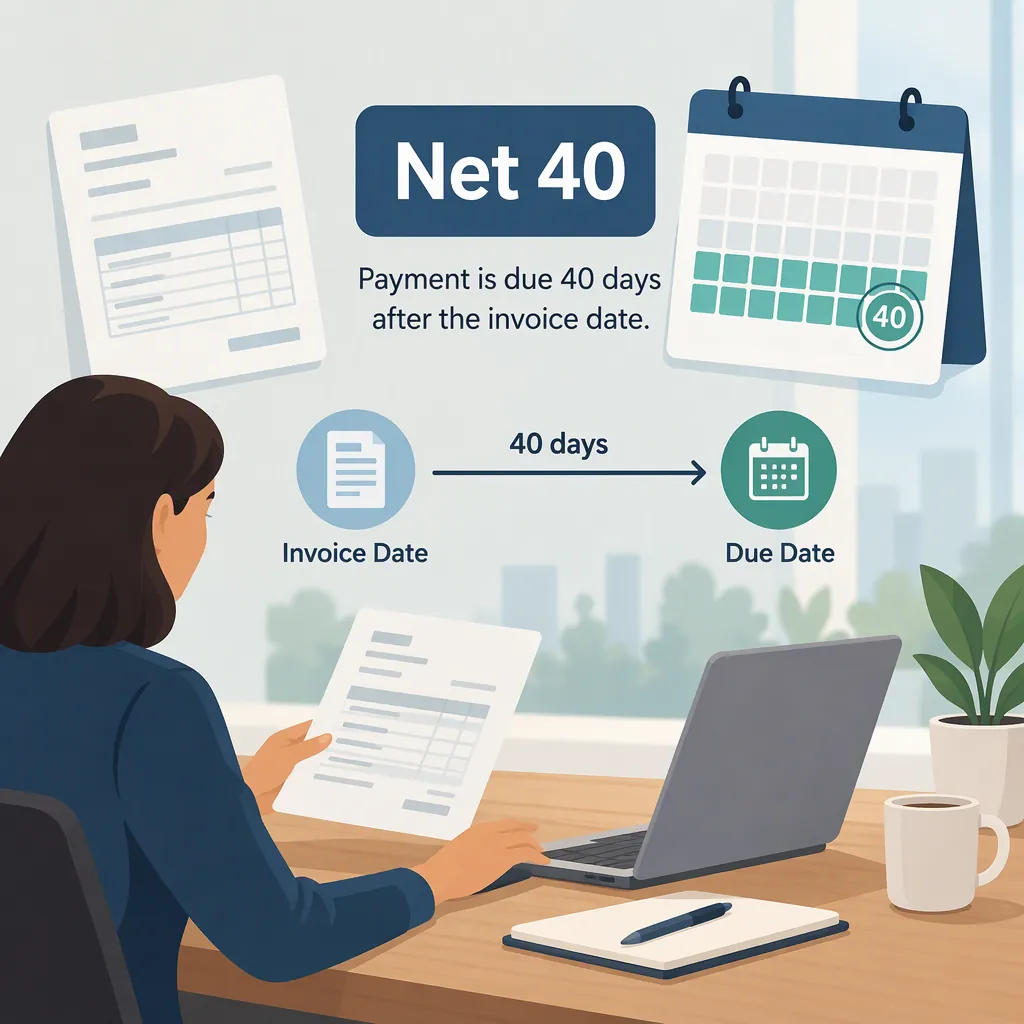
Net 40 Payment Terms: Meaning, Due Dates, and Deal Details
Net 40 payment terms mean the full invoice amount is due within 40 days of the agreed starting date, typically the invoice date. Net terms generally count calendar days, including weekends and holidays, unless otherwise stated. This applies the general net-terms convention to a 40-day period; the provided sources do not specifically define net 40. Confirm the starting event and exact due date in the agreement. [c1] [c2]
What Net 40 Means
The number in a net payment term specifies the payment window, while “net” refers to the full amount invoiced. Under that convention, net 40 gives the payer 40 days to pay the invoice in full. It does not mean a 40% payment, a discount, or a requirement to wait until day 40. [c1] [c3]
With the same starting date and counting rules, net 40 provides 10 more days than net 30 and five fewer days than net 45. These are arithmetic comparisons, not evidence that net 40 is standard in any particular industry.
For a creator collaboration or other service agreement, distinguish the payment deadline from the work schedule. As a drafting recommendation, record delivery, review, publication, invoicing, and payment dates separately rather than treating “net 40” as a complete deal timeline.
How to Calculate a Net 40 Due Date
First identify the agreed starting date. Then add 40 calendar days if that is the counting rule in the agreement. Net terms typically include weekends and holidays unless the parties specify otherwise. [c1]
Hypothetical example: An invoice is dated October 1, 2026. The agreement says payment is due 40 calendar days after the invoice date. Adding 40 days produces a due date of November 10, 2026.
Do not assume that invoice issuance and invoice receipt are the same event. The references describe invoice-date timing as typical, but also recognize alternative starting events such as delivery or acceptance. The actual wording therefore matters. [c2]
If the deadline falls on a weekend or holiday, check the agreed rule rather than automatically moving it to the next business day. Also clarify whether payment must be initiated or received by the deadline.
Due-Date Verification Checklist
- Record the agreed starting event and its date.
- Confirm calendar days or business days.
- For a calendar-day term, add 40 days to the starting date.
- Check any agreed weekend or holiday adjustment.
- Record the exact due date on the invoice.
- Confirm whether the deadline concerns payment initiation or receipt.
What to Clarify Before Work Begins
Payment terms should be communicated before work begins and documented in the agreement, including the due date, accepted payment methods, and any late-payment policy. [c1]
For a collaboration, use the following questions to make the proposed net 40 term precise:
- Starting event: Does the period begin on the invoice date, receipt of the invoice, delivery, or acceptance?
- Invoice requirements: What billing details or purchase order information must be included?
- Review process: If acceptance starts the clock, who confirms it and what review deadline applies?
- Payment completion: Must funds arrive by the due date, or is initiating payment sufficient?
- Exceptions: What happens if part of the invoice is disputed or needs correction?
- Additional terms: Are deposits, milestones, discounts, or late fees separately agreed?
These are drafting considerations, not conditions automatically created by the phrase “net 40.” Any approval-based trigger needs particular attention because it changes when the payment window begins.
The example below assumes invoice-date timing and calendar days. It is an educational drafting aid, not a complete contract or legal advice.
Illustrative Net 40 Wording
Payment terms: Net 40. The full invoice amount is due 40 calendar days after the invoice date. The invoice will state the exact payment due date. Payment must be received by that date. Any early-payment discount, late-payment charge, or deadline adjustment must be addressed separately in the parties’ written agreement.
Cash Flow and Overdue Payments
Longer payment terms allow the buyer to retain cash longer but delay the supplier’s receivables. That trade-off can put pressure on the supplier’s working capital. Net 40 should therefore be evaluated against the timing of expenses, not just the invoice amount. [c3]
As a planning exercise, map when work-related expenses occur, when invoicing is permitted, and when the 40-day deadline ends. If invoicing happens after delivery, the period between beginning work and receiving payment can exceed 40 days.
If the invoice becomes overdue, review the agreed terms, verify the invoice details, and send a factual reminder identifying the invoice and due date. Tracking outstanding invoices and following up on late payments are recommended net-terms practices. [c1]
Net 40 alone does not specify an early-payment discount or a late-fee rate. Such conditions should be stated separately. Whether a late charge is enforceable depends on the agreement and applicable law; this article does not establish that any particular charge is permitted. [c2]
FAQ
Does Net 40 Mean Calendar Days or Business Days?
Applying the general net-terms convention, it typically means 40 calendar days, including weekends and holidays. An agreement can specify a different counting rule, so check the wording rather than assuming business days. [c1]
Does Net 40 Start When the Work Is Finished?
Not necessarily. Invoice-date timing is typical for net terms, but the parties can specify delivery, acceptance, or another starting event. For a collaboration, state the trigger explicitly and show the resulting due date on the invoice. [c2]
Does Net 40 Include an Early-Payment Discount?
Not by itself. Under the general net-terms convention, the full invoice amount is due within the stated window. An early-payment discount requires additional terms specifying the discount and its deadline. The provided references explain this convention but do not specifically define net 40. [c3]