Net 35 Payment Terms: Meaning, Due Dates, and Deal Details
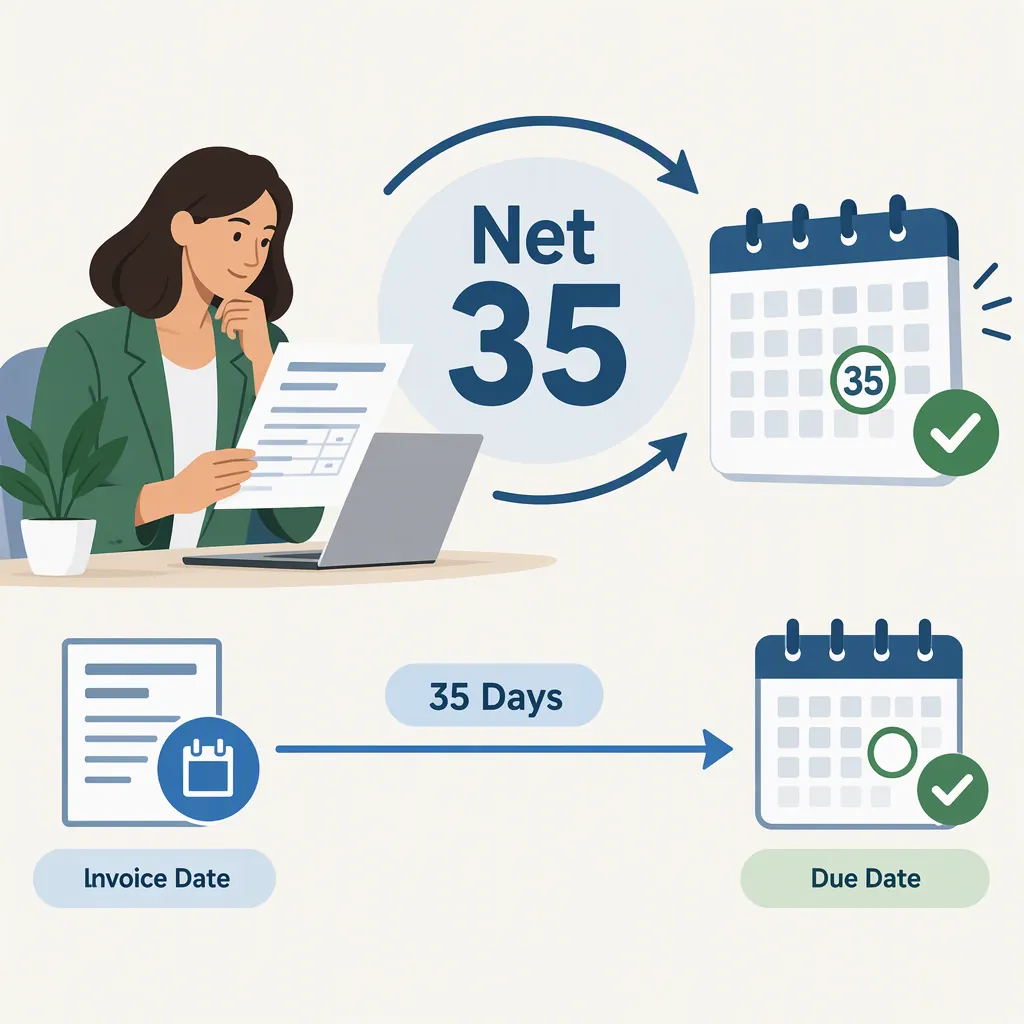
Net 35 means the invoice balance is due 35 days after the agreed starting event. Confirm whether that event is the invoice date, invoice receipt, delivery, or acceptance, and whether the agreement uses calendar or business days. The supplied references explain net terms generally, including Net 30, but do not specifically establish Net 35 counting rules. [c1]
What Net 35 Means
Net terms allow a buyer to pay later rather than immediately. One supplied reference illustrates Net 30 as payment in 30 days; Net 35 applies the same numbered-term concept to a 35-day payment window. [c1]
For a creator collaboration or other service agreement, separate two questions: when the work is due and when payment is due. A deliverable deadline does not identify the payment start date unless the agreement connects them.
Do not treat “Net 35” alone as a complete payment clause. Specify the starting event, counting method, amount owed, and due date. Any deposit, early-payment discount, or late-payment charge should be addressed separately rather than inferred from the number 35.
How to Calculate a Net 35 Due Date
Use this method once the parties have agreed on the counting rules:
- Identify the event that starts the payment period.
- Record the date that event occurred.
- Add 35 days using the agreed calendar-day or business-day method.
- Apply any expressly agreed weekend or holiday adjustment.
- Put the resulting due date on the invoice and check it against the agreement.
Illustrative calculation: Assume the agreement starts the clock on the invoice date, uses calendar days, treats the following day as day one, and makes no weekend or holiday adjustment. An invoice dated April 1, 2026, is then due May 6, 2026.
If the same invoice is received April 4 and the agreement starts the clock on receipt instead, the illustrative due date becomes May 9. These are arithmetic examples under stated assumptions, not universal contractual rules.
Due-Date Calculation Record
Invoice identifier: [identifier]
Agreed starting event: [invoice date / receipt / delivery / acceptance]
Starting event date: [date]
Counting method: [calendar days / business days]
Day-one convention: [agreed convention]
Weekend or holiday adjustment: [agreed rule or none]
Calculated due date: [date]
Agreement provision checked: [provision]
Details to Clarify in a Collaboration Agreement
Before relying on a Net 35 label, clarify the following in writing:
- Payment responsibility: Which legal entity owes the payment, and where should the invoice be submitted?
- Invoice requirements: What information or supporting documents must accompany it?
- Starting event: Does the clock begin at issuance, receipt, delivery, or acceptance?
- Approval timing: If acceptance starts the clock, who approves the work and by what deadline?
- Revisions and disputes: What happens to payment timing if a revision is requested or part of the invoice is disputed?
- Payment completion: Must funds be received by the due date, or is initiating the transfer sufficient under the agreement?
- Separate terms: Are deposits, fees, discounts, currency, and transfer costs addressed?
These are drafting considerations, not claims about any particular client's payment process. A clear invoice can record the agreed terms, but should not silently substitute a different trigger or deadline.
Illustrative Calendar-Day Payment Wording
Drafting example, not legal advice: The invoice balance is due 35 calendar days after the payer receives the invoice at the agreed submission destination. The day after receipt is day one. The invoice will state the calculated due date. The parties will separately specify invoice requirements, any weekend or holiday adjustment, and whether payment must be received or initiated by that date.
Cash-Flow Implications and Source Limits
Deferred payment leaves the seller waiting for funds while the buyer has time to pay. The supplied LinkedIn article describes this as a cash burden for suppliers, and the Resolve article also discusses the cash-flow gap associated with net terms. [c1] [c2]
For planning purposes, distinguish the work date, invoice-submission date, payment-clock start date, and expected receipt date. If invoicing can occur only after approval, the period from doing the work to receiving payment may exceed the stated 35-day window.
Evidence limitation: Both supplied sources discuss broader B2B payment arrangements and financing. Neither provides an authoritative Net 35 definition for creator agreements, a jurisdiction-specific counting rule, or a universal late-fee policy. This article uses them only for general net-terms context; its date calculations and drafting tools are explicitly illustrative. It does not assess the enforceability of a particular agreement.
FAQ
Does Net 35 Mean Calendar Days or Business Days?
Confirm the counting method in the agreement rather than assuming it. The supplied references do not establish a Net 35-specific rule. An explicit phrase such as “35 calendar days after invoice receipt” removes one important ambiguity.
Does the 35-Day Period Start When the Work Is Delivered?
Only if delivery is the agreed starting event. The agreement might instead use the invoice date, invoice receipt, or acceptance. Keep delivery and payment milestones separately documented.
How Does Net 35 Differ from Net 30?
With the same starting event and counting method, Net 35 provides five more counted days than Net 30. The supplied reference illustrates Net 30 as payment in 30 days, but does not separately define Net 35. [c1]
Does Net 35 Automatically Include a Late Fee?
Do not infer a late fee from “Net 35” alone. Check the agreement and applicable legal requirements before assessing any charge. The supplied sources do not establish a universal late-fee rule.