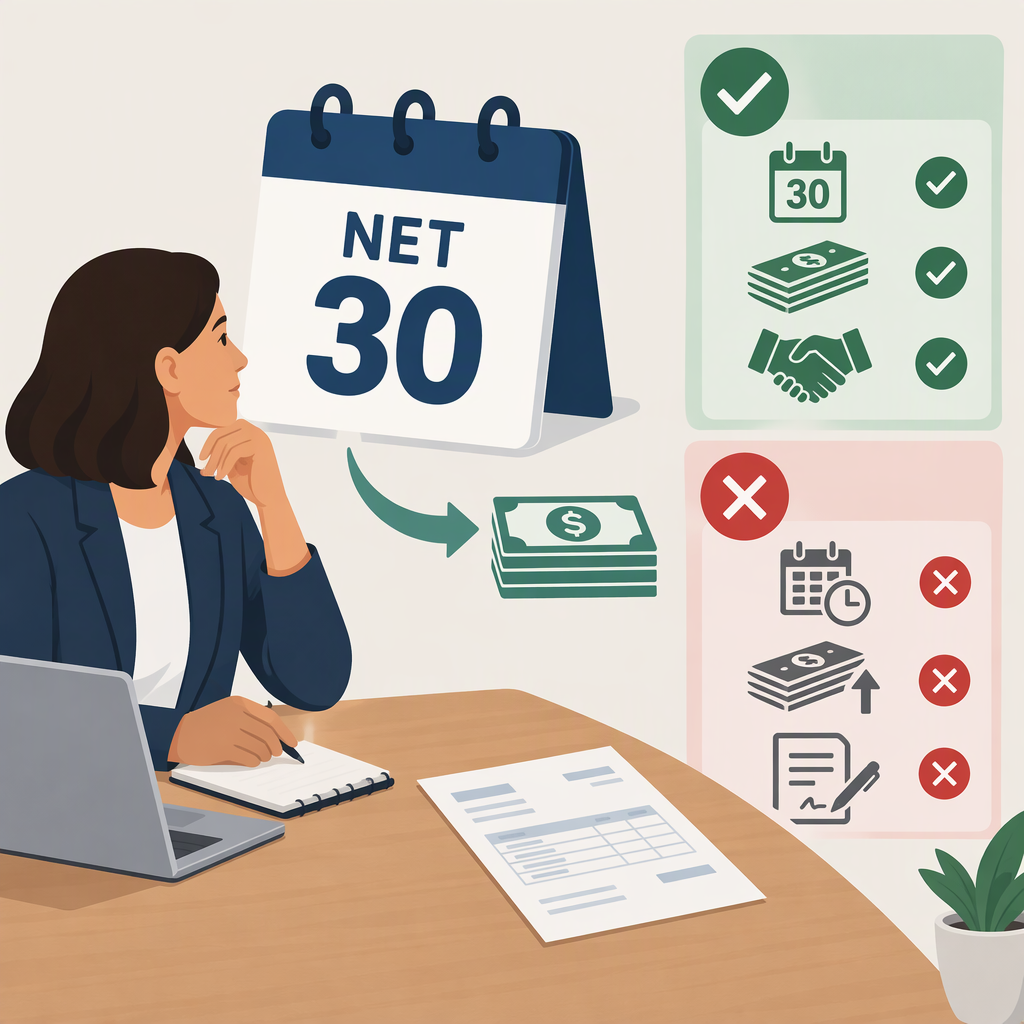
Net 30 Com: What the Payment Term Means—And What Isn’t Confirmed
Short Answer
“Net 30 Com” is not enough information to identify a particular company’s payment policy. The public sources located for this article did not establish which entity the phrase refers to or verify terms published by that entity. So there is no supported basis here for saying who qualifies, when its 30-day period begins, or what happens if a payment is late.
In general business invoicing, Net 30 means the full invoice balance is due within 30 days of an agreed starting date. The invoice date is commonly used, but the agreement may specify another trigger. Check the actual invoice and governing agreement for the start date, due date, and any other conditions; do not assume a general convention is a particular company’s policy. (sage.com)
What Does “Net 30 Com” Refer To?
The phrase could be a search for Net 30 payment terms, a reference to a domain or organization, or shorthand for a net-30 account. The phrase alone does not distinguish among those possibilities. No entity-specific terms should be attributed to “Net 30 Com” without an authoritative source identifying the entity and stating its policy.
That distinction matters: a general explanation of Net 30 is not evidence that a particular seller offers those terms, that a reader is eligible, or that its invoices follow a particular due-date rule.
What Net 30 Generally Means
For a business invoice, “net” generally refers to the full amount owed, and “30” refers to the payment period. Commonly, the buyer must pay the full balance within 30 days of the date specified by the parties—often the invoice date. (sage.com)
Illustration only: If an agreement says that the 30-day period starts on the invoice date, an invoice dated April 1 would ordinarily point to a due date 30 days later. This illustration does not establish the rule for any “Net 30 Com” account. Before calculating a real due date, confirm the contract’s start event and how it counts days; also check whether the invoice states a specific due date.
How to Work Out the Due Date
Use the terms that apply to your particular invoice or account:
- Find the governing terms. Check the signed agreement, account notice, purchase terms, or other document that applies to the transaction.
- Identify the trigger date. It may be the invoice date, but do not assume that if the terms specify another event, such as delivery or receipt of the invoice.
- Read the day-count rule. Confirm whether the terms say calendar days or business days and whether they address weekends or holidays.
- Compare the calculation with the stated due date. If the invoice and agreement appear inconsistent, ask the issuer to clarify before relying on an assumed date.
- Check payment instructions and late-payment language. Do not infer fees, interest, account restrictions, or other consequences from the words “Net 30” alone.
Who Qualifies, and What Happens If Payment Is Late?
Those are entity- and agreement-specific questions. The sources located for this article do not verify eligibility requirements, covered accounts or transactions, geographic limits, fees, or other late-payment consequences for an entity called “Net 30 Com.” Treat those details as unknown unless they appear in terms that clearly apply to your account.
If you have an invoice, look for the named issuer, the payment-terms section, the invoice date, the stated due date, and any linked agreement. If you mean a particular website or company by “Net 30 Com,” its exact name or the relevant terms document would be needed to explain that entity’s policy rather than general Net 30 usage.