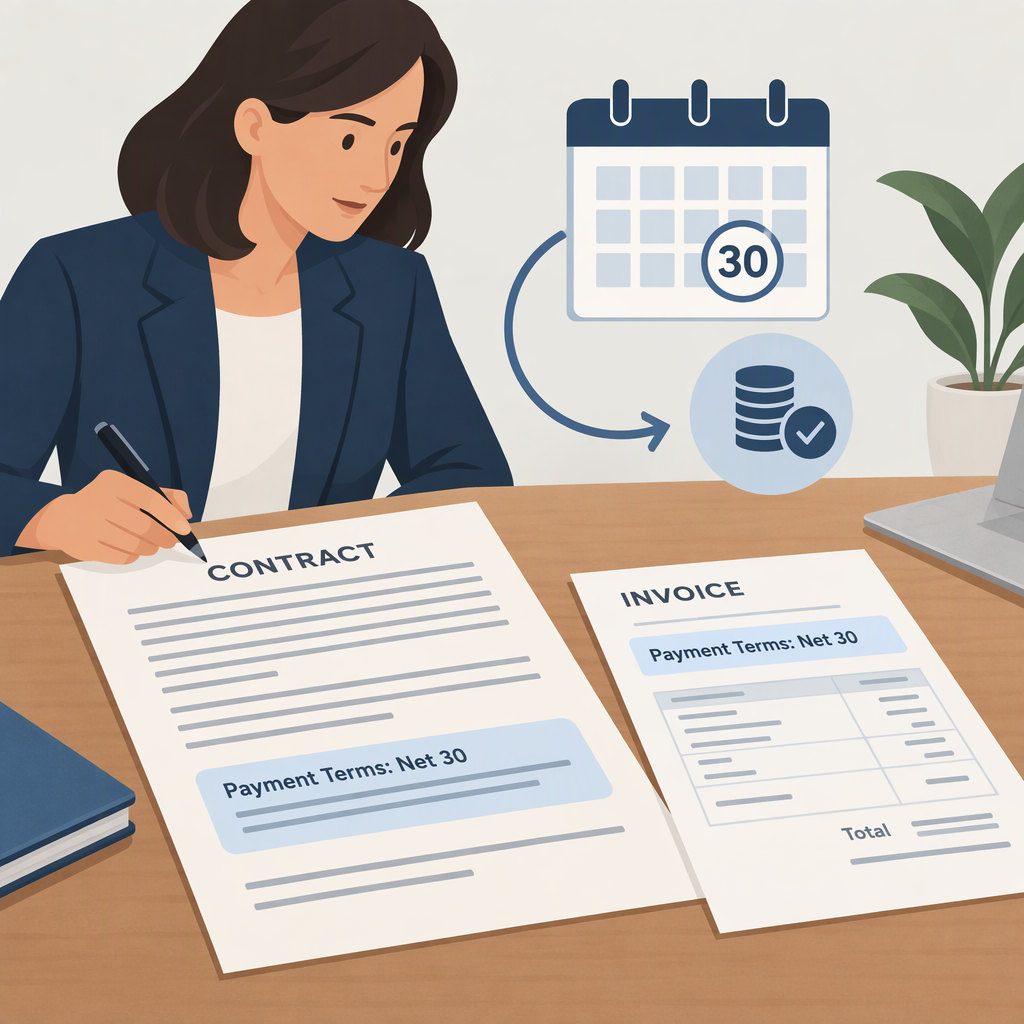
Net 30 Payment Terms: Contract Clause and Invoice Wording
The Short Answer
A “Net 30” label alone may leave an important question unanswered: 30 days from what? To make a payment term operational, state the event that starts the 30-day period, whether you mean calendar or business days, and how the due date is determined. Use the same details in the contract and on the invoice.
There is no single trigger or legal rule established here for every U.S. transaction. Rules can depend on the type of contract and governing law. For example, federal prompt-payment regulations address specified federal payments and include particular rules for determining when an invoice is received; those rules should not be assumed to govern an ordinary private contract. (law.cornell.edu)
Decide What Starts the 30 Days
Choose the start event with the other party and write it out. Possible choices include:
- Receipt of a proper invoice: The clock starts when the customer receives an invoice that meets the contract’s stated submission requirements.
- Invoice date: The clock starts on the date shown on the invoice. Specify this expressly; do not leave it to implication.
- Acceptance or approval: The clock starts after a defined acceptance or approval event. If you choose this, say what counts as acceptance and how the process works.
These are drafting options, not universal defaults. The right choice depends on the transaction and the parties’ agreement. If delivery, acceptance, invoice review, or dispute procedures affect when the clock starts, make those mechanics clear too.
Next, specify the day-count convention. Calendar days include weekends and holidays; business days use a business-day convention that should also be defined if the parties need one. Do not rely on the phrase “Net 30” alone to settle either choice.
Adaptable Contract Clause
Use this as a drafting starting point, not as legal advice or a guarantee of enforceability. Fill in the brackets and make sure the choices match the parties’ agreement:
Payment terms. Customer will pay each undisputed invoice within 30 [calendar / business] days after [the agreed start event—for example, Customer’s receipt of a proper invoice at the designated submission address]. The start date is [define the date or event used to begin counting]. The due date is [explain how the 30-day period is counted, including any agreed rule for a due date falling on a weekend or holiday]. Invoices must be submitted to [email address, portal, or mailing address] and include [any agreed required information].
If payment depends on acceptance, approval, or an invoice being undisputed, specify the relevant process and what happens if the customer raises an issue. Avoid a clause that says payment is due “Net 30” while another sentence starts the clock from a different event.
Matching Invoice Wording
The invoice should reflect the contract, not quietly change it. For a contract using receipt of a proper invoice and calendar days, a matching line could read:
Payment due: Within 30 calendar days after receipt of a proper invoice under the agreement. Invoice submission address: [agreed address or portal].
If the contract instead makes the invoice date the trigger, the invoice line should say that—and the contract should say so too. If the contract requires acceptance before the period begins, do not show an earlier due date that conflicts with that condition.
Worked Example: Calendar Days from Receipt
Suppose the parties expressly agree that the 30-day period starts the day after the customer receives a proper invoice, and that the period uses calendar days. If the customer receives the invoice on May 1, then May 2 is day 1 and May 31 is day 30. Under this illustrative counting convention, the invoice is due May 31.
This example applies only the stated hypothetical convention; it does not establish a legal rule for counting days. If the parties want a different trigger, a business-day count, or a weekend-and-holiday adjustment, put that choice in the contract and make the invoice consistent with it.
Quick Consistency Check
Before using the term, confirm that:
- The trigger is explicit. Does the 30-day period begin on the invoice date, receipt, acceptance, or another agreed event?
- The invoice can be delivered and received predictably. Is the submission address or method stated, and is receipt defined if that matters to the deadline?
- The count is clear. Are the days calendar or business days? If relevant, what happens when the due date falls on a weekend or holiday?
- The contract and invoice agree. Do both identify the same trigger and counting method?
- Other payment terms are handled separately. Late charges, interest, statutory deadlines, remedies, and dispute rights may depend on the contract and applicable law. Do not assume that a Net 30 clause settles those issues.
For a particular transaction—especially one involving public procurement, goods, cross-border parties, or a disputed acceptance process—have the wording reviewed against the full agreement and applicable law. The U.S. locale alone does not determine which law governs.