Net 28 Payment Terms: Meaning, Due Dates, and Deal Wording
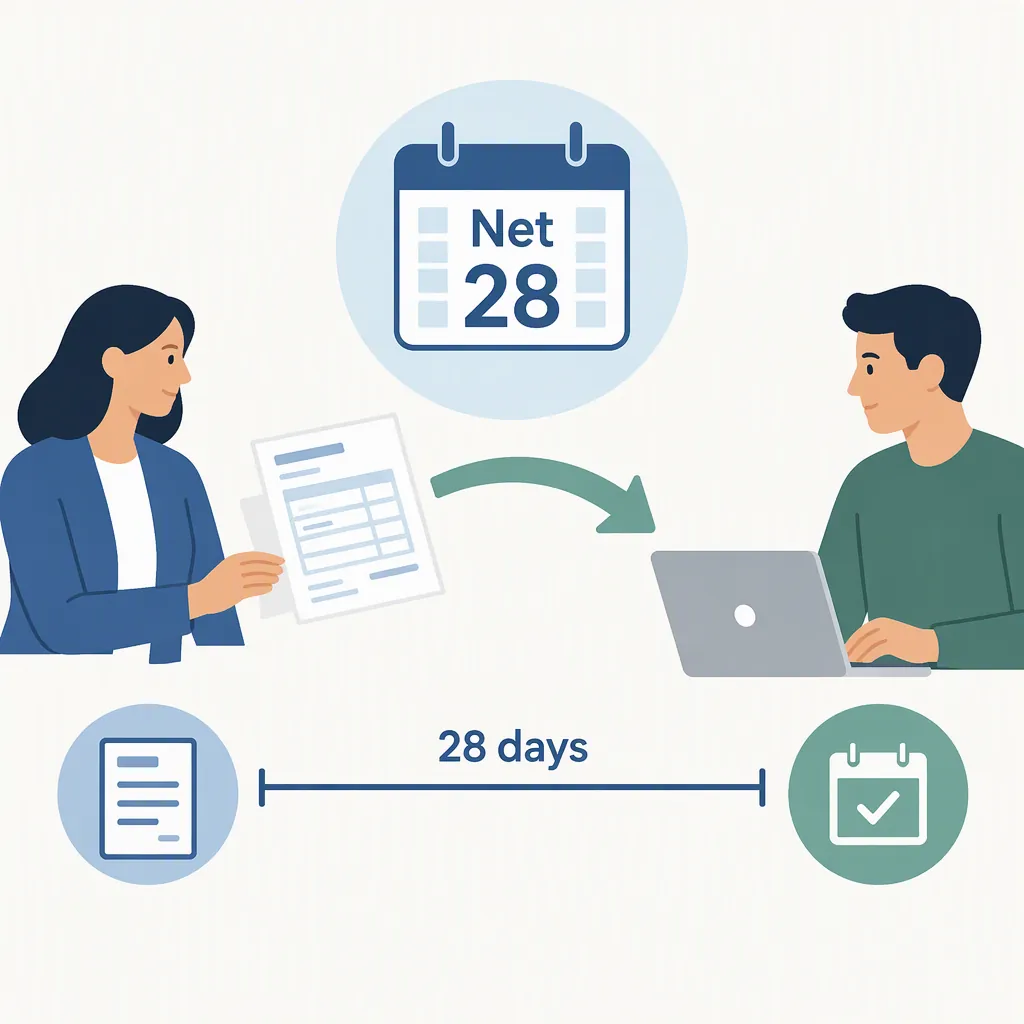
Net 28 payment terms mean the full invoice balance is due within 28 days of the agreed starting date. Using the calendar-day, invoice-date convention described in the provided net 30 references, net 28 means payment is due 28 calendar days after the invoice date, unless the agreement specifies a different trigger. For example, April 1 plus 28 days is April 29. The references explain net payment terms, not net 28 specifically; this article applies that framework to a 28-day period. [c1]
What Net 28 Means
Read net 28 as a payment deadline, not a promise to pay only on the twenty-eighth day. Payment can be made earlier. The amount due is the outstanding invoice balance after any agreed adjustments; an early-payment discount should be stated separately.
The provided sources describe net 30 as full payment within 30 days and explain other numbered net terms. Applying the same structure to net 28 gives a 28-day payment window. This is an interpretation of that framework, not evidence that net 28 is an industry standard. [c1] [c2]
For a creator collaboration or other service deal, keep the payment deadline separate from the work schedule. A delivery deadline tells the parties when work is due; the payment wording should identify what starts the 28-day clock.
Plain-English Payment Summary
Payment terms: Net 28. The outstanding invoice balance is due within 28 calendar days after the invoice date. The invoice will also show the exact payment due date.
How to Calculate a Net 28 Due Date
For terms expressly defined as 28 calendar days after the invoice date, add 28 days to that date. In this calculation, the invoice date is the starting point, and the next date is day one.
Illustrative example: An invoice dated April 1 has a due date of April 29. For a hypothetical $1,000 invoice with no deposit, discount, or other adjustment, the full $1,000 is due by April 29.
Calendar days include weekends and holidays. Do not silently substitute business days or move the deadline to a working day. Instead, specify any weekend or holiday adjustment in the agreement. The supplied net 30 guidance uses calendar days and recommends printing the actual due date rather than leaving the recipient to calculate it. [c1]
Also specify whether payment must be initiated or received by the deadline. That drafting choice makes the expectation clearer without assuming a particular payment method's processing time.
Due-Date Calculation Checklist
1. Confirm the agreed starting event and its date.
2. Confirm that the period is 28 calendar days, not business days.
3. Add 28 days to the starting date.
4. Apply only an expressly agreed weekend or holiday adjustment.
5. Print the resulting due date on the invoice.
6. Confirm whether the deadline concerns payment initiation or receipt.
Define What Starts the Payment Clock
Do not leave the starting event implicit. The provided net 30 guidance uses the invoice date unless the contract says otherwise. It also recommends agreeing to payment terms before the work begins. [c1] [c2]
For a collaboration, the parties could choose invoice issuance, invoice receipt, delivery, or written acceptance as the trigger. These are drafting options, not interchangeable dates. If acceptance starts the clock, define the acceptance process and review deadline rather than leaving approval open-ended.
A useful deal review separates four questions:
- What deliverables must be completed?
- When may the invoice be issued?
- What event starts the 28-day period?
- What exact date will payment be due?
If a purchase order, billing portal, or invoice approval is required, document the submission process and explicitly address whether it affects the payment deadline.
Payment-Trigger Review Sheet
Complete before work begins:
- Deliverables and delivery deadline: [describe].
- Invoice issuance milestone: [describe].
- Payment-clock trigger: [choose one clearly defined event].
- Payment period: 28 calendar days after that event.
- Required billing recipient and submission process: [describe].
- Acceptance deadline, if applicable: [describe].
- Effect of rejection, correction, or dispute on the due date: [state the agreed rule].
Sample Net 28 Invoice Wording
Use wording that states the amount, starting event, day-count convention, and due date. The sample below is an original drafting aid, not a quotation from a source or a complete legal agreement.
The provided references recommend clear invoice terms, an explicit deadline, and payment-method information. [c1] [c3] Keep the invoice consistent with the terms already agreed for the deal; do not use it to introduce a new payment trigger or penalty after the work.
If a deposit has already been paid, show it separately and identify the remaining balance subject to net 28.
Illustrative Invoice Payment Block
Invoice date: April 1, 2027.
Outstanding balance: $1,000 USD.
Payment terms: Net 28 — the outstanding balance is due within 28 calendar days after the invoice date.
Payment due date: April 29, 2027.
Payment method: [insert the agreed method and verified payment details].
Payment timing: [state whether payment must be initiated or received by the due date].
Billing questions: [insert the agreed billing contact].
Cash Flow and Late-Payment Expectations
A deferred payment window gives the payer time before payment is due while the payee waits for cash. The provided net 30 sources identify delayed collection, nonpayment risk, and invoice tracking as considerations. Those considerations are also relevant when evaluating a proposed 28-day window, although the sources do not measure net 28 outcomes. [c1] [c3]
Before accepting the terms, consider whether you can cover expenses during the wait. A deposit, milestone payments, or a shorter deadline can be discussed before work starts; the supplied guidance presents deposits and shorter terms as alternatives. [c1]
For an overdue invoice, a practical first step is to confirm receipt, check for an invoice error or dispute, and request a specific payment date. Keep a written record of the follow-up.
Do not assume that the words net 28 automatically authorize a late fee or interest. Specify any proposed late-payment policy in advance and check its enforceability under applicable law. The provided guidance flags jurisdiction-specific limits and recommends legal advice for significant matters. This article is educational, not legal advice. [c1]
Neutral Overdue-Invoice Message
Subject: Payment status for invoice [number]

Hello [name],

Invoice [number], with an outstanding balance of [amount], was due on [date] under our agreed net 28 terms. Please confirm receipt and let me know whether there is an invoice issue or dispute to resolve. If payment is pending, please provide the expected payment date.

Thank you,
[name]
FAQ
Does Net 28 Mean Calendar Days or Business Days?
Using the convention described in the supplied net 30 guidance, it means calendar days. Because the references do not address net 28 directly, write “28 calendar days” in the agreement rather than relying on shorthand. Business-day terms should be stated explicitly. [c1]
What Is the Difference Between Net 28 and Net 30?
With the same starting date and counting rule, net 28 makes payment due two days earlier than net 30. The supplied sources define net 30 as a 30-day payment period; the 28-day comparison applies that numbered-net-term framework. [c1]
Does the Clock Start When Work Is Delivered?
Not necessarily. The supplied net 30 guidance uses the invoice date unless the contract says otherwise. For net 28, expressly identify the starting event. Delivery and invoice issuance should not be treated as the same date unless the deal makes them the same. [c1]
Does Net 28 Include an Early-Payment Discount?
The net deadline alone does not state an early-payment discount. The supplied sources describe discount terms separately, such as “2/10 net 30,” meaning a 2% discount within 10 days and the full amount otherwise due within 30 days. Any discount attached to net 28 should likewise be expressly defined. [c1] [c2]