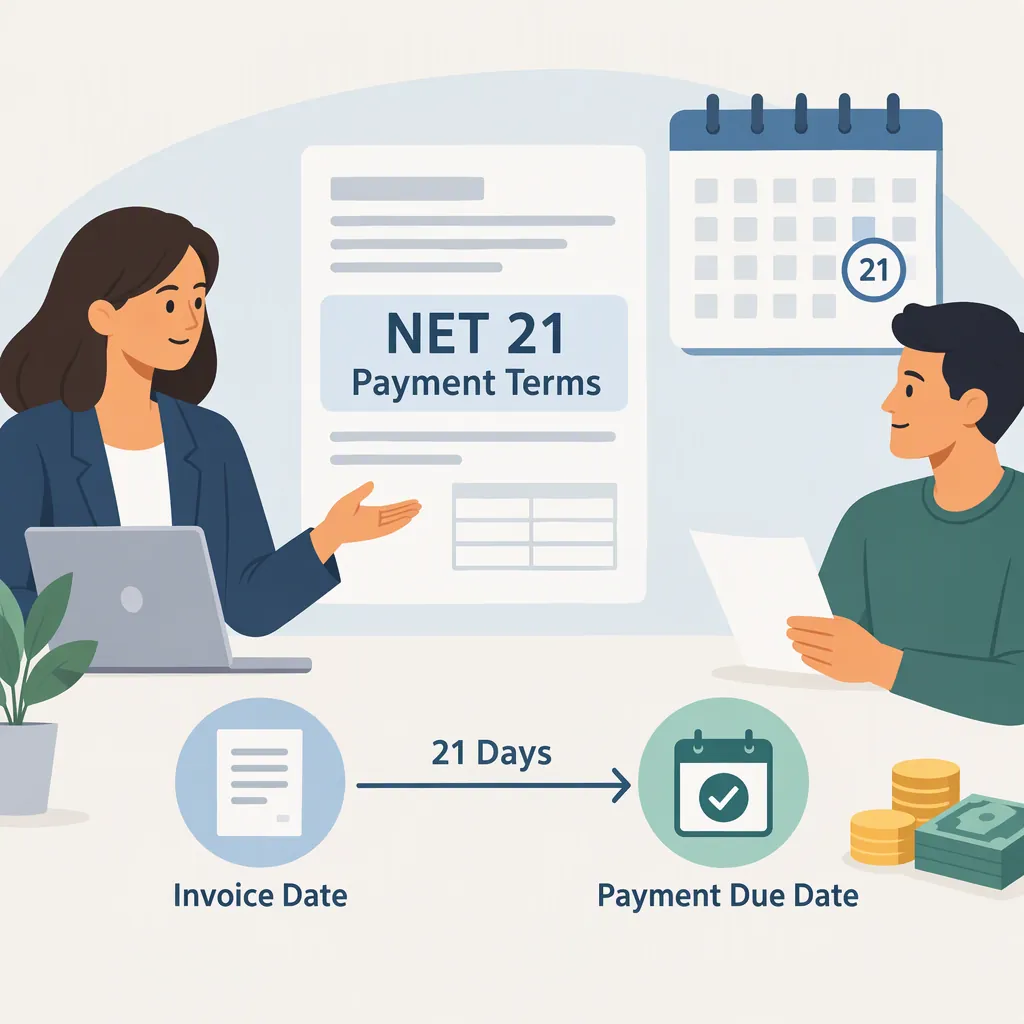
Net 21 Days Payment Terms Explained
Net 21 means the full invoice balance is due within 21 days of the agreed starting date, usually the invoice date. Under the general net-payment convention, those are calendar days, including weekends and holidays, unless the agreement states otherwise. For example, an invoice dated May 1 is due May 22 when the terms specify 21 calendar days after the invoice date. Confirm the starting event rather than assuming it is delivery, publication, or approval. [c1] [c2]
What Net 21 Means
Net payment terms specify the period allowed to pay an invoice in full. Applying that convention to Net 21 gives a 21-day payment period—not a 21% discount and not payment on the 21st of the month. Stripe explains the general convention using terms such as Net 30, Net 60, and Net 90. [c1]
For a collaboration, distinguish the payment period from the work schedule. A delivery deadline tells the parties when work is due; Net 21 tells them when the invoice balance is due once the agreed payment clock starts. As a drafting practice, record these as separate terms.
Net 21 alone does not describe a deposit, installment plan, or early-payment discount. If the parties want any of those arrangements, spell them out separately. The supplied guidance treats staggered payments and early-payment discounts as additional arrangements rather than an automatic feature of ordinary net terms. [c1] [c2]
How to Calculate the Due Date
For terms that explicitly say 21 calendar days after the invoice date, use:
Due date = invoice date + 21 calendar days.
Illustrative calculations—not actual invoices:
| Invoice Date | Agreed Payment Period | Due Date |
|---|---|---|
| May 1 | 21 calendar days after invoice date | May 22 |
| May 20 | 21 calendar days after invoice date | June 10 |
| December 20 | 21 calendar days after invoice date | January 10 of the following year |
In these examples, the day after the invoice date is day one. This follows the date-addition method illustrated in Tipalti's Net 30 guidance. [c2]
Net terms typically include weekends and holidays unless otherwise stated. Do not substitute 21 business days for 21 calendar days without an explicit agreement. [c1]
If the calculated date falls on a weekend or holiday, check the agreement for any adjustment rule. As a practical drafting choice, also specify whether payment must be initiated or received by the deadline. The supplied references do not establish a universal weekend-adjustment or payment-receipt rule for Net 21.
Agree on When the Clock Starts
The most important clarification is the event that starts the 21 days. Tipalti explains that a net-payment period can begin from the invoice date, shipment, receipt, or another agreed trigger, and warns that differing assumptions can create payment disputes. [c2]
For a creator or service collaboration, consider these drafting options:
- Invoice date: Identify when the invoice may be issued and how it should be submitted.
- Invoice receipt: Identify the designated submission channel and how receipt will be documented.
- Deliverable acceptance: Define what acceptance means and set a review deadline.
- Publication or another milestone: Name the event precisely and address what happens if it is delayed.
These are proposed clarification points, not evidence of standard creator-industry practice. Avoid leaving the trigger as simply “after approval” without explaining the approval process.
A useful timeline separates completion, invoicing, and payment. For example, if work is completed May 1 but the agreed trigger is invoice receipt on May 5, adding 21 calendar days gives May 26—not May 22. This is an illustrative calculation under that stated agreement.
Sample Wording and Invoice Checklist
Stripe recommends communicating payment terms before work begins and documenting the net period, due date, accepted payment methods, and any late-payment policy in the agreement. [c1]
The sample below is a drafting aid for an invoice-date arrangement, not a complete contract or legal advice. It deliberately uses calendar days and a receipt deadline. Change those choices only through agreement between the parties.
Before issuing the invoice, check that it shows:
- The invoice date and a specific payment due date.
- The amount and currency owed.
- The agreed Net 21 starting event.
- The accepted payment method and relevant payment instructions.
- Any separately agreed deposit, discount, or installment arrangement.
Keep the invoice wording consistent with the agreement. If they conflict, obtain written clarification rather than assuming that a new invoice label changes the negotiated terms.
Illustrative Net 21 Invoice Wording
Payment terms: Net 21. The full invoice balance must be received within 21 calendar days after the invoice date. Weekends and holidays count toward the payment period.

Invoice date: May 1, 2026.
Payment due date: May 22, 2026.

This example assumes the parties have agreed to an invoice-date trigger and a payment-receipt deadline. It does not add an early-payment discount or late fee.
Related Terms and Late Payments
Under the same starting date and counting method, Net 21 allows six more days than Net 15 and nine fewer days than Net 30. This is an arithmetic comparison, not a recommendation about which term to choose. Stripe advises considering cash flow, administrative capacity, and customer reliability when deciding whether to offer net terms. [c1]
Net 21 is different from 21 MFI. The latter means payment on the 21st of the month following the invoice date, according to nibusinessinfo.co.uk's terminology guide. A May 1 invoice under that definition would be due June 21 rather than May 22. That source is Northern Ireland guidance and is used here only to distinguish the abbreviations, not to establish US legal rules. [c3]
If an invoice remains unpaid after the agreed deadline, a practical first step is to confirm receipt and send a reminder identifying the invoice, balance, and due date. Stripe recommends tracking overdue invoices and beginning follow-up with a friendly reminder. [c1]
Do not infer a particular late fee or interest rate from “Net 21.” Check the agreed policy and applicable requirements before adding charges. The supplied sources do not establish a universal US late-fee rule for Net 21.
Evidence limitation: This article applies the general net-payment convention to a 21-day period. The cited business guides primarily explain other net periods, and they do not establish a creator-specific Net 21 standard. This is general educational guidance, not advice on the enforceability of a particular contract.
FAQ
Does Net 21 Mean Calendar Days or Business Days?
Under the general net-payment convention, it means calendar days, including weekends and holidays, unless the terms state otherwise. If the parties intend 21 business days, write that explicitly. [c1]
Does Net 21 Start When the Invoice Is Sent or Approved?
The invoice date is a common starting point, but the agreed terms can specify receipt, approval, or another event. Define the trigger before work begins; do not assume that sending, receiving, and approving an invoice are interchangeable. [c2]
Can an Invoice Be Paid Before the Net 21 Due Date?
Net terms set the deadline for full payment rather than requiring the payer to wait until that day. An early-payment discount applies only if separately offered and agreed; it is not implied by Net 21. [c1] [c2]
Is Net 21 the Same as Payment on the 21St of Next Month?
No. Applying the general net convention, Net 21 is a 21-day period from the agreed starting date. The separate abbreviation 21 MFI means the 21st of the month following the invoice date in nibusinessinfo.co.uk's terminology guide. [c1] [c3]