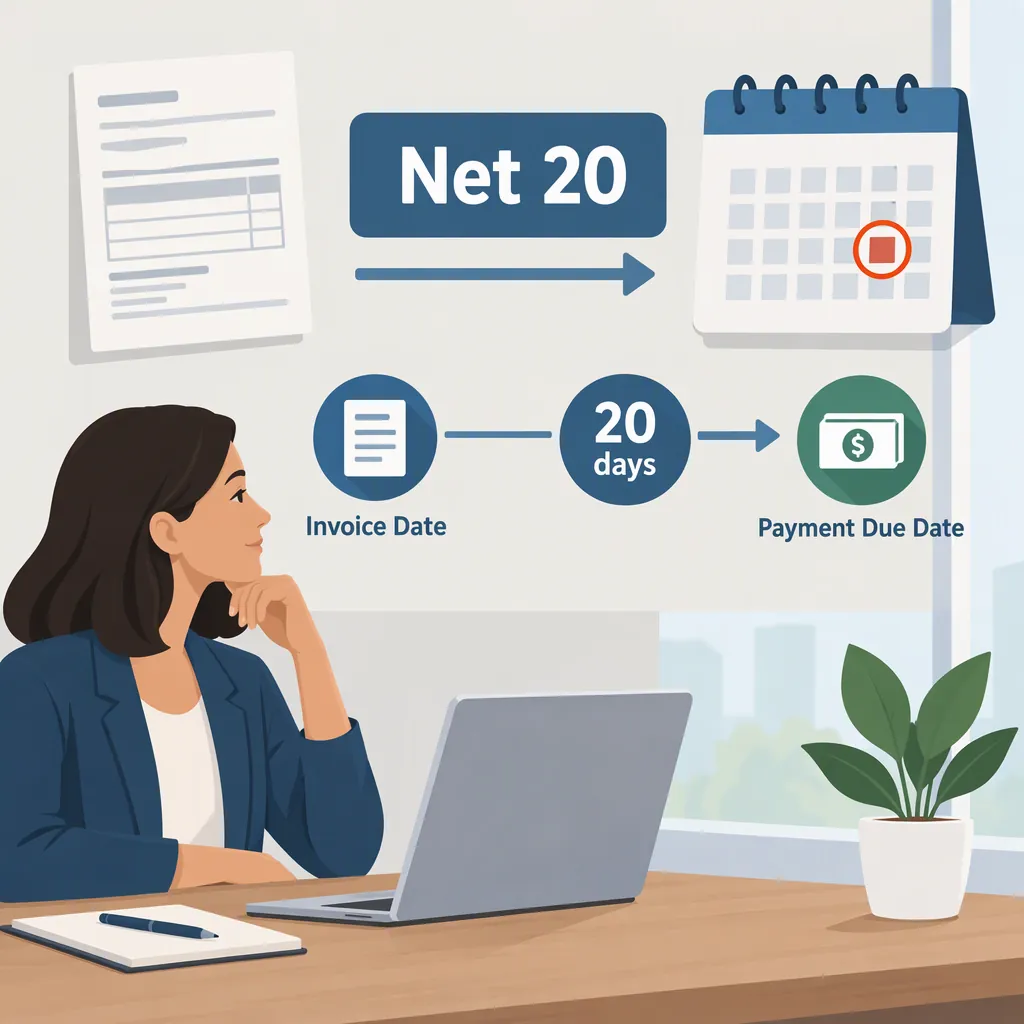
Net 20 Payment Terms: Meaning, Due Dates, and Deal Wording
Net 20 payment terms mean the full invoice amount is due within 20 days, generally from the invoice date. Net terms typically count calendar days, including weekends and holidays, unless stated otherwise. For a creator collaboration, specify the start event and an explicit due date rather than relying on “Net 20” alone. [highradius] [stripe]
What Net 20 Means
“Net” means the full amount is due; “20” identifies the payment window in days. Net 20 does not mean a 20% discount or payment in 20 installments. eCapital explicitly defines Net 20 as full payment due in 20 days, and HighRadius describes the deadline as 20 days from the invoice date. [ecapital] [highradius]
Payment timing and early-payment discounts are separate concepts. If an agreement offers a discount, it should describe that discount separately rather than leaving either party to infer it from “Net 20.” [ecapital]
How to Calculate a Net 20 Due Date
For terms that explicitly start on the invoice date, add 20 calendar days to that date. Stripe states that net terms typically include weekends and holidays unless otherwise stated. [stripe]
Illustrative example: An invoice dated April 1 with payment due 20 calendar days after the invoice date has an April 21 deadline. Under this example’s convention, April 2 is day one.
Before calculating, confirm:
- Whether the starting event is the invoice date, invoice receipt, or another expressly agreed event.
- Whether the agreement uses calendar days or business days.
- Whether it specifies a different deadline when the calculated date falls on a weekend or holiday.
Write the calculated due date on the invoice. If the wording is unclear, clarify it rather than silently substituting a different counting rule.
Clarify the Start Event in a Creator Deal
Stripe recommends defining payment terms before work begins and documenting the terms, due date, accepted payment methods, and any late-payment fees in contracts or agreements. [stripe]
For a creator collaboration, use that principle to separate the delivery schedule from the payment clock. A draft handoff, approval, publication, and invoice submission are distinct possible milestones. Specify which event starts the 20-day period; do not assume everyone interprets them as interchangeable.
A practical review checklist is:
- Amount and scope: Identify the fee, currency, and deliverables covered by the invoice.
- Invoice timing: State when the creator may submit the invoice.
- Payment trigger: Identify the exact event that starts the 20 days.
- Approval process: If approval is a payment trigger, define what approval requires and when it should occur.
- Payment completion: Clarify whether the deadline refers to initiating payment or receiving funds.
These are suggested drafting checks, not claims about standard creator-industry practice. The provided sources explain general business payment terms, not creator-specific legal requirements.
Illustrative Net 20 Invoice Wording
Payment terms: Net 20. The full invoice amount is due 20 calendar days after the invoice date.
Invoice date: [Month Day, Year].
Payment due date: [Month Day, Year].
Amount and currency: [Amount and currency].
Accepted payment method: [Agreed method].
Payment completion: [Specify whether funds must be received or payment must be initiated by the due date].
Weekend or holiday treatment: [State the agreed rule].
Use this wording only if invoice-date terms match the agreement; replace all placeholders before use.
Net 20 Compared with Other Terms
With the same starting event and counting rule, Net 20 allows five more days than Net 15 and ten fewer days than Net 30. Stripe defines Net 15 and Net 30 as payment due within 15 and 30 days of the invoice date, respectively. [stripe]
End-of-month terms are different. eCapital explains that EOM terms count a specified number of days after month-end. Do not treat wording such as “Net 20 EOM” as equivalent to “20 days after the invoice date.” [ecapital]
A shorter payment window may support the seller’s cash flow, while a longer window gives the buyer more time before paying. Neither label guarantees timely payment; Stripe identifies delayed payment and default as risks of extending net terms. [ecapital] [stripe]
What to Check If Payment Is Overdue
Start by checking the agreed trigger, calculated due date, invoice submission, and any payment-status information. Then send a factual reminder identifying the invoice, amount outstanding, and deadline, and ask for the expected payment date. Stripe recommends tracking aging invoices and beginning late-payment follow-up with a friendly reminder. [stripe]
Do not infer a particular late fee from “Net 20.” Any proposed fee policy should be addressed separately in the agreement. The sources are general educational guidance and do not establish whether a fee or remedy is enforceable in a particular jurisdiction. This article is not legal, tax, or accounting advice.
FAQ
Does Net 20 Mean Calendar Days or Business Days?
Net terms typically use calendar days, including weekends and holidays, unless otherwise stated. If the agreement specifies business days, use that rule instead. [stripe]
Does Net 20 Start When the Invoice Is Sent or Received?
HighRadius defines Net 20 from the invoice date. To avoid ambiguity, state the start event expressly in the agreement and include the resulting due date on the invoice. If the agreement specifies receipt or another milestone, calculate using that agreed event. [highradius] [stripe]
Can an Invoice Be Paid Before the Net 20 Deadline?
Yes. Net 20 sets the deadline for full payment, not a requirement to wait until day 20. An early-payment discount is a separate term and should not be assumed from the Net 20 label. [ecapital]
Does Net 20 Automatically Start After Content Approval?
Do not assume that it does. The general definition uses the invoice date; an approval-based trigger should be expressly documented. For a creator deal, clarify the approval requirements and payment start event before work begins. [highradius] [stripe]
Sources
-
[highradius] What are net payment terms
-
[stripe] What are net payment terms? | Stripe
-
[ecapital] Net Payment Terms Explained: Net 10, EOM & More | eCapital