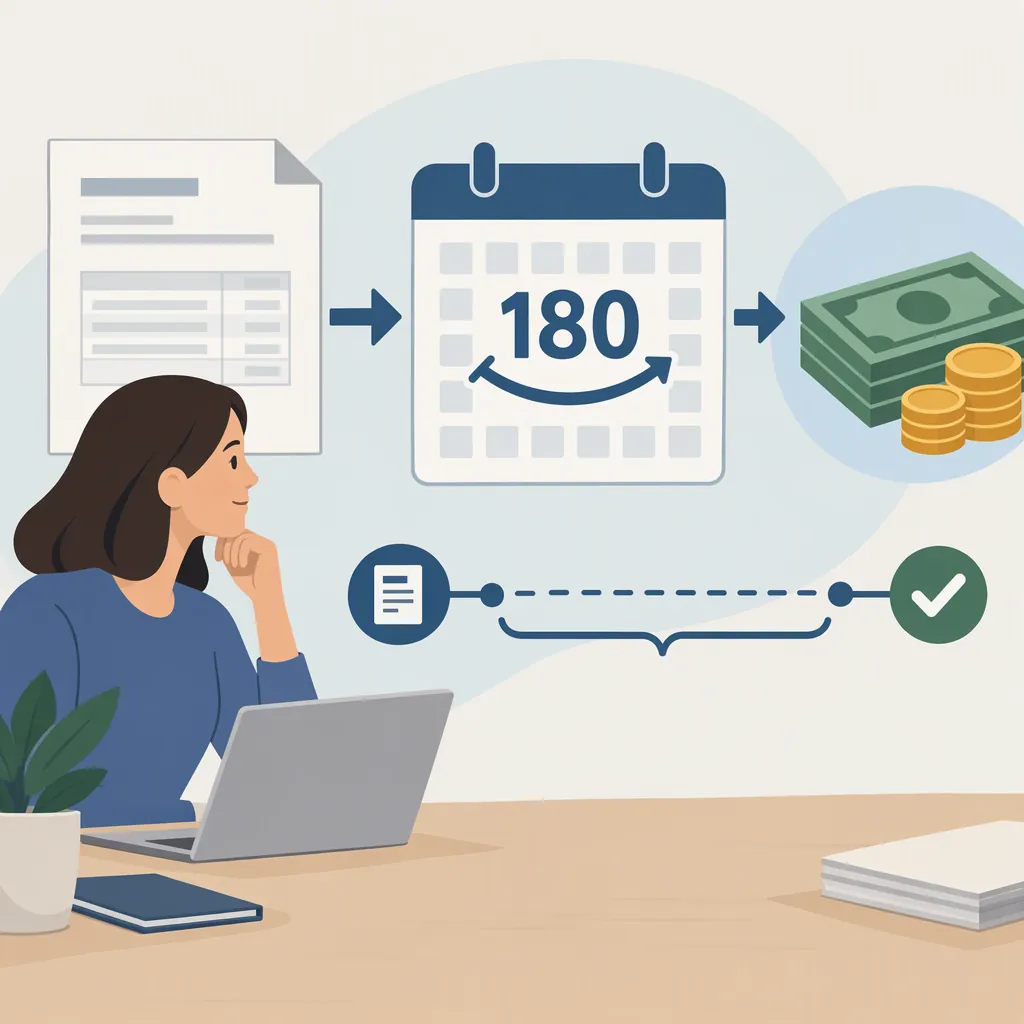
Net 180 Payment Terms: Meaning, Timing, and Deal Planning
Net 180 means the full invoice balance is due within 180 days of the agreed starting date. Applying the general net-terms convention, the number specifies the payment window—not an additional grace period. Confirm whether the clock starts on the invoice date, receipt, or another defined event. The provided sources explain shorter net terms rather than net 180 specifically, and they differ on the starting point. [c1] [c2]
What Net 180 Means
Net terms express how many days a buyer has to pay an invoice. Jobber describes net terms as counting from invoice receipt; OnlineInvoiceGenerator describes terms such as Net 30 as counting calendar days from the invoice date. Applying that notation to Net 180 gives a 180-day payment window, but the label alone leaves the starting event unclear. [c1] [c2]
For a creator collaboration or other service agreement, separate the payment deadline from the work deadline. A publication date, delivery date, approval date, and invoice date may be different dates. Specify which one starts the payment clock rather than assuming that finishing the work starts it.
Neither source establishes Net 180 as a standard for creator deals. This article applies their general payment-term explanations to a proposed 180-day arrangement; it does not establish an industry norm or determine a particular contract's legal effect.
How to Calculate the Due Date
For an arrangement expressly defined as 180 calendar days after the invoice date, use:
Due date = invoice date + 180 calendar days.
Illustrative calculation: an invoice dated January 1, 2026, would be due June 30, 2026, when January 1 is the starting date and the following day is day one. This is date arithmetic, not a customer example.
Do not substitute “six months” for 180 days. Calendar months vary in length, so the resulting date can differ. If the agreement instead starts the clock on invoice receipt or acceptance, use that documented date.
OnlineInvoiceGenerator recommends writing the actual due date on the invoice rather than requiring the recipient to calculate it. [c2] Also agree how weekends and holidays affect the deadline; the supplied references do not establish a universal rule for those adjustments.
Due-Date Verification Checklist
- Record the agreed starting event and its date.
- Confirm whether the agreement uses calendar days or business days.
- Add 180 days using the agreed counting method.
- Check any agreed weekend or holiday adjustment.
- Put the resulting due date on the invoice.
- Keep evidence of submission or receipt if that event starts the clock.
What to Clarify Before Agreeing
Payment terms can appear in contracts as well as invoices. Jobber identifies the invoice number, date, total due, deadline, accepted payment methods, and payment instructions as important invoice details. [c1]
For a proposed Net 180 deal, use those basics to resolve these questions in writing:
- Starting event: Is payment measured from invoice issuance, receipt, delivery, or approval?
- Submission requirements: Which recipient or portal receives the invoice, and what supporting documents are needed?
- Approval conditions: If approval starts the clock, what qualifies as approval and how is it documented?
- Amount and method: What balance, currency, and payment method apply?
- Payment completion: Does the deadline refer to initiating payment or receiving funds?
- Disputes and corrections: What happens to the deadline if an invoice is challenged or corrected?
These are drafting questions, not automatic features of Net 180. Avoid leaving payment dependent on an undefined future event.
Illustrative Payment-Term Wording
For discussion only, not a complete legal clause: “The invoice balance is due 180 calendar days after the invoice date. Each invoice will state the calculated due date. Invoices must be submitted to [agreed recipient or portal] with [agreed supporting documents]. Payment method, currency, treatment of disputed amounts, and any deadline adjustments will be stated in the agreement.”
Assess the Cash-Flow Gap
Longer payment windows can require the service provider to fund operations while waiting for payment. The provided guide identifies that cash-flow drawback even for Net 60 and Net 90. [c2] A proposed 180-day window deserves a separate budget check rather than being treated as routine paperwork.
For planning, list the expenses payable before the invoice comes due: production costs, subcontractor payments, software, and other commitments relevant to the work. Compare those outflows with available funds, not just the invoice's face value.
If invoicing occurs after delivery or approval, include that earlier waiting period in the plan as well. The total time between spending money and receiving payment may be longer than the stated invoice term.
Possible alternatives include a deposit, staged payments, or a shorter term for the remaining balance. Jobber and OnlineInvoiceGenerator describe upfront and milestone-based payment arrangements. These are options to negotiate, not entitlements or guarantees that a counterparty will accept them. [c1] [c2]
Track the Invoice and Handle Delays
Keep a record of the invoice, submission confirmation, agreed starting date, due date, and payment status. Before the deadline, verify that the recipient has the required documents and that no unresolved issue is preventing processing.
If the agreed deadline passes without payment, send a factual overdue reminder identifying the invoice, outstanding balance, and due date. Jobber recommends an overdue reminder as an initial response to nonpayment. [c1]
Net 180 does not itself specify a late-fee rate or collection process. Do not assume that an invoice label authorizes a penalty. Any late-payment provision needs separate consideration under the agreement and applicable law; the provided guides are not legal authority for a specific fee or remedy.
FAQ
Is Net 180 the Same as Six Months?
Not exactly. A 180-day period counts days, while six calendar months can contain a different number of days. Specify the counting method and write the actual due date on the invoice. The provided guide recommends using an explicit due date. [c2]
Does Net 180 Start When the Work Is Delivered?
Do not assume so. The provided sources describe shorter net terms from either invoice receipt or invoice date. For a Net 180 agreement, expressly identify the starting event; delivery should start the clock only if that is what the parties agree. [c1] [c2]
Does Net 180 Include an Early-Payment Discount?
The label alone does not specify a discount. Payment-term guides describe early-payment discounts separately, such as 2/10 Net 30. If a discount is offered for a Net 180 invoice, state its amount and deadline explicitly rather than inferring it from the term. [c2]
Can a Deal Use a Deposit Instead of Waiting for the Full Amount?
A deposit or milestone schedule is an alternative to discuss before agreeing to the deal. The supplied guides describe both upfront payments and staged payments. Specify which portion, if any, remains subject to Net 180; a deposit does not automatically change the balance's deadline. [c1] [c2]