Net 15 Payment Terms: Meaning, Due Dates, and Agreement Wording
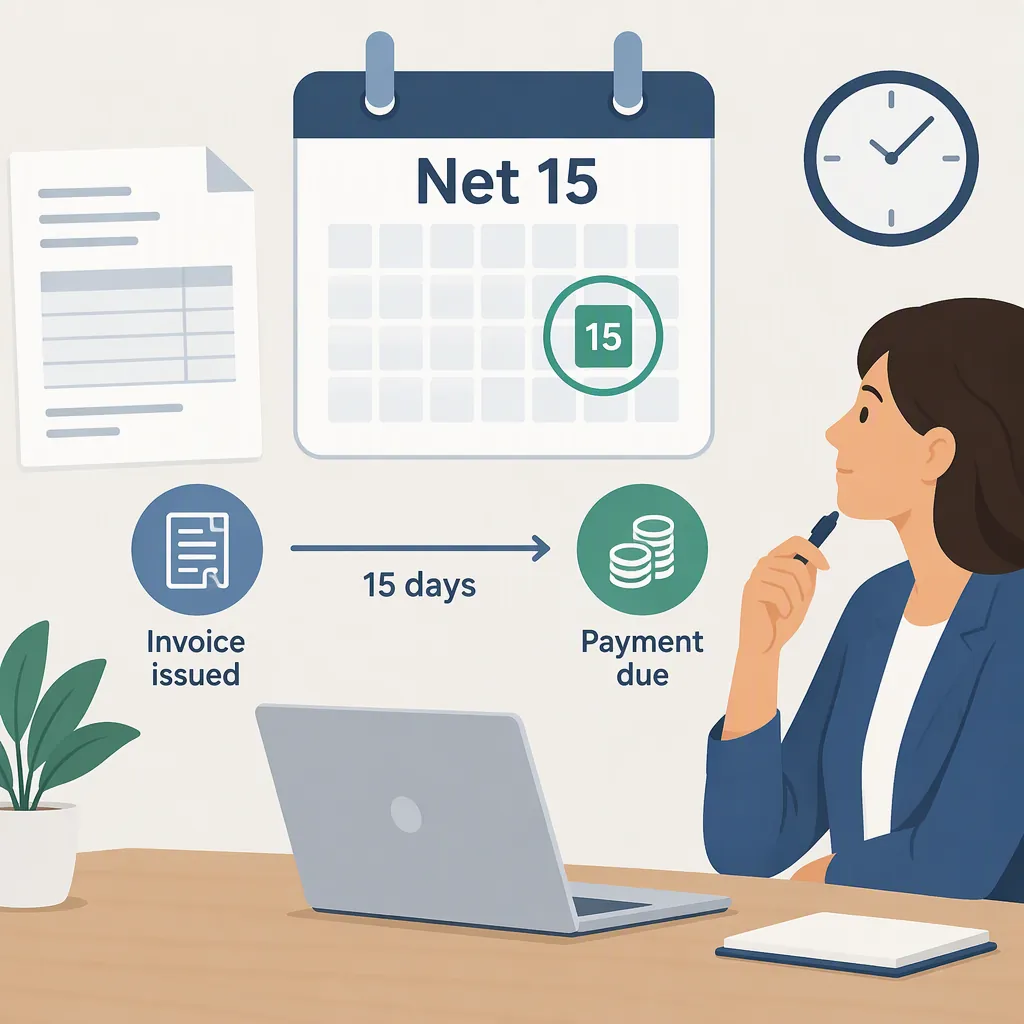
Net 15 payment terms mean the full invoice balance is due 15 days after the invoice date, unless the agreement specifies another starting event. Net terms generally use calendar days rather than business days. State both the starting event and the exact due date so the payment deadline is clear. [c1] [c3]
What Net 15 Means
The number in Net 15 describes the payment window: 15 days. It is not a 15% discount or an instruction to pay only part of the invoice. Clientary defines Net 15 as payment due 15 days after the invoice date. [c1]
For a creator collaboration or other service engagement, distinguish when an invoice can be issued from how long the client has to pay it. An agreement might allow invoicing after a defined milestone, then give the client 15 days to pay. Net 15 alone does not define that milestone or the approval process. Service agreements should specify the billing schedule and the event that starts the payment clock. [c3]
How to Calculate a Net 15 Due Date
For an agreement that specifies 15 calendar days after the invoice date, add 15 days to that date. Calendar-day counting includes weekends and holidays; a different counting method should be stated explicitly. [c2] [c3]
Illustrative example—not a real transaction:
| Item | Example |
|---|---|
| Invoice date | November 3, 2026 |
| Payment terms | Net 15 from the invoice date |
| Counting method | Calendar days |
| Due date | November 18, 2026 |
If the agreement instead starts the clock on invoice receipt or milestone approval, calculate from that event. For example, an explicitly agreed November 6 starting date gives a November 21 deadline under the same calendar-day method. [c3]
Do not silently move a weekend or holiday deadline. A practical agreement should explain any deadline adjustment and whether payment must be initiated or received by the due date.
Due-Date Check
1. Read the agreement for the payment-clock starting event.
2. Record the date that event occurred.
3. Confirm whether the agreement uses calendar or business days.
4. Add 15 days using that method.
5. Check any agreed weekend or holiday adjustment.
6. Show the resulting calendar date on the invoice.
What to Clarify Before Work Begins
Payment terms should be agreed before work begins, then repeated consistently on the invoice. An invoice should not introduce a different payment window from the agreement. [c1] [c3]
For a service collaboration, a useful review checklist is:
- Billing milestone: What work or event permits invoicing?
- Starting event: Does the 15-day clock begin on the invoice date, receipt, or documented approval?
- Acceptance process: Who reviews the deliverable, and how are correction requests handled?
- Submission requirements: Is a purchase-order number, supporting record, or portal submission required?
- Payment details: What currency and payment method will be used?
- Questions and disputes: Who handles invoice issues, and what process applies?
These details address the billing and approval workflow described in the service-payment reference. They are suggested review points, not a claim that every collaboration requires the same process. [c3]
Illustrative Net 15 Invoice Wording
Payment terms: Net 15. The full invoice balance is due 15 calendar days after the invoice date.
Invoice date: November 3, 2026.
Payment due date: November 18, 2026.
Payment method and currency: Insert the agreed method and currency before use.
This wording assumes the signed agreement uses the invoice date as the starting event.
Net 15 Compared with Other Payment Terms
Compare terms using the same starting event and counting method. Otherwise, a shorter label may not describe a shorter overall wait. [c3]
| Term | Typical Meaning |
|---|---|
| Due on receipt | Payment is due when the client receives the invoice. |
| Net 15 | Payment is due 15 days after the invoice date. |
| Net 30 | Payment is due 30 days after the invoice date. |
| Upfront deposit | An agreed portion is paid before work begins. |
| Milestone payments | The fee is divided across agreed project stages. |
These are general descriptions; the agreement supplies the actual conditions. [c1]
Net 15 sets an earlier deadline than Net 30 under matching conditions, but it does not guarantee receipt of funds within 15 days. Approval time, complete documentation, and the client's payment process also affect the cash timeline. A deposit or milestone schedule addresses when billing occurs, while a net term addresses the deadline for an invoice. [c3]
What to Do After the Due Date
If payment has not arrived, start with a factual check: confirm invoice receipt, required documents, and any unresolved billing issue. Then send a reminder identifying the invoice, amount, and due date, and request an expected payment date. Keep written records of submission and subsequent responses. [c3]
Net 15 does not itself specify a late-fee amount. Any fee or interest provision should be agreed in advance and stated clearly in the contract and invoice. This article does not establish whether a particular fee is legally enforceable. [c2]
Source limitation: The provided references are general business-payment guides, not jurisdiction-specific legal authorities. The sample wording is educational and does not resolve contract conflicts, local legal requirements, or a particular payment dispute.
Neutral Overdue-Invoice Reminder
Subject: Payment status for invoice INVOICE_NUMBER

Hello RECIPIENT_NAME,

Invoice INVOICE_NUMBER for AMOUNT was due on DUE_DATE under the agreed Net 15 terms. Please confirm receipt and let me know whether any documentation or billing issue is outstanding.

If payment has not yet been made, please provide the expected payment date. If it has been sent, please share the payment reference.

Thank you,
SENDER_NAME
FAQ
Does Net 15 Mean Calendar Days or Business Days?
Net terms generally use calendar days unless the agreement specifies otherwise. For clarity, write “15 calendar days” or “15 business days” and include the exact due date. [c2] [c3]
Does Net 15 Start When the Work Is Delivered?
Not automatically. The usual starting point is the invoice date, but an agreement can specify delivery, invoice receipt, or milestone approval instead. Define the event rather than relying on the Net 15 label alone. [c1] [c3]
Does Net 15 Include an Early-Payment Discount?
No discount is specified by the Net 15 label alone. An early-payment discount needs separate wording describing its amount and deadline. For comparison, 2/10 Net 30 explicitly offers a 2% discount for payment within 10 days. [c1]
Can Net 15 Terms Be Negotiated?
Payment terms can be negotiated as part of the commercial agreement. Possible alternatives include a longer payment window, a deposit, or milestone billing. Record the agreed arrangement before work begins, and discuss changes rather than introducing them on an invoice. [c1] [c3]