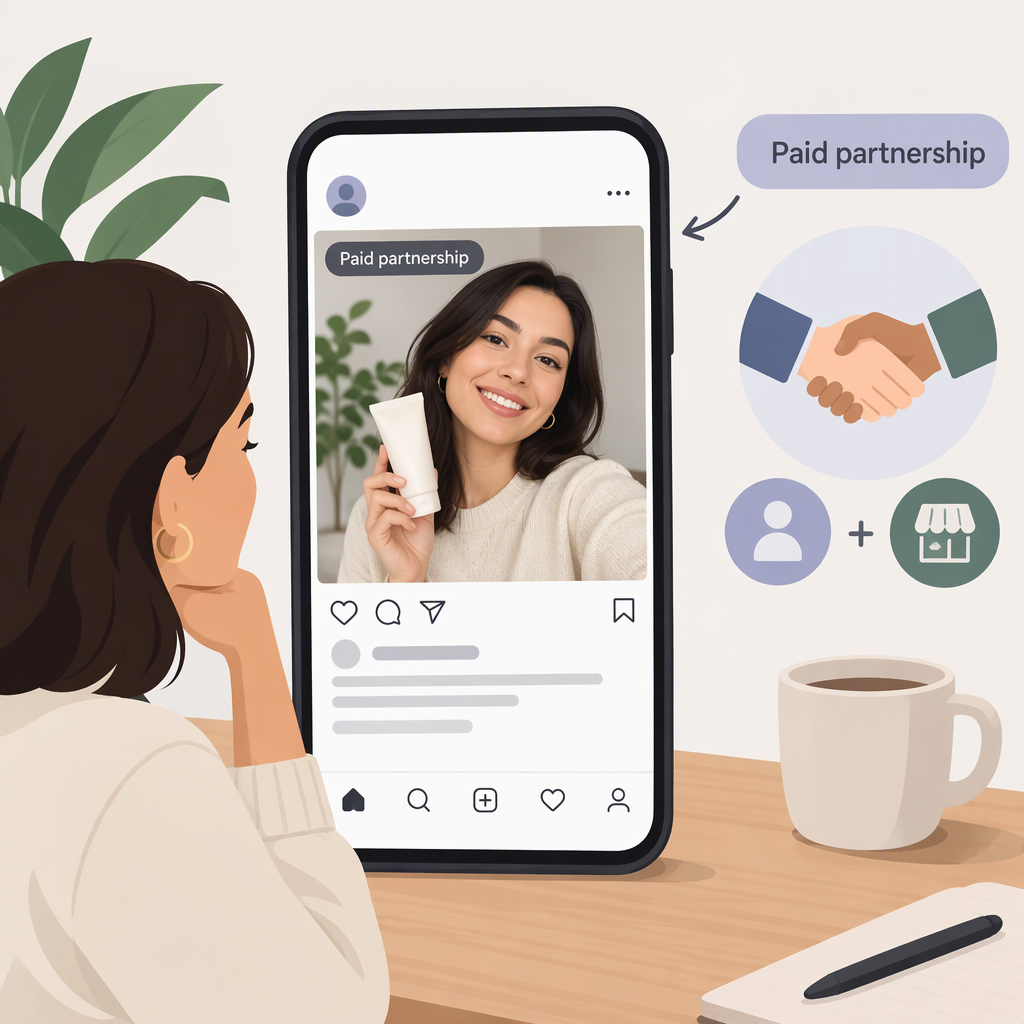
What Is Instagram’s Paid Partnership Label? Meaning and Disclosure
Instagram’s “Paid partnership” label is Instagram’s on-platform way of identifying branded content and naming the business partner. In plain terms, it tells viewers that the post is connected to a brand partnership; it does not, by itself, establish that every applicable disclosure requirement has been met. For U.S. creators, FTC guidance says not to assume a platform’s disclosure tool is enough: use it alongside a disclosure that viewers can easily notice and understand when one is needed. (about.fb.com)
What the Label Means
Meta describes branded content as content that features or is influenced by a brand partner in exchange for value. Its developer documentation gives that definition for Facebook, while Meta’s Instagram materials discuss branded content and the “Paid partnership” label in the context of creator-brand collaborations. (developers.facebook.com)
The label therefore identifies a branded-content relationship on Instagram. It is a platform label, not a general verdict about the content: its presence alone does not tell viewers exactly what the creator received, whether the creator’s opinions are independent, or whether the post complies with every rule that may apply.
When Might a Creator Encounter It?
A creator may encounter the label when sharing branded content connected to a business partner. For example, a creator who receives a product from a brand and features it in a recommendation has a relationship that may be relevant to disclosure. Meta’s cited materials do not establish the full set of Instagram eligibility requirements or supported formats, so this guide does not give interface instructions or claim that the label is available in every situation.
The FTC’s U.S. influencer guidance separately identifies payments, free or discounted products or services, and certain personal, family, or employment relationships as examples of connections that may need disclosure when endorsing a brand. It says that if a brand gives you free or discounted products or other perks and you mention one of its products, you should disclose the relationship—even if the brand did not ask you to mention it. (ftc.gov)
Does the Label Replace a Disclosure?
Do not assume it does. In the United States, FTC guidance says disclosures should make a relevant material connection obvious, be easy to notice and understand, and appear with the endorsement. The FTC’s influencer brochure specifically says not to assume a platform disclosure tool is good enough; it suggests using the tool in addition to a good disclosure. (ftc.gov)
A practical approach, when a disclosure is needed, is to use Instagram’s label and add plain-language wording that explains the relationship—for example, “Ad — [Brand] gave me this product.” Put the wording where people are likely to see it with the endorsement. For a video or Story, FTC guidance says a disclosure should be noticeable in the content itself, rather than relying only on text viewers might not see. The details depend on the specific post and relationship. (ftc.gov)
Example: If a brand sends you a free product and you recommend it, the FTC says to disclose that connection even if you were not asked to post. The Instagram label can identify the partnership, while a clear statement such as “Gifted by [Brand]” tells viewers what the connection is. By contrast, the FTC says you do not need to announce that you have no brand relationship when you simply share a product you bought and happen to like. (ftc.gov)
This is U.S.-specific educational guidance, not legal advice. The FTC notes that whether a disclosure is needed or sufficient depends on the context; other jurisdictions may have different rules. (ftc.gov)
A Quick Creator Check
Before publishing, ask: Is there a brand connection viewers might not expect? If yes, consider whether it needs to be disclosed under the rules that apply to your audience and situation. For U.S. endorsements, make the relationship clear in the content itself, and do not rely on Instagram’s “Paid partnership” label alone. (ftc.gov)