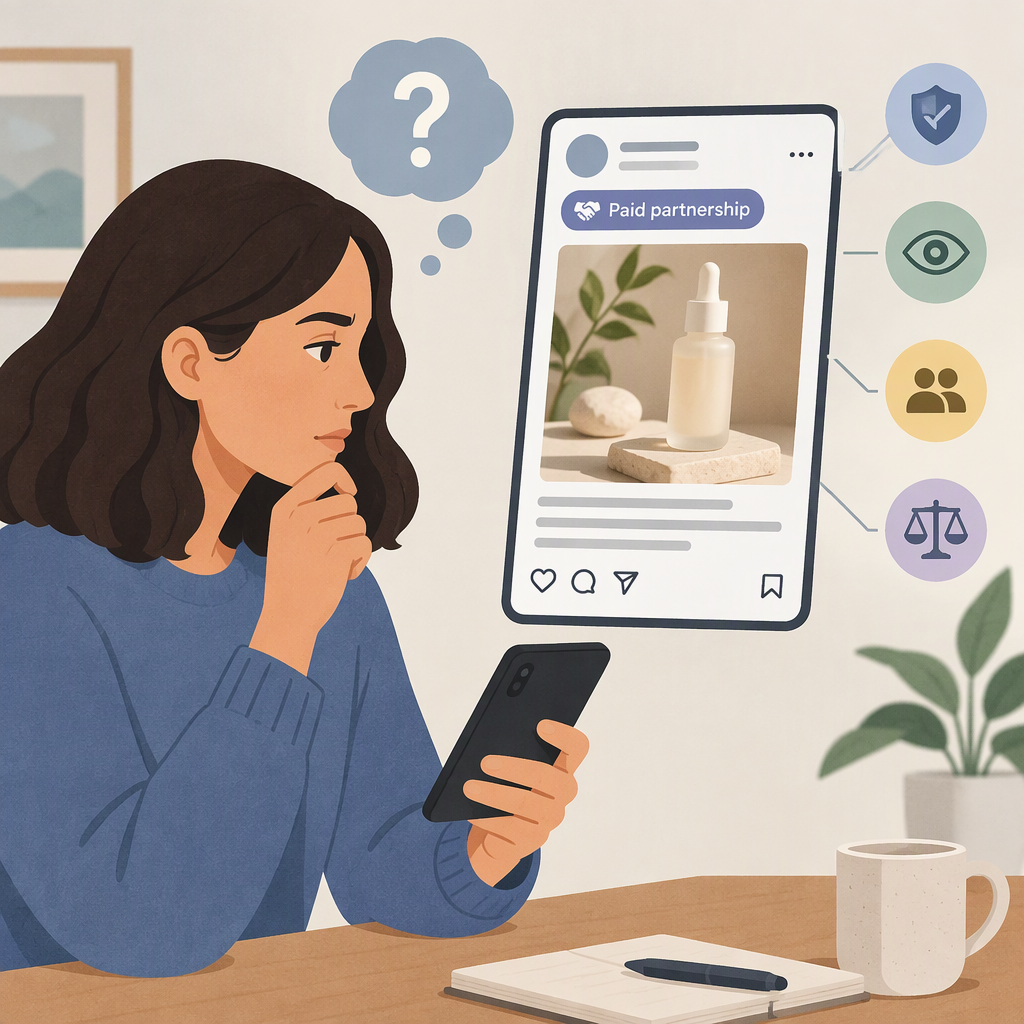
Is a Platform’s Paid Partnership Label Enough for a Sponsored Post?
Not necessarily. A platform’s paid-partnership label can help disclose a sponsorship, but you shouldn’t assume the label alone is enough. The answer depends on the rules that apply to your post and whether people viewing it can readily notice and understand the disclosure. In the United States, FTC guidance specifically cautions creators not to assume a platform’s disclosure tool is good enough on its own. (ftc.gov)
There is no platform-independent yes-or-no answer here: the platform, post format, audience, and relevant jurisdiction all matter. The U.S. guidance below is an example, not a claim that U.S. law governs every reader or post.
What the Label Does—And Doesn’t—Establish
The label tells viewers something about the relationship, but its presence doesn’t by itself establish that a disclosure is clear in the context of your post. FTC staff guidance says disclosures should be easy to notice and understand, and placed with the endorsement. It warns that a disclosure can be missed if it appears only on a profile, at the end of a post or video, or somewhere people must click to see. (ftc.gov)
That’s especially relevant for video: a viewer may watch without reading the caption. In a November 2023 warning letter concerning particular Instagram and TikTok posts, FTC staff said the “Paid partnership” tool alone could be too easy to miss in those posts. The letter discussed the specific content and disclosure placements at issue; it is a concrete warning, not a finding that every platform label is inadequate in every case. (search.ftc.gov)
In the U.S., the FTC’s Endorsement Guides provide guidance on applying truth-in-advertising principles; the FTC says the Guides are not regulations. Its guidance says a relationship that could affect how people evaluate an endorsement—such as payment or something of value—may need to be disclosed clearly and conspicuously. FTC staff also stresses that the sufficiency of a disclosure depends on the context. (ftc.gov)
Practical takeaway: use the platform label if it applies, but assess whether your audience can actually see and understand it in the post itself. Depending on the post and applicable rules, you may need an additional disclosure. That is a practical approach, not a universal legal formula.
Check the Post Before Publishing
- Identify the relevant jurisdiction. Don’t treat the page’s U.S. English language as proof that U.S. rules apply to your post. If U.S. consumers may be affected, FTC influencer guidance says U.S. law may apply even when the post is made abroad; other countries’ laws may also apply. (ftc.gov)
- Check the platform’s current rules and the exact format. Confirm what its label says, where it appears, and how it displays in the format you’ll publish. Don’t assume a label behaves the same way in a feed post, Story, or video; verify the actual format against current official platform information.
- Preview as a viewer. Is the disclosure easy to notice without opening “more,” reading to the end, or visiting your profile? Is the sponsor or relationship understandable? These are useful checks drawn from the FTC’s guidance that a disclosure should be hard to miss and easy to understand. (ftc.gov)
- Match the disclosure to the content. For example, FTC influencer guidance says a disclosure for an endorsement in a video should appear in the video, not only in its description. If your endorsement is both spoken and visual, the FTC’s warning letter describes making the disclosure in both portions as appropriate in that case. Consider any extra disclosure a context-based step, not a guaranteed fix for every post. (ftc.gov)
- Resolve uncertainty before posting. If you can’t tell whether the label meets the rules that apply to your circumstances, consult the relevant authority’s current guidance or a qualified legal professional.
A Simple Example
Suppose a creator is paid to recommend a product in a short video. They turn on the platform’s paid-partnership label, but the sponsorship is not otherwise apparent in the video and its caption disclosure is easy to miss. The label is present, yet viewers could still miss the relationship. Under FTC guidance, the creator should not assume the tool alone is enough; they should check the applicable rules and make any needed disclosure readily noticeable in the content. This is an illustration of the guidance—not a ruling about every platform or video. (ftc.gov)
Bottom Line
A paid-partnership label is useful, but don’t rely on it automatically as your only disclosure. Check the rules for your jurisdiction, verify how the platform’s label appears in your exact post format, and make sure viewers can readily notice and understand the sponsorship. In the U.S., FTC guidance says not to assume a platform disclosure tool is sufficient on its own; what is adequate depends on context. (ftc.gov)