How to Quote Rush Fees for Last-Minute Cyber Week Deliverables
Got a last-minute Cyber Week sponsorship request landing in your inbox?
Don't panic—and don't work overnight for standard pay. When brands ask for urgent holiday deliverables, you should charge a rush fee percentage on top of your baseline rate: 25% extra for 48–72 hours, 50% extra for 24–48 hours, and 100% extra for same-day turnaround. To protect your income during peak holiday posting, pair these surcharges with 100% upfront payment and a strict one-round revision cap before starting production.
Quick Comparison: Cyber Week Rush Fee Tiers
| Turnaround Window | Rush Markup | Illustrative Baseline Rate | Adjusted Total Quote |
|---|---|---|---|
| 48–72 Hours | +25% | $1,000 | $1,250 |
| 24–48 Hours | +50% | $1,000 | $1,500 |
| Under 24 Hours | +100% | $1,000 | $2,000 |
Note: Baseline rates and turnaround windows above are illustrative examples for structuring your proposal.
Here is how to evaluate late briefs, build your rush pricing, and protect your schedule without losing high-value brand deals.
Evaluating Last-Minute Cyber Week Briefs
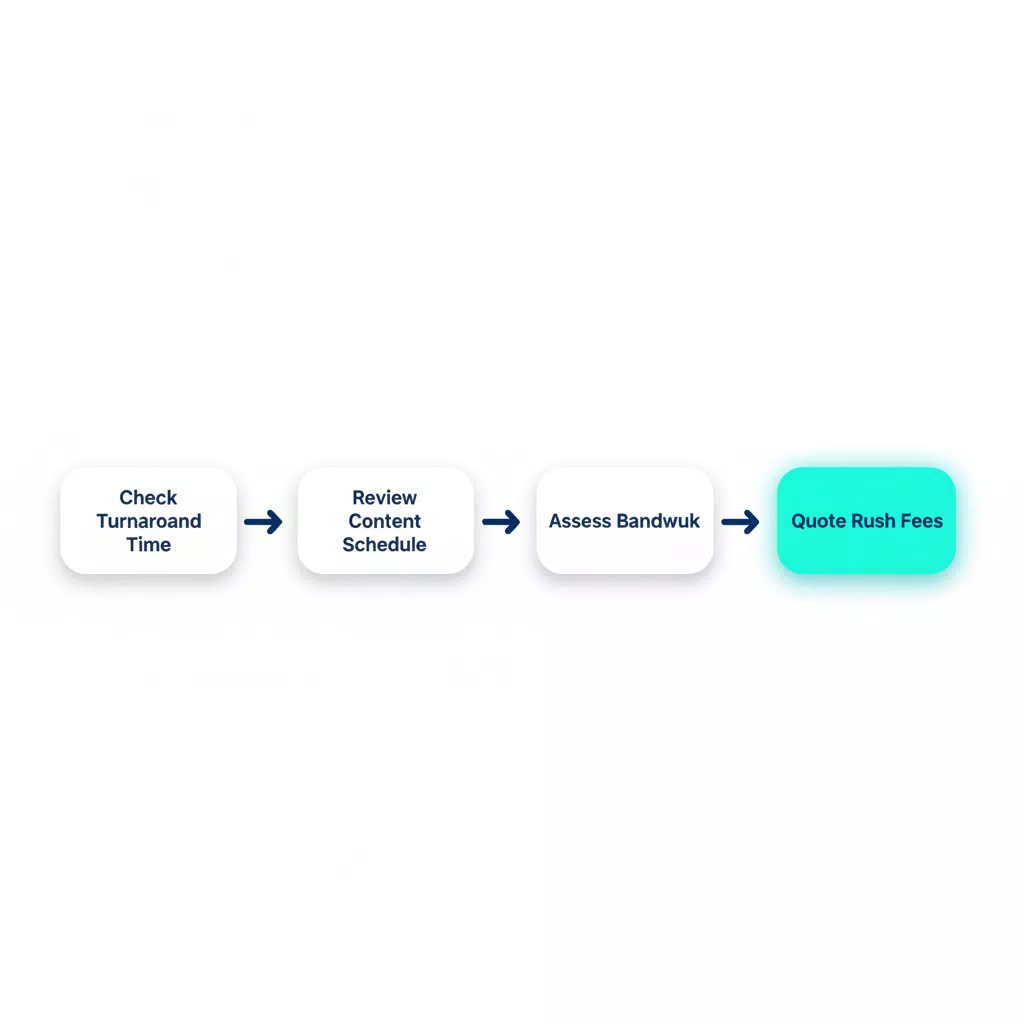
When a brand reaches out during Cyber Week with an urgent request, your first step isn't calculating pricing—it's auditing feasibility. Holiday campaign turnarounds leave minimal margin for error, making a rapid schedule evaluation essential.
Assessing Turnaround Times and Approval Deadlines
Audit the time window between receiving the final campaign brief and the required post launch. Last-minute briefs often hide rigid internal approval chains. If a brand requests a post within 24 hours but requires sign-off from both marketing and legal teams, your active production window might drop from 24 hours to 4 hours.
In an illustrative scenario where a brand delivers a brief on Saturday morning for a Cyber Monday post, every stage must be hardcoded into the agreement. Demand fixed timeframes for asset approval so administrative delays do not force you into midnight editing sessions.
Calculating the Capacity Impact on Existing Content
Adding a fast-track project directly impacts your broader publishing grid. Every emergency deliverable takes focus away from organic audience engagement or previously scheduled client work during peak shopping days.
Before taking on an urgent holiday deal, review your production calendar to ensure your team has bandwidth to execute without dropping existing client deadlines.
Calculating Your Rush Fee Percentage
Rush fees protect your time and compensate for the operational friction of shifting schedule priorities during peak holiday weeks.
Applying Tiered Surcharges Based on Delivery Windows
Apply your percentage markup directly to your baseline rate. Consider an illustrative baseline rate of $1,000 for a single short-form video deliverable:
- 48–72 Hours (+25%): Adjusted fee is $1,250.
- 24–48 Hours (+50%): Adjusted fee is $1,500.
- Under 24 Hours (+100%): Adjusted fee is $2,000.
These surcharges account for working unsociable hours, pausing personal plans, or rescheduling organic content.
Factoring in Expedited Scripting and Licensing Costs
Your rush markup covers your immediate labor, but expedited production often introduces distinct hard costs. These expenses must be billed directly to the brand alongside your rush percentage.
| Expense Category | Standard Turnaround Handling | Fast-Track / Rush Handling | Financial Impact on Quote |
|---|---|---|---|
| Music & Asset Licensing | Standard commercial license ($30) | Priority sync commercial clearance ($100) | Paid by brand |
| Product Delivery | Standard ground shipping (Free/Included) | Overnight courier delivery ($75) | Paid by brand |
| Post-Production Assets | Standard render and export time | Fast-tracked rendering and stock graphics ($50) | Added to invoice |
Note: Example expenses above are illustrative figures to show how expedited costs are categorized.
Always list hard costs as separate line items in your quote so the brand understands why emergency turnarounds cost more.
Structuring Rush Terms in Your Brand Proposal
Clear contractual terms prevent misunderstandings when speed is the main priority.
Setting Non-Negotiable Upfront Payment Milestones
Standard 30-day payment terms do not work for emergency holiday deliverables. When turnarounds are under 72 hours, insist on 100% upfront payment before script writing or filming begins.
If a brand's corporate procurement system cannot process same-day full payments, require a minimum 50% non-refundable deposit before starting production. This safeguards your time if the campaign gets canceled unexpectedly before launch.
Defining Strict Revision Limits for Fast-Tracked Campaigns
Tight deadlines increase the risk of scope creep—where small client feedback requests quickly snowball into full reshoots. Limit rush deals to one round of minor edits restricted to simple audio or text overlay adjustments.
Sample Proposal Revision Clause: "Due to the expedited 48-hour delivery timeline, this package includes exactly one (1) round of minor text or voiceover revisions. Creative overhauls, script rewrites, or reshoots will require an updated scope and will push the scheduled publishing date back by 48 hours."
Make sure the brand acknowledges this limit in writing before you hit record.
Negotiating Rush Rates Without Losing the Deal
Communicating rush pricing requires an authoritative, professional tone. Frame fees as necessary operational adjustments rather than arbitrary markups.
Communicating Turnaround Trade-Offs to Brand Managers
Explain that emergency pricing reflects real schedule adjustments and priority resource allocation during high-demand retail events.
Sample Email Response to Urgent Briefs: "Hi [Name], thanks for reaching out! We would love to feature [Brand] for Cyber Week. Because our holiday posting schedule is currently fully booked, accommodating a 24-hour turnaround requires clear-cutting our current production queue and prioritizing rapid licensing. Our rush total for this timeframe is [Amount], which includes full priority production and immediate review turnarounds. Let me know if you would like me to lock this in on our schedule today!"
Offering Scope Adjustments If the Rush Budget Is Fixed
If a brand manager lacks the budget to cover a 50% rush markup on a full dedicated video, offer a simplified asset instead of discounting your baseline rate.
- Swap a dedicated video for a single Instagram Story frame with a direct link sticker.
- Transition a custom review into a quick product placement within an existing Cyber Week gift guide.
- Convert a standard post into a brief native highlight using Spark Ads or grant short-term digital usage rights on existing assets.
This approach preserves your baseline pricing integrity while offering the brand a viable route to participate in Cyber Week sales.
Key Takeaways for Cyber Week Rush Pricing
- Audit capacity immediately: Confirm your schedule allows for tight turnaround windows before sending proposals.
- Apply structured surcharges: Use clear percentage markups (+25%, +50%, or +100%) based on the delivery deadline.
- Secure payment upfront: Require 100% payment (or a non-refundable 50% deposit) before filming fast-track projects.
- Enforce strict revision limits: Cap feedback at one round of minor text or audio adjustments to prevent delays.
FAQ
What If a Brand Refuses to Pay a Rush Fee for a Last-Minute Cyber Week Request?
If a brand cannot cover your rush markup, offer to scale back the project scope to fit their fixed budget (such as substituting a full video with a single Instagram Story frame). If they insist on full deliverables without rush pay, decline the offer to protect your schedule and existing commitments.
How Do You Enforce Rush Fee Deadlines If the Brand Delays Asset Approvals?
Include a strict approval window clause in your contract stating that if brand approvals take longer than agreed upon (e.g., more than 4 hours), the post date will automatically shift forward and late fees may apply.