How to Build a Pinterest Sponsorship Rate Card: Itemizing Pins, Usage, and Revisions
Relying on a single flat fee for Pinterest brand deals is one of the fastest ways to undercharge for your hard work.
When you bundle visual asset creation, audience reach, and ad licensing into one flat price, you risk giving away valuable commercial rights for free. Building a dynamic, itemized rate card allows you to customize your quotes based on campaign scope, asset complexity, and licensing demands.
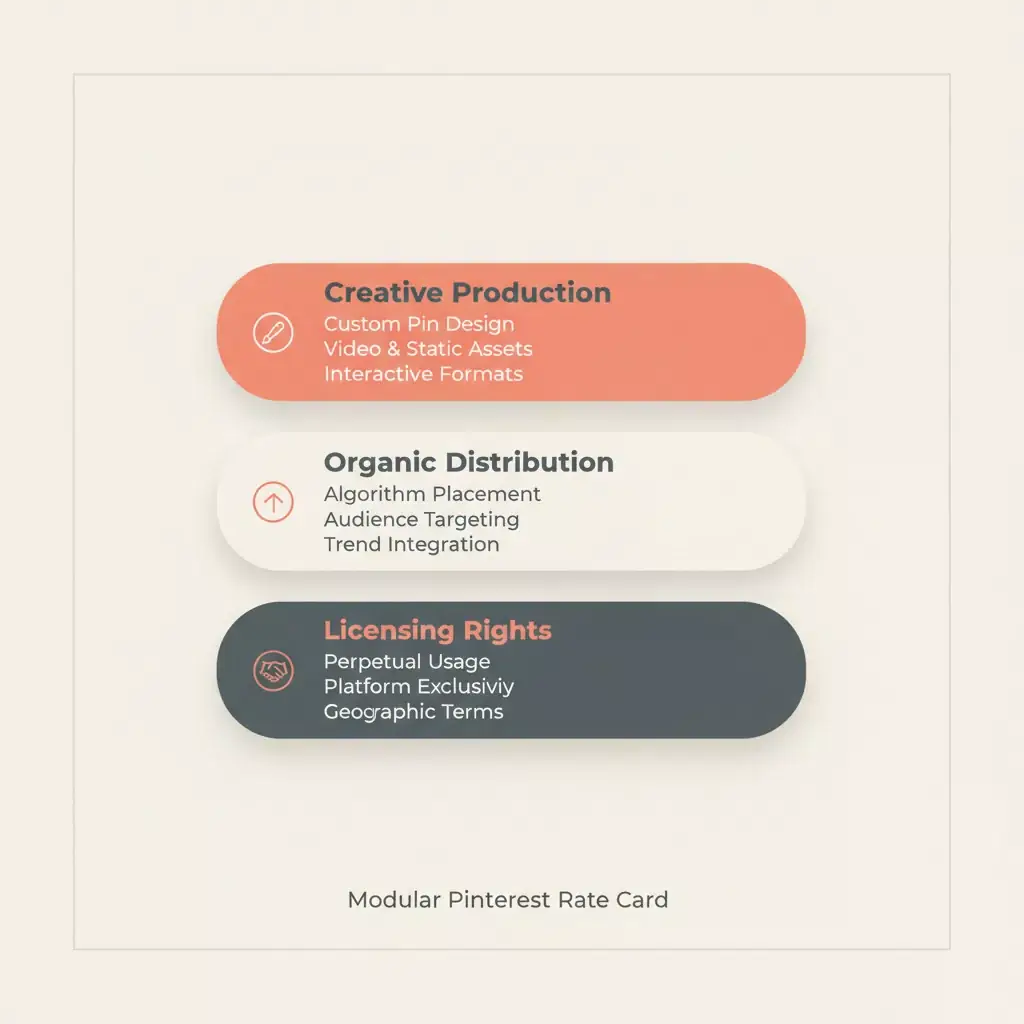
Here is a quick summary of the core components to unbundle on your rate card:
- Asset Production: Price raw asset creation (Static Pins vs. higher-lift Video or Carousel content) separately from posting.
- Audience Distribution: Set a clear base fee for publishing content to your organic Pinterest audience.
- Usage Rights & Paid Promotion: Charge percentage-based or flat add-on fees when brands run paid ads using your content.
- Revision Boundaries: Establish clear limits on feedback rounds to prevent unpaid scope creep.
Let's break down how to price each component step by step so you can protect your margins and negotiate with confidence.
Core Components of a Pinterest Rate Card
When you quote a brand deal on Pinterest, never bundle everything into one single price. Bundling asset creation, posting to your feed, and ad permissions obscures what the brand is actually paying for—and usually leaves you underpaid.
Instead, build an itemized rate card. This modular approach lets you adjust your fees based on deliverables, commercial scope, and licensing parameters.
Base Asset Production Vs. Audience Distribution
Creating a Pin and publishing it to your audience are two completely separate services.
- Asset Production: The labor, staging, equipment, and editing needed to create the visual asset (whether it is a photo, infographic, or video clip).
- Audience Distribution: Delivering that asset to your specific organic following and search reach on Pinterest.
If a brand only wants your visual asset to post on their own official website or social media account without you publishing it on your profile, you charge for asset production—not distribution. Separating these two line items ensures you get paid fairly for your creative labor even when distribution is not required.
Usage Rights and Licensing Durations
Once you create an asset, who owns it and where can it be used?
Standard organic posting only covers publishing the Pin on your own profile. If a brand wants to feature your Pin in their email newsletter, print catalog, website banner, or paid advertising, they must purchase extra rights.
Always specify the licensing duration (such as 30 days, 90 days, or 1 year) and the platform scope. Charging a recurring or timed licensing fee allows you to earn passive revenue when brands extend the commercial lifespan of your work.
Itemizing Pinterest Content Formats
Different Pin formats require different amounts of production time, prop costs, and visual design. Itemizing your asset options helps brands understand why pricing varies between a simple graphic and a multi-step video.
Static Pins and Carousel Graphics
Static Pins require high-res photography and visual design, while Carousels demand multiple curated cards that encourage swiping.
For example, an illustrative rate structure might look like this:
| Content Format | Included Assets | Illustrative Base Rate |
|---|---|---|
| Static Image Pin | 1 high-res image + optimized text overlay | $150 – $300 |
| Carousel Pin | 3–5 sequential cards + custom graphic overlays | $300 – $500 |
| Infographic Pin | 1 tall long-form graphic with step-by-step layout | $250 – $400 |
Note: All prices shown above are illustrative examples to show how to structure your tiers, not fixed industry standards.
When building your card, set your base rate according to your visual production setup and edit complexity.
Video Pins and Tutorial Content
Video Pins are high-lift deliverables. They require lighting, shooting multi-angle footage, voiceover recording, and editing timed to music or voice tracks.
Because video assets demand more effort than static graphics, your base fee for video content should reflect the extra production time.
Sample Rate Card Note: "Base visual rates cover production of 1 final asset for organic distribution on creator profile only. Commercial usage, paid amplification, and extended licensing fees are calculated separately per campaign."
Pricing Usage Rights, Amplification, and Exclusivity
Once you set your base production and distribution fees, add fee add-ons for advertising permissions and market restrictions.
Paid Partnership Promotion and Off-Platform Rights
Brands frequently want to run paid ads using your content to tap into your audience trust. On Pinterest, an eligible Pin with a paid partnership label can be promoted by the brand partner. Define the Pin, duration, permitted channels, and any separate off-platform use in writing.
Instead of bundling this into your base rate, charge an add-on fee calculated as a percentage of your base rate or a fixed monthly license:
- 30-Day Paid Partnership Promotion: Add 20% to 30% of your base deliverable rate.
- 90-Day Paid Partnership Promotion: Add 40% to 50% of your base deliverable rate.
- Off-Platform Rights (Website / Ad Units): Add a flat fee (e.g., $200/month per platform) or 25% of the total base fee.
If a brand plans to put tens of thousands of dollars behind your content in paid ad spend, your visual deliverable is doing heavy commercial lifting. Make sure your licensing rate scales with that usage.
Exclusivity Terms and Category Lockouts
When a brand requests an exclusivity clause, they are asking you to block competing brands from sponsoring your content for a specific time window.
Because an exclusivity clause prevents you from accepting other paid deals in your niche, charge a surcharge based on how broad and long the lockout is:
- Strict Niche Exclusivity (30 Days): Add 25% to your base fee.
- Category Lockout (60–90 Days): Add 50% to 100% of your total contract value.
Example Exclusivity Clause Response: "Our standard agreement allows non-compete locks for up to 30 days within the exact product sub-category (e.g., organic skincare serum). Broad category locks (e.g., all beauty products) require a 50% exclusivity surcharge per month."
Setting Revision Limits and Scope Boundaries
Scope creep can quickly turn a profitable sponsorship into unpaid labor if you do not define revision boundaries upfront.
Defining Minor Edits Vs. Paid Reshoots
Include explicit rules on your rate card regarding what counts as a standard edit versus a major reshoot.
- Minor Edits (Included in Base Rate): Adjusting text overlay colors, tweaking caption copy, fixing minor spelling mistakes, or updating a link tag. Limit this to 1 or 2 rounds of review.
- Major Reshoots (Paid Add-On): Changing approved recipe ingredients, re-filming video footage after a script was approved, or altering brand props.
Charge 50% to 100% of the original asset fee for major reshoots caused by changes in brand direction after initial sign-off.
Key Takeaways for Structuring Your Pinterest Rate Card
To protect your time and maximize deal revenue on Pinterest, keep your pricing approach modular:
- Unbundle your quote: Separate creative creation, distribution, paid rights, and exclusivity.
- Set standard revision terms: Cap edits at 1–2 minor rounds; charge full rates for scope shifts.
- Use time-bound licensing: Never hand over perpetual rights for a standard flat fee.
- Present clean quotes: Send brands an itemized PDF or interactive line-item card so they can see exact costs for every deliverable.
For a general template, see Influencer Rate Card.
FAQ
How Do I Calculate Rates for Pin Packages Versus Single Pins?
Offer slight bundle discounts when brands buy multiple assets upfront (for example, a 10% discount on a 3-Pin package), but keep usage rights and licensing fees unbundled from the package base price.
Should I Publish My Pinterest Rate Card Publicly or Send Custom Quotes?
Keep an internal rate card to calculate baseline numbers quickly, but send brands custom itemized quotes based on their specific asset specs, licensing duration, and exclusivity requirements.