How to Balance Your Revenue Mix: A Step-By-Step Decision Matrix for Retainers, Flat Rates, and Performance Deals
The Fast Way to Balance Creator Income
Think relying on one-off brand deals is enough? Here's the reality: single sponsored posts lead to unpredictable income spikes and cash flow stress.
To stabilize your income, you need a balanced revenue mix. That means dividing your content inventory across three core pricing models based on your past performance data:
- Monthly Retainers: Lock in predictable baseline revenue with repeat brand partners.
- Upfront Flat Rates: Protect your production time and creative effort on single integrations.
- Performance Deals: Capture high-upside revenue on products with proven audience conversion.
Here is a quick breakdown of how these three pricing models compare:
Quick Comparison
| Pricing Model | Primary Goal | Risk Level | Best Deliverable Type | Cash Flow Predictability |
|---|---|---|---|---|
| Flat Rate | Time protection | Low | Single-video integrations or one-off posts | High (One-time) |
| Monthly Retainer | Baseline stability | Low | Ongoing multi-asset campaign deliverables | High (Recurring) |
| Performance Payout | Revenue upside | High | High-converting niche product reviews | Variable (Scalable) |
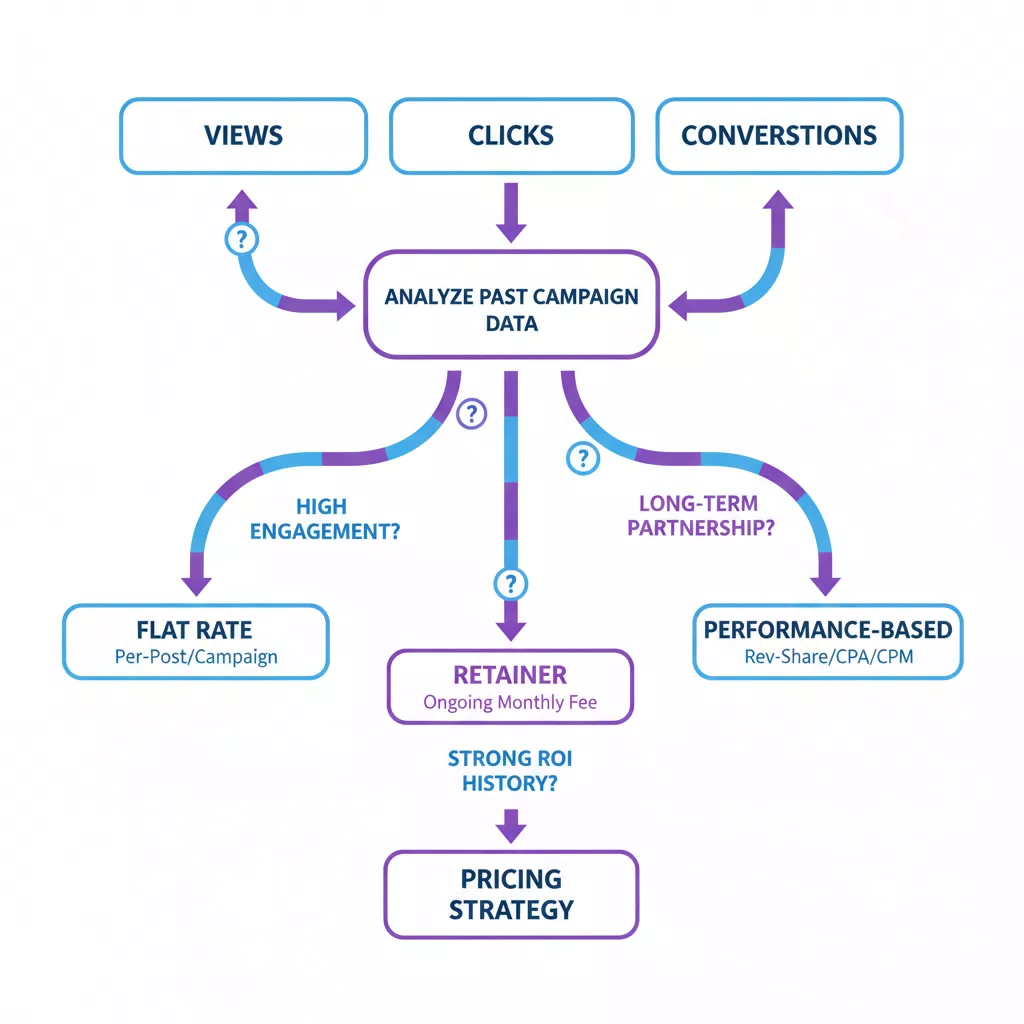
Here is the exact step-by-step decision matrix to audit your past performance metrics and assign the right pricing structure to every brand opportunity.
Audit Your Past Content and Collaboration Records
To structure your revenue mix effectively, you must analyze your historical channel performance. Relying on guesswork often leads to underpricing your work or committing to risky performance deals on products that do not convert.
Calculate Baseline Performance and Conversion Rates
Start by auditing your last 5 to 10 brand integrations. You need three core numbers: average organic views per post, average click-through rate (CTR) on sponsor links, and overall conversion counts.
For example, consider an illustrative scenario where a tech channel averages 50,000 views per video. If past sponsored links generated 1,000 link clicks, that equals a 2% CTR. If those 1,000 clicks resulted in 50 product purchases, the landing page conversion rate sits at 5%.
Knowing these baseline figures allows you to calculate the expected financial output of any deal type before signing a contract.
Categorize Content Deliverables by Predictability and Effort
Not all deliverables require the same production workload or yield the same viewer action. Categorize your content inventory into two distinct buckets:
- High-Predictability Assets: Standard 60-second video integrations or dedicated reviews where view counts remain consistent across uploads.
- High-Converting Niche Assets: Deep-dive tutorials, product comparisons, or problem-solving videos where viewers possess high purchase intent.
Assigning guaranteed flat rates to high-predictability assets ensures your base production costs are covered regardless of external algorithm changes.
The Creator Revenue Mix Decision Matrix
Choosing the right deal structure for an incoming brand pitch requires matching the sponsor's objectives with your historical metrics.
When to Pitch Upfront Flat Rates
Pitch an upfront flat rate when working with a new brand sponsor, promoting an unproven product, or delivering high-production content.
In our illustrative creator setup, if a new sponsor requests a dedicated integration on a 50,000-view video, quoting a flat rate of $1,500 guarantees time protection against unproven sales conversion.
When to Lock in Long-Term Monthly Retainers
Offer a monthly retainer when a brand partner has sponsored your channel at least twice with successful results.
Retainers benefit both parties: the brand locks in dedicated inventory at a slight discount, while you secure predictable recurring revenue. For example, offering a brand three video integrations per month at $3,500 per month (instead of three individual $1,500 flat-rate deals totaling $4,500) gives the brand a 22% discount while guaranteeing your baseline operational expenses.
Sample Pitch Wording: "Based on our last two integrations which generated a 2.5% click-through rate, I would love to reserve predictable inventory for your upcoming campaign. We can lock in a 3-month retainer at $3,500 per month for multi-asset deliverables, saving you over 20% compared to single-video flat rates."
When to Accept Performance-Based Payouts
Accept performance-based payout models—such as affiliate commissions or a fixed cost per acquisition (CPA)—only when product-audience fit is established and the product offers strong ongoing conversion rates.
If an illustrative software brand offers a $15 CPA payout on a product your audience heavily uses, and your past performance shows 100 conversions per review video, your projected revenue reaches $1,500. If higher conversion volume occurs, your revenue uncaps significantly beyond standard flat fees.
| Opportunity Scenario | Historical Performance | Recommended Pricing Model | Target Deal Terms |
|---|---|---|---|
| New Brand Partner | Untested conversion rates | Upfront Flat Rate | 100% fixed fee due upon content delivery |
| Repeat Sponsor (2+ Deals) | Consistent CTR & Sales | Monthly Retainer | 3- to 6-month contract with monthly upfront billing |
| High-Fit Niche Product | Proven high conversion | Performance Payout | CPA payout or baseline flat fee + affiliate bonus |
Map Your Annual Content Calendar and Seasonal Inventory
Brand advertising budgets fluctuate dramatically across the calendar year. Allocating your content inventory according to quarterly demand protects your earnings.
Reserve High-Demand Quarters for Guaranteed Revenue
During fourth-quarter (Q4) holiday shopping periods, ad rates peak as brands rush to capture consumer spend.
Reserve 70% to 80% of your Q4 content slots strictly for high-rate flat fees and long-term retainers. Because brand demand is high, avoid filling prime seasonal slots with unproven performance deals.
Use Off-Peak Months for Testing Performance Agreements
First-quarter (Q1) ad spend typically drops across social platforms. Use lower-demand months to test performance agreements with vetted partners.
Testing affiliate models or custom tracking links during off-peak periods allows you to identify evergreen, high-converting products without sacrificing peak flat-rate revenue.
Build a Systematized Outreach Pipeline
Maintaining a balanced revenue mix requires proactive pipeline management rather than waiting passively for inbound emails.
Target Repeat Brand Categories and High-Fit Prospects
Identify the top two product categories that generate the highest engagement from your past campaigns. Build a target list of 15 to 20 potential sponsors operating within those exact niches.
Prioritizing high-fit prospects increases acceptance rates for retainer pitches, as these brands already target your specific demographic profile.
Streamline Pitching, Rates, and Administrative Contracts
To maintain a consistent deal pipeline, minimize administrative overhead. Standardize your outreach templates, media kits, and licensing agreements.
Make sure your contracts explicitly define usage rights, payment schedules, and deliverable review windows to prevent scope creep or payment delays.
Key Takeaways for Managing Creator Revenue Strategy
- Audit baseline metrics: Calculate your historical CTR and conversion rates before negotiating new campaign terms.
- Protect production time: Use upfront flat rates for first-time brand collaborations and high-effort assets.
- Stabilize baseline income: Convert repeat sponsors into 3- to 6-month retainers with bundled deliverable discounts.
- Capture upside potential: Reserve performance deals for high-converting products during off-peak ad quarters.
- Manage seasonal shifts: Reserve prime Q4 inventory for guaranteed flat-rate and retainer contracts.
FAQ
How Much Discount Should I Offer When Pitching a Brand Retainer?
Offering a 10% to 20% discount on bundled deliverables incentivizes brands to commit to 3- to 6-month retainer agreements while guaranteeing your recurring baseline income.
What Should I Do If a Brand Insists on a Performance Deal for an Untested Product?
Propose a hybrid pricing structure that pairs a baseline flat rate to cover production costs with a performance-based affiliate bonus for sales exceeding performance thresholds.