How to Build a Realistic Brand Outreach Pipeline for 2027 (Using Your Historical Deal Math)
Want to build a predictable brand deal revenue stream for 2027?
Here is the reality: Relying on random inbound emails won't cut it. To build a realistic brand outreach pipeline, you need to turn your historical deal data into exact weekly targets.
Instead of guessing your rates or outreach volume, you can use your past campaign metrics to calculate your true hourly yield, map seasonal demand, and structure a balanced portfolio of retainers and single deals.
Here is a quick overview of how to build your 2027 pipeline:
- Audit Hourly Yield: Divide gross payouts by total production and administration hours to identify your most profitable brand categories.
- Balance Your Deal Mix: Combine monthly retainers, one-off posts, and affiliate models to reduce income volatility.
- Map Seasonal Inventory: Reserve your highest-value slots for high-CPM quarters like Q4 while pacing Q1 inventory.
- Calculate Pitch Volume: Use your historical response and close rates to figure out exactly how many pitches you need to send each week.
Let's walk through the exact mathematical framework to set up your outreach pipeline for 2027.
Audit Past Campaign Records to Pinpoint High-Yield Categories
Calculate Effective Hourly Yield by Product Niche
To find out which brand deals actually make you money, you need to look past the total invoice amount. A $3,000 deal sounds great until you spend 40 hours on endless script revisions.
That is where calculating your effective hourly yield comes in. It tells you exactly how much money you earn per hour of work for each product category.
Here is the simple formula:
Effective Hourly Yield = Gross Payout ÷ Total Production and Admin Hours
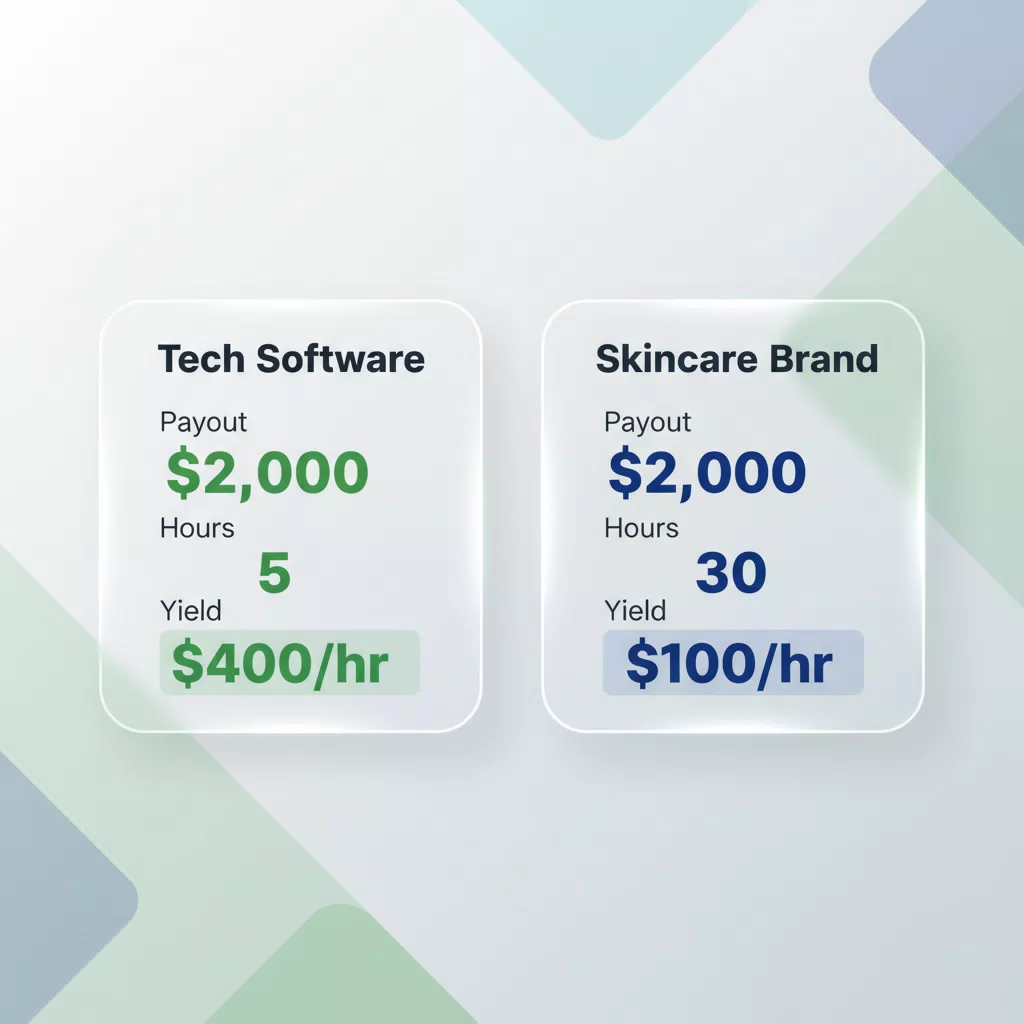
Let's look at a concrete illustrative scenario comparing two past campaigns:
| Sponsor Category | Gross Payout (Illustrative) | Production & Admin Hours | Effective Hourly Yield |
|---|---|---|---|
| Tech Software | $2,000 | 5 hours | $400 / hour |
| Skincare Brand | $3,000 | 30 hours | $100 / hour |
In this illustrative scenario, the skincare campaign pays more upfront. But when you track communication, filming, and edits, the tech deal earns 4x more per hour.
Evaluate Revision Friction and Client Administrative Load
Not all deals are created equal. High-friction clients drain your time through slow communication, endless legal edits, and late payments.
To spot these high-friction categories, track three metrics from your past campaign records:
- Script Rewrites: How many draft revisions did the brand request before approving the video?
- Contract Delay Days: How many days did it take from the initial contract draft to the final signature?
- Payout Timelines: Did the client pay within Net 30 terms, or did you have to send five follow-up emails?
If a specific niche consistently takes weeks to finalize contracts and requires three script rewrites, raise your base pricing or cut back outreach to that category for 2027.
Structure Your 2027 Sponsorship Mix and Rights Pricing
Balance Retainers, Flat One-Offs, and Performance Models
Relying entirely on one-off sponsored posts creates a roller-coaster income. To build a predictable revenue stream, balance your annual deal portfolio across three distinct offer structures:
- 50% Monthly Retainers: Multi-month agreements providing recurring revenue and stable monthly cash flow.
- 30% Flat One-Off Posts: Single-deliverable campaigns that give you flexibility to test new brand partners.
- 20% Performance Models: Affiliate or baseline-plus-bonus structures tied to conversions or view milestones.
Differentiate Platform-Specific Ad Usage Terms
Brands frequently ask to run paid ads using your content. Giving away usage rights for cheap is a huge mistake. Make sure you charge separately for platform-specific ad rights and distinguish between the ad products:
- TikTok Spark Ads: Allows brands to boost your native organic TikTok post using an authorization code.
- Instagram Partnership Ads: Allows brands to run sponsored ads directly through Meta Ads Manager using your handle via a paid partnership tag.
- YouTube Creator Partnerships: Involves licensing your long-form video assets or clips for brand-owned distribution and ad campaigns.
Never bundle organic post creation with paid ad rights for free. Charge an additional monthly usage fee whenever a sponsor requests ad rights.
Example Pitch Line for Usage Rights: "Our flat fee covers organic publication to my audience for 30 days. If your team would like to run TikTok Spark Ads or Instagram Partnership Ads using this creative, we can add a 30-day paid usage license for an additional 30% of the base campaign fee."
Map Seasonal Inventory and Renewal Pitch Windows
Align Deliverables with Quarterly Brand Spend Cycles
Brand marketing budgets fluctuate drastically throughout the year. If you pitch the wrong inventory at the wrong time, you will miss out on higher rates.
- Q1 (Jan – Mar): Brands re-evaluate annual budgets. Pitch early-stage trial deals and lock in long-term retainer discussions.
- Q2 & Q3 (Apr – Sep): Steady baseline spend. Ideal for summer product launches and mid-year campaign pushes.
- Q4 (Oct – Dec): Peak CPM rates and holiday ad spending. Reserve your premium inventory slots for your highest-paying partners.
Set a 60-Day Re-Engagement Timeline for Past Sponsors
The easiest brand deal to close is one with a client who already paid you. Do not wait for past sponsors to reach out to you.
Set a strict 60-day re-engagement timeline: contact past brand contacts exactly 60 days before a new product season or before their previous contract expires.
Example Re-Engagement Template: "Hi [Name], our Q3 skincare integration last year generated great audience engagement! I am finalizing my Q4 content calendar next week and reserved a couple of premium slots for existing partners. Would you be open to exploring a quick multi-post retainer for the upcoming holiday product launch?"
Calculate Your Required Weekly Pitch Volume
Apply the Historical Lead-To-Close Formula
You cannot build a predictable pipeline on guesswork. You need to calculate your exact weekly pitch targets using your historical campaign conversion numbers.
Here is the pipeline math formula:
Target Revenue ÷ Average Deal Size ÷ Close Rate ÷ Response Rate = Total Pitches Needed
Let's work through an illustrative scenario for a creator planning for 2027:
- Annual Revenue Target: $60,000 (Illustrative)
- Average Deal Size: $2,000 (Illustrative)
- Required Deals per Year: 30 deals ($60,000 ÷ $2,000)
- Historical Proposal-to-Close Rate: 25% (1 closed deal out of 4 proposals)
- Historical Pitch-to-Response Rate: 20% (1 brand reply out of 5 cold pitches)
Now let's run the math step-by-step:
- Proposals Needed: 30 closed deals ÷ 0.25 close rate = 120 proposals per year
- Cold Pitches Needed: 120 proposals ÷ 0.20 response rate = 600 cold pitches per year
- Weekly Outreach Target: 600 pitches ÷ 50 active weeks = 12 pitches per week
By sending exactly 12 tailored pitches every week, this illustrative creator stays on track to reach their $60,000 revenue target.
Automate Matchmaking, Account Valuation, and Pitching
Manually researching brand contacts, calculating account market rates, and writing dozens of outreach emails every week can take over 12 hours.
This is where leveraging AI tools makes a massive difference. For instance, CreaSeed functions as an AI business partner through a chat interface. It analyzes your social account performance metrics—like reach, engagement, and growth—to calculate your true account valuation so you do not underprice your deliverables.
Instead of hunting for brand emails manually, tools like CreaSeed handle AI matchmaking by surfacing tailored brand opportunities with confidence scores, spotting viral niche trends, and generating automated outreach messages. This allows you to maintain your required weekly pitch volume without giving up agency commission cuts.
Summary: Key Takeaways for 2027 Outreach Planning
Building a predictable revenue stream for 2027 boils down to treating your creator channel like a real business:
- Know Your Numbers: Calculate your effective hourly yield across product categories to eliminate low-margin deliverables.
- Diversify Income: Aim for 50% monthly retainers to protect your baseline income.
- Price Usage Rights: Separate organic post fees from ad licensing like TikTok Spark Ads and Instagram Partnership Ads.
- Hit Weekly Math Targets: Use your historical response and close rates to execute a consistent weekly pitch volume.
FAQ
How Do I Set Pitch Targets If I Don't Have Historical Conversion Rates?
If you lack historical pitch data, use standard industry baselines as an illustrative starting point: assume a 15% pitch-to-response rate and a 20% proposal-to-close rate. Adjust these figures after your first 50 outreach attempts.
What Is the Key Technical Difference Between TikTok Spark Ads and Instagram Partnership Ads?
TikTok Spark Ads allow a brand to boost your organic TikTok video using an authorization code generated directly from your post, whereas Instagram Partnership Ads require linking creator accounts in Meta Ads Manager to run ad sets directly under your handle.