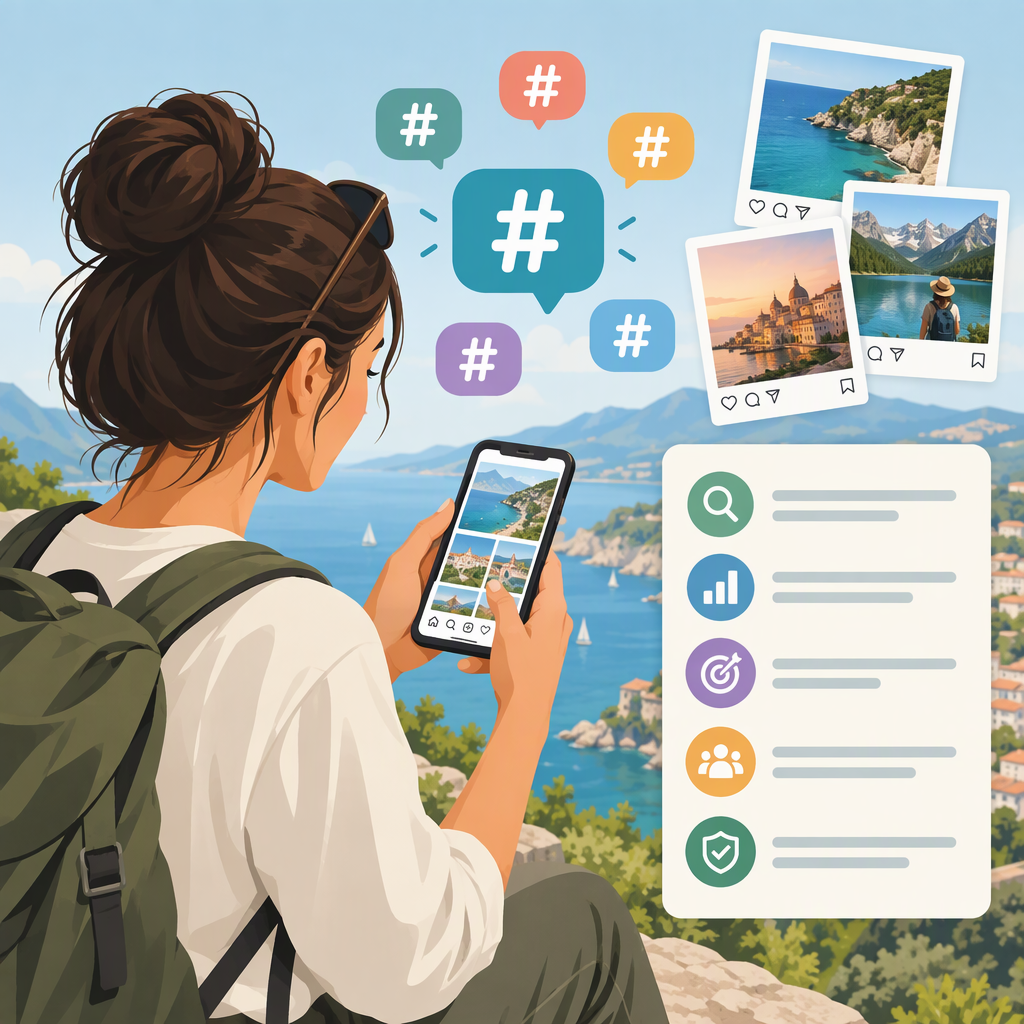
Trending Travel Hashtags on Instagram: What to Check and How to Choose
Short Answer
As of November 14, 2026, I can’t substantiate a named list of travel hashtags as currently trending from the available evidence. A November report says it analyzed more than 15.4 million public Instagram posts from October 2–31 and included a travel category, but its measure is most-used tags, not fastest-growing trends; the reported summary does not name the travel tags. A high post count or a frequently suggested hashtag is not proof that a tag is newly trending. (dashsocial.com)
For search candidates—not verified current trends—a hashtag directory’s list, last updated November 10, includes #travel, #travelgram, #travelphotography, #instatravel, #travelblogger and #wanderlust among frequently used travel tags. Treat these as starting points to check against your actual post, not as a copy-and-paste trend list. (displaypurposes.com)
Choose Tags That Describe This Post
Pick hashtags for what viewers can actually see or learn from the post. A useful selection process is:
- Name the place if it is central to the post: a destination, region, park, or city.
- Name the activity or subject: for example, hiking, a road trip, or travel photography—only when that accurately describes the post.
- Add the trip context or community if it is genuinely relevant, such as solo travel or family travel.
- Use a broad travel tag only if it adds useful context. A broad label is less specific; a narrow one may fit the post better. Neither guarantees discovery or reach.
- Remove anything that misrepresents the image, location, or audience. Don’t add a tag just because a list calls it popular.
Hypothetical example: For a photo from a Big Sur road trip, a creator might consider one destination tag, one road-trip tag, one photography tag, and one broad travel tag—then keep only those that accurately fit the image and intended audience. This illustrates a selection method; it is not evidence that those tags are trending.
Instagram announced a gradual limit of up to five hashtags per post or Reel in December 2025. The platform said more targeted tags are preferable to many generic ones; it did not promise that hashtags will increase reach. (socialmediatoday.com)
Check Whether a Tag Is Active and On-Topic
Use a public, manual spot-check rather than treating a generated list as live trend data:
- Search the candidate hashtag in Instagram and open its matching hashtag result if one appears. The app’s labels and layout may vary.
- Review the posts Instagram makes visible. Check whether they are recent where dates are shown, and whether they actually match the destination, activity, language, or travel context you intend.
- Look for repeated, relevant recent use—not just one viral post or a large lifetime post count. If visible posts are old, unrelated, spammy, or aimed at a different place or audience, skip the tag.
- If you need to call a tag trending, require time-based evidence: for example, a credible source that reports a recent increase or recent-period posting data, with the observation window stated. Record that window and region or language when available. If you only see a large post count or repeated use, call it popular or active—not trending.
- Recheck when the destination, event, season, language, or posting date changes. A tag that fit one trip or moment may not fit the next.
This is a relevance check, not a measurement of total Instagram activity: visible search results are only a sample. One recent industry report explicitly notes that its counts cover the public posts in its own listening data, not every Instagram post, and that most-used is not the same as fastest-growing. (dashsocial.com)
Quick Pre-Publish Checklist
- Does every hashtag accurately describe this post?
- Is each place-specific tag the right location?
- Have you checked visible posts for recency and topical fit?
- Are you calling a tag “trending” only when you have dated, time-based evidence?
- Are you within Instagram’s five-hashtag limit?
- Are the caption and tags clear without promising reach or treating a popular tag as a growth shortcut?
Bottom line: Start with relevant travel search candidates, verify their current fit on Instagram, and reserve “trending” for tags supported by recent, time-bounded evidence. Popularity alone is not a trend signal.