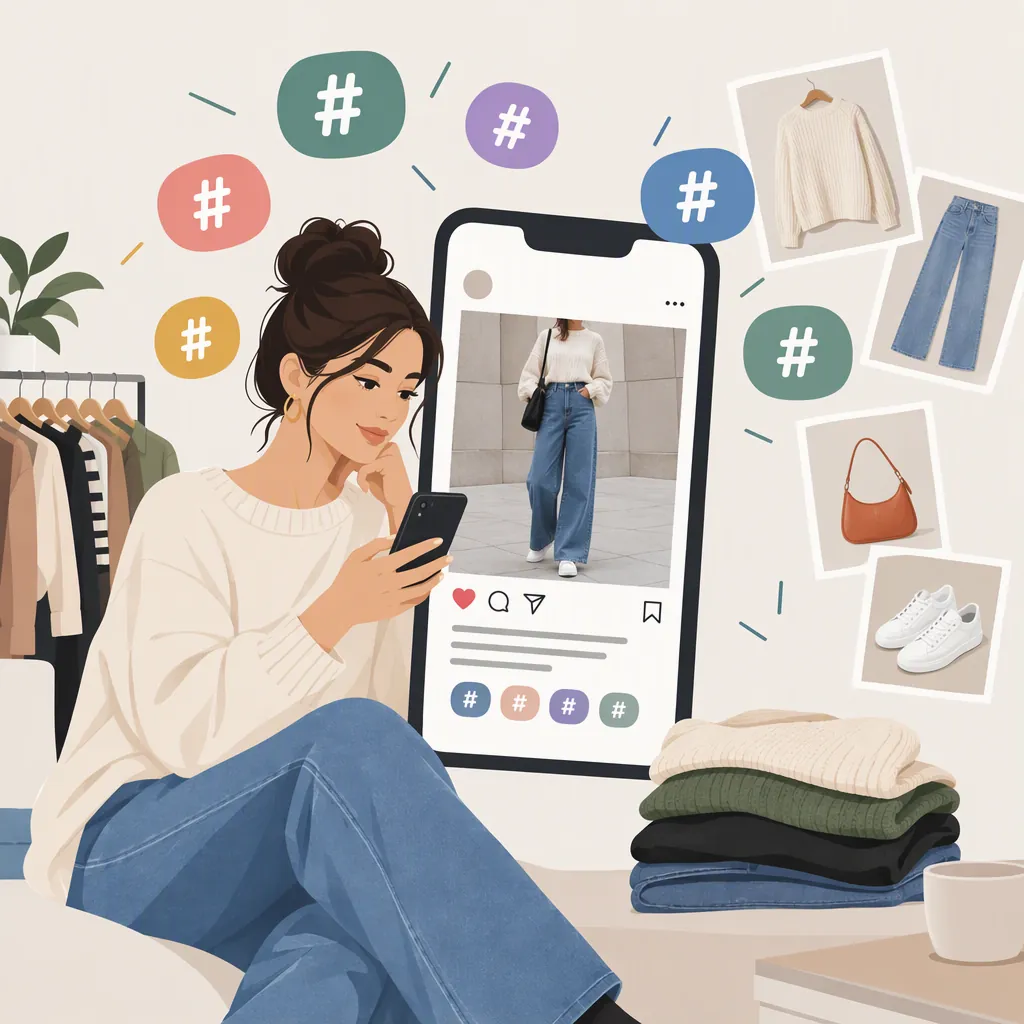
Trending Hashtags for Clothing on Instagram: How to Choose and Check Them
For clothing posts on Instagram, relevant hashtag candidates include #OOTD, #Streetwear, #DenimStyle, #Activewear, and #MinimalFashion. These appear in Apparel Factory’s August 12, 2024 list; they are starting points to investigate, not verified hashtags trending today. Choose tags that match your clothing, style, and audience, then check recent public activity before using them. [src1]
Evidence boundary: Apparel Factory’s 2024 article supplies categorized hashtag examples but no measurement window, growth data, or ranking methodology. It also does not establish an optimal hashtag count or demonstrate increased reach from the listed tags. The review process below is an editorial method for assessing public samples—not a platform-wide trend measurement. [src1]
Clothing Hashtag Examples: 2024 Candidates, Not a Current Trend Ranking
Apparel Factory groups its examples into categories including general fashion, clothing-specific tags, streetwear, activewear, seasonal fashion, and niche styles. The table reorganizes selected examples by the clothing content you might post. All candidates come from that 2024 list. [src1]
| Content focus | Hashtag candidates to investigate |
|---|---|
| Outfit posts | #OOTD, #WhatIWore, #OutfitInspo |
| Casual clothing and streetwear | #CasualStyle, #Streetwear, #GraphicTees |
| Denim outfits | #DenimStyle, #StreetStyle |
| Workout clothing | #Activewear, #GymOutfit, #YogaWear |
| Seasonal outfits | #SummerOutfit, #AutumnStyle, #WinterOutfit |
| Specific aesthetics | #MinimalFashion, #PreppyStyle, #Y2KFashion |
| Vintage and upcycled clothing | #VintageFashion, #UpcycledClothing |
Use the table to identify relevant options, not to copy an entire row automatically. A denim outfit may justify investigating #DenimStyle; workout clothing may justify #Activewear. An aesthetic or garment-attribute tag should accurately describe what the post shows.
Check Whether a Clothing Hashtag Is Active or Gaining Momentum
A useful public review separates three questions:
- Relevance: Do the visible posts match your garment, aesthetic, and intended audience?
- Activity: Is there dated, relevant use by multiple accounts?
- Possible momentum: Does relevant activity appear to increase across comparable observations?
Repeated use alone does not distinguish stable activity from growth. Use the following process to make your observations more consistent.
1. Define the Clothing Context
Before searching, write down the garment, style, audience, and any relevant season or location. Define what will count as a relevant result.
For example, a review for a graphic T-shirt outfit could count visible outfit posts featuring graphic tees, rather than every post that includes the hashtag. This is a hypothetical review rule, not a finding about current Instagram activity.
2. Record How You Inspect Public Results
Search each candidate in Instagram and review whatever public results are available to you. Record:
- The review date and time.
- The entry point, such as hashtag search.
- The visible result type, such as posts or Reels.
- Any visible sorting or filtering option.
- The number of results you inspect.
Choose a manageable sample size in advance—for example, 20 visible results per candidate—and use the same target on later reviews. That number is a convenience for manual review, not a statistically validated threshold. If fewer results are available, record the actual sample size.
3. Count Relevant Posts and Distinct Accounts
For each sample, record:
- Total results inspected.
- Results matching your clothing criteria.
- Distinct accounts represented among relevant results.
- Visible publication dates, where available.
- Relevant results falling within a consistent recent-date window.
Choose the date window before comparing reviews. If publication dates are unavailable, mark them as unknown rather than treating the posts as recent.
Multiple relevant posts from one account show that account’s use of the tag. They do not, by themselves, demonstrate broader adoption.
4. Repeat Under Comparable Conditions
On another date, use the same candidate, relevance criteria, entry point, result type, target sample size, and recent-date window where possible.
Compare the relevant-post count, its share of inspected results, and the number of distinct relevant accounts. Note overlapping posts or accounts so repeated appearances are not mistaken for new adoption.
Even consistent samples do not establish Instagram-wide growth. If conditions differ substantially—or the visible results cannot be compared—report content fit and observed activity only.
5. Make a Limited, Explicit Decision
Use conclusions that match the evidence:
| Observation | Appropriate decision or wording |
|---|---|
| Results do not match the clothing or audience | Exclude the candidate for this post |
| Relevant dated posts appear across several accounts | Keep as an active candidate in the inspected sample |
| Comparable reviews show more relevant recent posts across more accounts | Investigate possible momentum; describe the sample and dates |
| Dates or observation conditions are unavailable or inconsistent | Record the limitation; do not infer growth |
Prefer “active in the public sample reviewed on these dates” over “trending across Instagram.”
Build a Relevant Hashtag Shortlist
After reviewing candidates, choose tags that describe the post at three levels:
- General context: the type of post, such as #OOTD.
- Clothing or activity: the garment or use, such as #GraphicTees or #Activewear.
- Style or season: the visible aesthetic or setting, such as #MinimalFashion or #WinterOutfit.
These examples appear in Apparel Factory’s 2024 list. The three-level approach is an editorial selection method, not a tested performance formula. [src1]
For a hypothetical graphic T-shirt outfit, you could investigate #OOTD, #GraphicTees, and #CasualStyle. For a hypothetical minimalist winter outfit, you could investigate #WhatIWore, #MinimalFashion, and #WinterOutfit. These combinations illustrate content matching; they do not predict reach. [src1]
Apply a stricter check to tags implying clothing attributes. Apparel Factory lists #SustainableFashion, #EthicalFashion, and #ZeroWasteFashion, but listing those tags does not verify those attributes for any garment. Use such labels only when the post can substantiate the implication. [src1]
Keep a Dated Hashtag Review Log
Use one record per hashtag per review. Keep observations separate from conclusions so another review can follow the same method.
Public Hashtag Review Worksheet
| Field | What to record |
|---|---|
| Review date and time | When you inspected the results |
| Clothing context | Garment, aesthetic, audience, season, or location |
| Candidate hashtag | Exact tag reviewed |
| Relevance rule | What qualifies as a matching clothing post |
| Observation entry point | How you reached the public results |
| Result type and settings | Visible format, sorting, or filters |
| Sample size | Target and actual number of results inspected |
| Relevant results | Count and share of inspected results |
| Relevant distinct accounts | Number of different accounts in the relevant sample |
| Visible post dates | Dates available; mark missing dates as unknown |
| Recent-date window | Consistent window used and relevant posts within it |
| Overlap | Posts or accounts also seen in the previous review |
| Comparison | Changes in counts under comparable conditions |
| Limitations | Missing information or changed observation conditions |
| Decision | Keep, investigate further, or exclude—with a reason |
If you also evaluate your own clothing posts, record the hashtag set alongside the format, subject, publication date, and available performance measures. Treat this as a separate record: when several elements change, do not attribute the result to hashtags alone.
FAQ
Which Clothing Hashtags Are Trending on Instagram Right Now?
No current trend ranking is verified here. #OOTD, #Streetwear, and #Y2KFashion are candidates from Apparel Factory’s August 2024 list, not evidence of present-day growth. Review dated public posts and compare consistent samples before describing a candidate as gaining momentum. [src1]
How Many Hashtags Should a Clothing Post Use?
Apparel Factory’s 2024 article does not establish an optimal number. Choose tags you can justify from the post’s content and stay within the limits shown in Instagram’s current publishing interface. Do not treat a fixed count as a guaranteed performance strategy. [src1]
Should Every Clothing Post Use the Same Hashtags?
Reassess tags for each garment, aesthetic, and season. Apparel Factory’s list includes distinct activewear, seasonal, and niche-style categories, but does not demonstrate that one universal set performs best. As an editorial approach, retain recurring tags only while they remain relevant to the individual post. [src1]
Does an Active Hashtag Mean It Is Trending?
Not necessarily. Relevant use across multiple accounts can show activity in the sample you inspected; growth requires comparison over time. Apparel Factory’s 2024 list provides no growth measurements, so it cannot resolve that distinction for its listed hashtags. [src1]