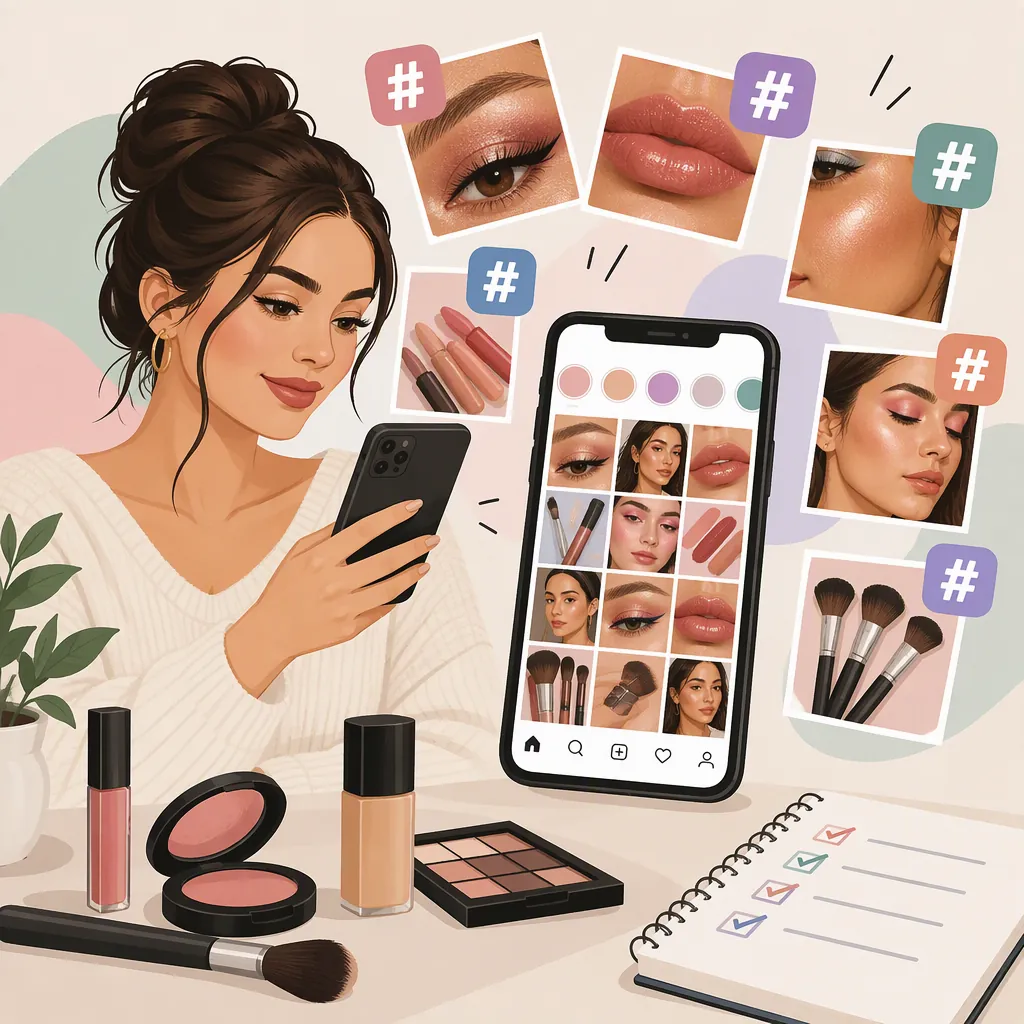
Trending Makeup Hashtags on Instagram: How to Find and Choose Them
To find trending makeup hashtags on Instagram, start with tags that describe your post, check their current public use, and compare dated observations before claiming growth. Candidates include #makeup, #makeuptutorial, #eyeshadow, #eyeliner, and #lipstick. These appear in historical beauty hashtag guides—not a verified ranking of what is trending today. [c1] [c2]
Evidence limits: ShortStack’s guide was published on May 21, 2019, and nichemarket’s on July 5, 2018. They provide useful hashtag vocabulary but no current time-series ranking. This article uses those sources for candidate tags and offers a manual review method, not verified current trends, an optimal hashtag count, or reach guarantees. [c1] [c2]
Separate Relevant, Popular, and Trending Hashtags
These labels answer different questions:
| Label | Question to Answer | Evidence to Look For |
|---|---|---|
| Relevant | Does the tag accurately describe this post? | Matching subject, technique, format, or creator role |
| Popular | Is the tag widely used? | Dated usage evidence with a clear measurement method and scope |
| Trending | Is use increasing over a defined period? | Comparable observations or measurements across time |
A tag can be relevant without being a trend. It can also be widely used without showing recent growth.
For your research notes, distinguish “relevant in the public results reviewed” from “increasing in a comparable sample.” Neither phrase, by itself, establishes an Instagram-wide trend.
Build a Relevant Makeup Hashtag Shortlist
Historical candidates from 2018–2019 guides; not a current trend ranking. The tags below come from ShortStack and nichemarket. Use them as starting points to inspect, rather than a set to copy wholesale. [c1] [c2]
| Post Focus | Historical Candidate Hashtags | Selection Check |
|---|---|---|
| General makeup | #makeup, #cosmetics, #instamakeup | Is makeup the main subject? |
| Tutorial | #makeuptutorial | Does the post explain a process? |
| Eye makeup | #eyeshadow, #eyeliner, #mascara | Is the named feature or product category shown? |
| Lip makeup | #lipstick, #lips, #gloss | Does the tag describe the visible lip look? |
| Base makeup | #foundation, #concealer, #contour | Is that application central to the post? |
| Brows | #brows, #eyebrows | Are brows a meaningful part of the content? |
| Makeup creator | #makeupartist, #beautyblogger | Does the label accurately describe the creator? |
Select only the rows that fit. A lipstick close-up does not need eye, brow, and base-makeup tags merely because they belong to the same broad category.
You can also note additional tags encountered in relevant public posts. Treat each as a new candidate: check its meaning and current use before adding it to your shortlist.
Check Current Public Use Before Calling a Tag Trending
A useful review needs a defined method, not just a collection of screenshots.
- Describe the post first. Record its subject, technique, visible features, format, and intended audience.
- Define the review scope. Choose the candidate tag, public search or browsing route, sample size, and publication-date window you intend to inspect. Record the account or viewing context used.
- Review available public results. Note which posts match your subject, their visible publication dates, and distinct creators where observable. Mark missing information rather than estimating it.
- Repeat the same method. Use the same route, sample rule, viewing context, and equal-length date window on a later date. Record any differences in access or presentation.
- Decide what is actually comparable. Separate relevance observations from activity measurements. If the displayed results are incomplete or their selection is unknown, a change in the sample is not a measurement of total hashtag growth.
- Assign a cautious decision. Retain a relevant candidate, revisit a possible activity signal, or exclude a poor fit. Reserve a trend claim for evidence whose time period, coverage, and measurement method support it.
Fixed review rules make your notes more consistent; they do not make an incomplete public sample representative of Instagram.
Worked Example: Two Reviews Without a Trend Claim
Method example only: the dates, counts, and observations below are hypothetical, not real Instagram findings.
Suppose the planned post is an eyeshadow tutorial and the candidate is #eyeshadow, a tag listed in nichemarket’s historical guide. [c2]
| Review Field | First Observation | Second Observation |
|---|---|---|
| Review date | September 1, 2026 | September 8, 2026 |
| Viewing method | Same account and public hashtag browsing route; inspect up to 20 displayed posts | Repeat the same method |
| Publication window | Previous seven complete days: August 25–31 | Previous seven complete days: September 1–7 |
| Posts inspected | 20 | 20 |
| Relevant posts dated within the window | 6 | 10 |
| Distinct creators among those posts | 5 | 8 |
| Missing information | Dates unavailable on 3 posts; result selection and completeness unknown | Dates unavailable on 2 posts; result selection and completeness unknown |
| Access or presentation changes | None recorded | None recorded |
What is comparable: Both reviews used the same sample size and equal-length publication windows. More recent, relevant posts appeared in the second reviewed sample.
What is not established: The sample does not show how many qualifying posts existed overall, whether the displayed selection was representative, or whether missing dates affected the comparison. The additional creators do not establish platform-wide growth.
Decision: Retain #eyeshadow for relevance and revisit its activity. Record: “More recent matching posts appeared in the second sample; trend status remains unverified.”
If you later obtain a complete or clearly defined dataset, compare the same metric across equal-length windows and document its coverage. Even then, describe growth within that dataset’s scope rather than automatically generalizing to all of Instagram.
Public Hashtag Review Worksheet
- Candidate hashtag:
- Post topic and format:
- Review date and viewing context:
- Public search or browsing route:
- Sample-selection rule and size:
- Publication-date window:
- Relevant examples within that window:
- Distinct creators, if observable:
- Missing dates or other unavailable information:
- Earlier observation using the same method:
- Changes that weaken comparability:
- Conclusion supported by the observations:
- Decision: Retain, revisit, or exclude.
- Reason:
Choose Tags That Describe the Actual Post
As an editorial approach, pair a broad subject label with more specific labels when each adds useful description.
For an eyeshadow tutorial, #makeup, #makeuptutorial, and #eyeshadow are reasonable candidates to evaluate because they describe the subject, format, and feature. These tags appear in the historical guides; this example is a relevance-based selection, not a tested performance combination. [c1] [c2]
Consider how the choice changes with the content:
| Illustrative Post | Candidates to Evaluate | Tags to Leave Out Unless Supported |
|---|---|---|
| Step-by-step eyeshadow application | #makeup, #makeuptutorial, #eyeshadow | #lipstick if lips are not part of the lesson |
| Lipstick close-up without instructions | #lipstick, #lips | #makeuptutorial if no process is explained |
| Brow application demonstration | #brows, #eyebrows, #makeuptutorial | #makeupartist if that role does not describe the creator |
The candidate vocabulary comes from the two historical guides. [c1] [c2]
Treat brand tags separately. Use one only when the brand is genuinely relevant to what the post shows or discusses. A tag should not imply an unsupported affiliation, endorsement, professional role, or product attribute.
Pre-Publish Hashtag Checklist
- Each tag accurately describes the post or creator.
- Specific tags match visible features or explained techniques.
- Brand references are relevant and do not imply an unsupported relationship.
- Current-use observations include dates and a review method.
- Any trend label has comparative evidence appropriate to its scope.
- Irrelevant tags and unsupported performance promises have been removed.
Review Results Without Overstating Cause
If you evaluate your own posts, record the selected tags alongside the topic, format, publication date, and any performance measures available to you. Choose a consistent review interval and change as few variables as practical.
Use those records to refine your shortlist, not to declare that hashtags alone caused a result. Posts with different subjects, visuals, timing, or audiences are not equivalent tests. Where comparisons are weak, describe the result as an observation rather than proof.
Keep two separate notes:
- Content fit: Did the tag accurately describe the post?
- Observed results: What happened, and how comparable was the review?
A relevant tag may remain useful as a description even when its trend status or contribution to performance is uncertain.
FAQ
Which Makeup Hashtags Are Trending on Instagram Right Now?
The cited guides cannot verify a current ranking. Historical candidates include #makeup, #makeuptutorial, #instamakeup, #eyeshadow, and #lipstick. Use the dated public-review method above to assess current relevance and possible activity signals. [c1] [c2]
How Can I Tell Whether a Makeup Hashtag Is Trending Rather than Just Popular?
Look for comparable evidence of increased use over a defined period. Record the metric, time windows, collection method, and coverage. A larger displayed sample or more visible creators alone does not establish Instagram-wide growth.
How Many Makeup Hashtags Should I Use?
The cited historical guides do not establish a verified optimal count or a current platform limit. Choose tags for accurate description rather than filling a fixed quota. [c1] [c2]
Should I Reuse the Same Hashtags on Every Makeup Post?
Reuse a tag when it remains relevant, but reassess the set for each post. A brow demonstration, lipstick close-up, and full-face tutorial may need different descriptive tags. This is a relevance-based recommendation, not a claim that Instagram rewards or penalizes repeated sets.