Best Hashtags for Hiking: Relevant Tags and How to Choose
The best hashtags for a hiking post are the ones that accurately describe the hike, the place, or the photo—not a long list copied onto every post. As a starting point, consider #hiking, #hikingadventures, or #hikingtrails for hiking content; add a tag such as #backpacking only when it fits the activity, and a destination tag only when it accurately names the location. Hiking hashtag lists commonly include these examples, but they do not establish that a tag is trending or will increase reach. (best-hashtags.com)
This guide focuses on hiking posts, including hikes shared as part of a trip. It is platform-neutral except where Instagram is named; platform rules and tag counts can differ.
Hiking Hashtag Ideas by Purpose
Treat these as a shortlist to choose from, not a set to paste all at once. The examples below appear in hiking- or destination-focused hashtag lists; their presence there is not proof of popularity, performance, or current trend status.
| What the post is about | Examples | Use when… |
|---|---|---|
| Hiking in general | #hiking, #hike | The post is clearly about hiking, and a broad topic label fits. |
| Hiking trails or outings | #hikingtrails, #hikingadventures | The post shows a trail or an outing. These tags appear in hiking hashtag lists. (best-hashtags.com) |
| Backpacking | #backpacking | The post actually features a backpacking trip, rather than just a day hike. (ritetag.com) |
| A hiking community | #womenwhohike | The post is relevant to that community; a community-oriented tag is not a generic substitute for describing the hike. The organization Women Who Hike identifies this as its social-media hashtag. (womenwhohike.org) |
| A named destination | #yosemite, #yosemitenationalpark | The hike is actually in Yosemite. These tags appear in destination-related lists. (best-hashtags.com) |
| Hiking photography | #naturephotography | The post’s main focus is a nature photograph, not just the fact that you went hiking. (best-hashtags.com) |
A useful choice is not automatically the broadest or most-used tag. A general tag may describe many kinds of posts; a specific activity or destination tag is only appropriate when it genuinely matches yours. If a suggested tag feels like a stretch, leave it out.
How to Choose Hashtags for Your Hike
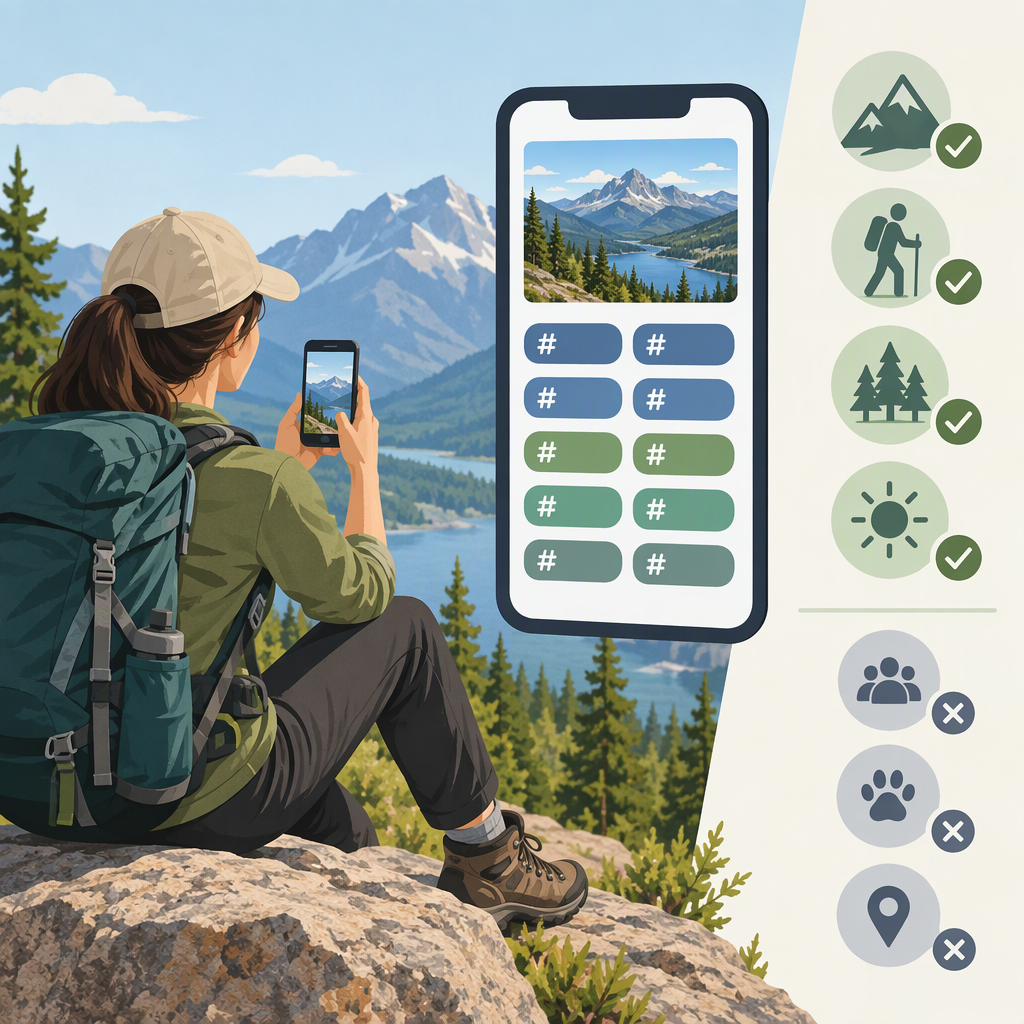
- Describe what the post shows. Is it a day hike, a backpacking trip, a trail scene, or a landscape photo? Start with the clearest topic.
- Add the place only if it is relevant. Use an accurate destination tag if the location is an important part of the post and you are comfortable sharing it. Avoid tagging a place you did not visit or revealing a sensitive location.
- Consider who the post is for. A community hashtag may fit a post intended for that community; it should not replace a clear description of the activity.
- Check the tag on the platform where you will post. Search the exact hashtag and review the results. Confirm that the tag is being used in the sense you intend, and that it still fits your post. Lists on the web can offer ideas, but are not a live check of every platform.
- Keep only the tags that earn a place. If a tag does not accurately describe the activity, location, community, or image, remove it. There is no need to fill a set number with weak matches.
Illustrative example: For a post showing a hike in Yosemite, a relevant shortlist might be #hiking #yosemite #yosemitenationalpark #hikingadventures. Use only the tags that fit the actual post; if it is not about an adventure outing, for example, choose a more accurate label instead. The list is an example of matching tags to a topic and place—not a tested recipe for reach.
How Many Hiking Hashtags Should You Use?
There is no universal hashtag count established for every platform. Use the rules for the specific channel and post format rather than treating an Instagram limit as a rule for TikTok, YouTube, or another service.
For Instagram posts and Reels, Instagram announced on December 18, 2025, a gradual change to allow up to five hashtags in a post or Reel caption. The announcement recommended fewer, more targeted hashtags instead of many generic ones. Five is a platform ceiling in that guidance, not a target you need to fill. (greenhousemag.com)
For other platforms, this guide does not establish a current count. Check the platform’s own guidance or the publishing interface for the format you are using. Do not assume that an older hashtag list or an Instagram-specific limit applies everywhere.
Quick Check Before Posting
- Does each hashtag describe something actually shown or discussed?
- Is the destination tag accurate, and are you comfortable sharing that location?
- Does a community tag genuinely fit the post and intended audience?
- Have you checked the tag on the platform where you will publish?
- Are you following that platform’s current rule for this post format?
Use hashtags as descriptive labels, not as a promise of reach or engagement. A short, accurate selection is more useful to readers than a padded list of loosely related tags.