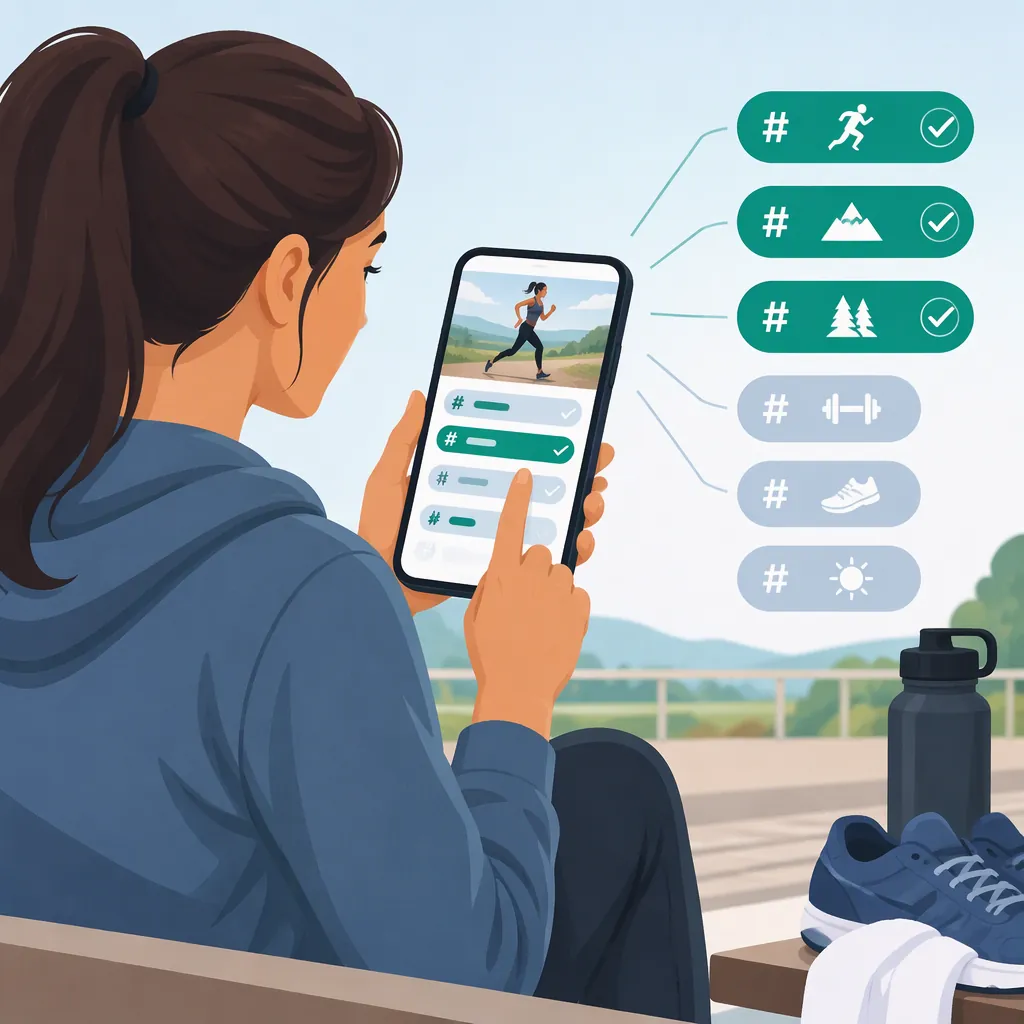
Sport Hashtags: How to Choose Tags for Your Posts
Choose sport hashtags that describe the actual post: the sport, the specific activity, and any relevant community or event. Start with a broad topic tag, then add more precise tags rather than copying a generic list. Hopper HQ recommends combining general fitness tags with relevant niche tags, but its guide does not establish a guaranteed reach benefit or a universal formula for every sport. [C1]
Start with the Post, Not a Popularity List
Before choosing hashtags, describe your post in one sentence. For example: “A beginner basketball player practicing free throws” or “A trail runner sharing an easy training run.” Use that description to shortlist tags.
Consider four categories:
- Sport: What discipline is shown?
- Activity: Is the post about a drill, training session, competition, or analysis?
- Audience: Is it intended for beginners, recreational players, coaches, or fans?
- Context: Does a real event, team, or location matter to the post?
Hopper HQ organizes its fitness suggestions into categories such as running, yoga, workouts, and bodybuilding, and advises keeping tags relevant to the content. That is a useful selection principle, not evidence that its listed tags are best for every sports post. [C1]
Build a Specific Hashtag Set
Use a broad tag only when it accurately describes the content. Then add tags that clarify what viewers will see.
For a running post, the supplied guide lists options including #Running, #TrailRunning, #MarathonTraining, and #RunningCommunity. These describe different subjects; they are not interchangeable. A trail run does not need #MarathonTraining unless marathon preparation is actually part of the post. [C1]
Treat team, league, and event tags with the same care. Check the spelling against the relevant public account or event materials before using them. Do not describe an invented tag as official, and do not add an unrelated competition simply because it is receiving attention.
A useful editing question is: Does this tag add accurate information that the other tags do not? If not, consider removing it.
Illustrative Sport Hashtag Sets
The following sets are editorial examples of topic matching—not verified popularity rankings, official event tags, or promises of discovery. Check their current use on your chosen platform before posting.
| Post Subject | Illustrative Tags | Relevance Check |
|---|---|---|
| Beginner basketball free-throw practice | #Basketball #FreeThrows #BasketballPractice | Does the post actually show free-throw practice? |
| Recreational trail-running session | #Running #TrailRunning #RunningCommunity | Is the route a trail, and is the community framing appropriate? |
| Soccer passing drill | #Soccer #PassingDrills #SoccerTraining | Is passing the focus rather than match highlights? |
| Swimming technique demonstration | #Swimming #SwimmingTechnique #SwimTraining | Does the caption identify the technique being shown? |
Keep the caption descriptive too. For instance, “Free-throw practice focused on a consistent setup” is clearer than a caption made entirely of broad sports tags.
Check Platform Context and Source Limits
Do not assume the same set is appropriate for Instagram, TikTok, and every other platform. Review each candidate tag in the app where you plan to publish. Look at whether the results match the sport, meaning, language, and audience you intend.
The supplied fitness guide offers different hashtag-count recommendations for Instagram, Reels, and TikTok. Those are third-party recommendations, not platform documentation establishing an optimal count. It also makes claims about restricted tags and algorithm behavior that are not independently verified by the provided references. [C1]
For that reason, this article does not prescribe a universal hashtag count, repeat reach estimates, or provide a definitive banned-tag list. Follow the platform's current posting rules and avoid tags whose visible results or warnings make them unsuitable for your content.
Use a Selection and Review Worksheet
Save candidate tags by subject, but review them for each new post. A reusable list should be a starting point, not an automatic addition to every caption.
If you compare results, record the post topic, format, publication time, and hashtag set alongside whatever metrics your account provides. Compare similar posts cautiously: a change in views or engagement alone does not establish that hashtags caused the difference.
Sport Hashtag Selection Worksheet
Post description: ____________________
Platform: ____________________
Sport or discipline: ____________________
Specific activity: ____________________
Intended audience: ____________________
Relevant event or location, if any: ____________________
Candidate hashtags: ____________________

Before publishing:
- Each tag accurately describes this post.
- Spellings and event references have been checked.
- Current in-app results match the intended meaning.
- Unrelated or redundant tags have been removed.
- The caption explains the content without relying on hashtags.

After publishing:
Metrics available: ____________________
Comparable posts and important differences: ____________________
What to test next, without assuming causation: ____________________
FAQ
What Are the Best Sport Hashtags?
There is no verified universal best set in the provided references. Choose tags that accurately name your sport and activity, then add relevant audience or event context. Treat the examples in this article as candidates to check, not performance rankings.
How Many Sport Hashtags Should I Use?
Use a concise set in which every tag has a clear purpose, within the platform's current limits. Hopper HQ offers different counts for Instagram, Reels, and TikTok, but the supplied evidence does not establish one optimal number for sports content. [C1]
Can I Reuse the Same Sport Hashtags?
Keep a shortlist for recurring subjects, but select from it according to each post. A general sport tag may remain relevant, while drill, competition, location, and audience tags may need to change. This is a relevance practice, not a claim that repetition triggers an algorithmic penalty.