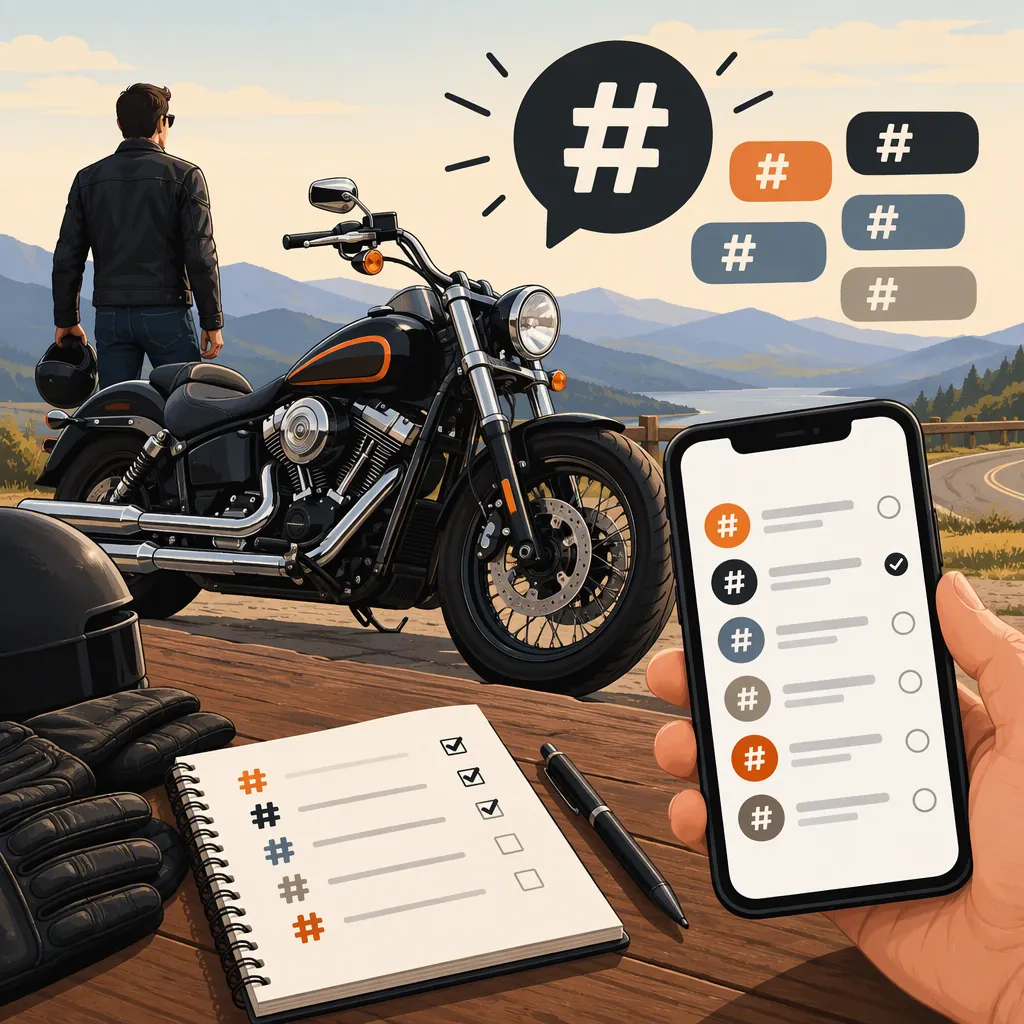
How to Choose Harley-Davidson Hashtags
For a Harley-Davidson motorcycle post, start with #harleydavidson, then add tags that accurately describe the model, subject, or activity. Include an event or location tag only when it is relevant and appropriate to disclose. Choose tags for what the post actually shows—not because they sound popular.
Choose Tags That Describe the Post
Build your selection from the most specific details you can confirm:
- Brand: Use #harleydavidson when the motorcycle or discussion is about Harley-Davidson.
- Model: Add a model tag only after confirming the model name. For example, a confirmed Road King could be labeled #harleydavidsonroadking; a confirmed Street Glide could be labeled #harleydavidsonstreetglide. These are illustrative spellings to check on your chosen platform, not verified recommendations.
- Subject: Consider #motorcyclephotography for a photography-focused post or #motorcyclemaintenance for a maintenance discussion.
- Activity: Use a tag such as #motorcycleride when the post describes a ride, rather than a stationary display.
- Place or event: Include a location only if you are comfortable disclosing it. Check an event’s public materials for its tag, and use it only when the post genuinely relates to that event.
Do not guess a model from appearance alone. If you cannot confirm it, keep the brand and subject tags and leave the model tag out. Likewise, avoid tags that imply event attendance or an affiliation the caption does not support.
Example Hashtag Sets by Post Type
These are illustrative combinations, not popularity or performance rankings. Check each candidate on the platform where you intend to post.
| Post type | Illustrative tags | Relevance check |
|---|---|---|
| Motorcycle portrait | #harleydavidson #motorcyclephotography | The image features a Harley-Davidson motorcycle, and photography is the focus. |
| Confirmed Road King portrait | #harleydavidson #harleydavidsonroadking #motorcyclephotography | The model is confirmed as a Road King, and the model tag’s results match the intended subject. |
| Confirmed Street Glide ride recap | #harleydavidson #harleydavidsonstreetglide #motorcycleride | The model is confirmed as a Street Glide, and the caption describes an actual ride. |
| Maintenance discussion | #harleydavidson #motorcyclemaintenance | Maintenance is the subject, rather than simply a parked motorcycle. |
Keep a tag only if it adds useful context. You do not need to fill every category: a portrait with an unconfirmed model may need only a brand tag and a photography tag.
For maintenance content, separate the topic label from the technical advice. A hashtag does not establish that a procedure is safe or suitable for a particular motorcycle.
Check Candidate Tags Before Posting
Search each proposed tag on your chosen platform and inspect the available results:
- Brand or model match: Are the results mainly about the intended motorcycles, or does the tag point to something else?
- Ambiguity: Does the name have another meaning, or does a shortened spelling mix unrelated subjects?
- Content match: Do the results fit your post’s subject—photography, riding, maintenance, or an event?
- Event accuracy: Does the spelling match the event’s public materials, and does your caption explain the connection?
If the results are mostly unrelated, remove or replace the tag. If a model tag is ambiguous, try a fuller brand-and-model spelling and inspect it again. If no useful match appears, leave it out rather than adding a tag solely because its name looks plausible.
Final Selection Checklist
- Confirm the brand and any model name.
- Choose subject or activity tags that describe the actual content.
- Check candidate tags for unrelated meanings.
- Verify event-tag spelling against public event materials.
- Remove unnecessary location details and unsupported affiliation cues.
- Make sure the caption explains the post without relying on hashtags alone.
Caption and Tag Worksheet
- Main subject: What does the post show or discuss?
- Caption: Explain that subject in ordinary language.
- Brand tag: #harleydavidson, if relevant.
- Optional model tag: Use only after confirming the model and checking the tag’s results.
- Subject or activity tag: Choose one that adds accurate context.
- Optional event or location tag: Check relevance, spelling, and privacy.
- Final check: Remove anything misleading or redundant.
Evidence Limits and Comparing Results
The hashtag.place account describes itself as a bridge that mirrors posts with #harleydavidson. The cited pages display November 2024 entries with zero likes and zero boosts. These are records of the displayed mirror-feed entries—not measures of the hashtag’s overall audience, current popularity, or performance elsewhere. They do not establish a best-performing combination or an optimal hashtag count. [c1] [c2]
If you compare your posts, record the subject, caption, format, publication date, and hashtag set alongside available metrics. Treat differences as observations, not proof that a hashtag caused the result: other aspects of the posts may have changed too.
FAQ
Which Harley-Davidson Hashtags Should I Use?
Start with #harleydavidson when relevant, then consider a matching subject tag such as #motorcyclephotography or #motorcycleride. Add a model tag only after confirming the model and checking the tag’s results. Event and location tags are optional, not required.
How Many Hashtags Should I Include?
There is no evidence-backed count established by the cited mirror records. Use a concise set in which each tag adds a distinct, accurate description, and check your platform’s current requirements. [c1] [c2]
Should I Use a Model Tag If I Am Unsure Which Motorcycle Is Pictured?
No. Leave the model tag out until you can confirm the model. A relevant brand tag and subject tag can describe the post without introducing an unsupported identification.
Does the Mirror Feed Prove That #Harleydavidson Is Popular?
No. It documents mirrored posts, not overall popularity or improved discovery. Use it as evidence that the feed exists, not as a ranking of effective hashtags. [c1]
Sources
-
[c1] #harleydavidson
-
[c2] #harleydavidson