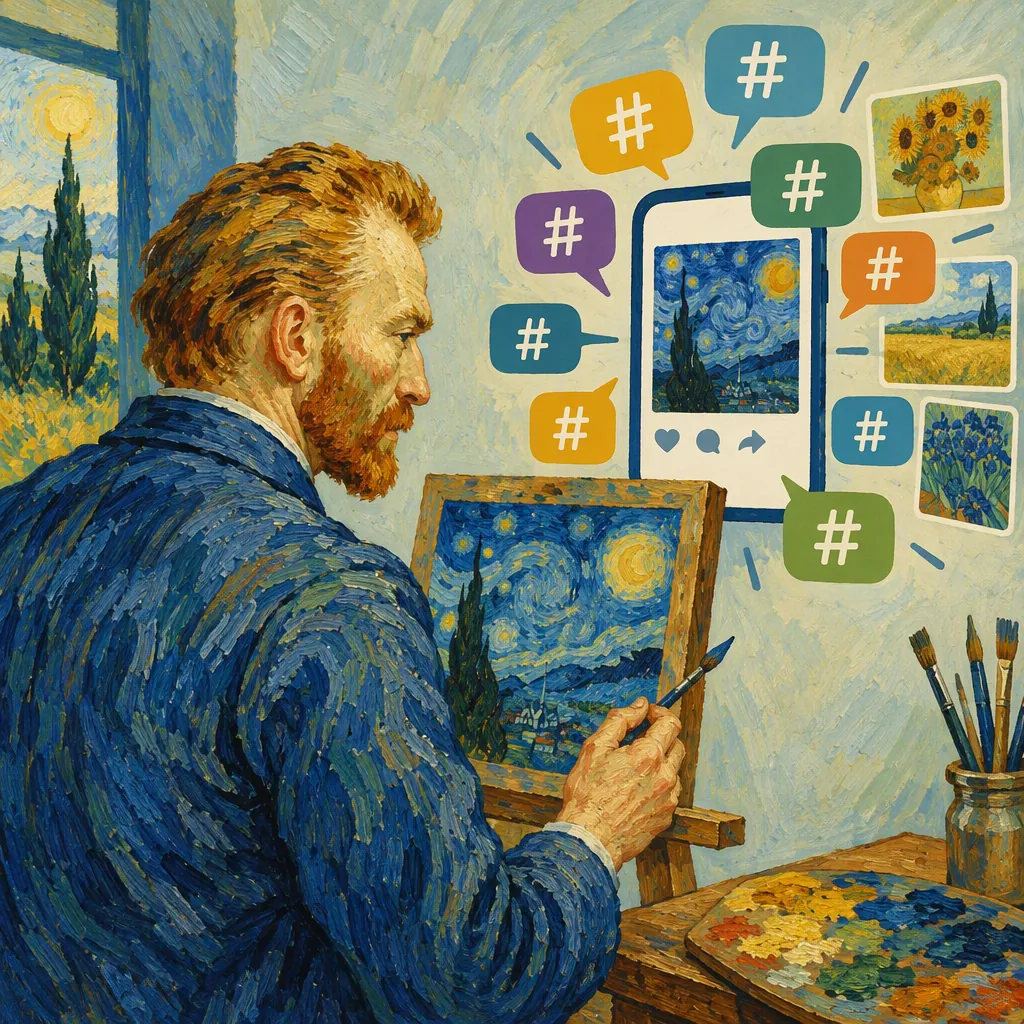
How to Choose Van Gogh Hashtags for Art Posts
For a Van Gogh post, start with an artist tag such as #VanGogh or #VincentVanGogh, then add tags that accurately describe the artwork, discussion, or creative process. The supplied Instagram examples include #VanGogh, #VincentVanGogh, #ArtHistory, and #ArtLovers, but they do not establish an optimal hashtag count or prove that any tag improves reach. Treat these as relevant examples, not a performance ranking. [c1] [c2]
Start with the Subject of the Post
Choose tags after deciding what your post actually shows. A discussion of a painting, a museum photograph, and an original artwork inspired by Van Gogh need different context.
The supplied Instagram reel pairs #VanGogh with #ArtHistory, #FamousPaintings, #ArtLovers, and #museumart. The supplied aggregation page also displays #VincentVanGogh and #ArtStory. These are examples of tags used in the provided material—not evidence that they are the best-performing choices. [c1] [c2]
Use a simple selection framework:
- Artist: Choose an artist-name tag when Van Gogh is central to the post.
- Artwork or subject: Add a tag naming the depicted work or subject only when it matches.
- Purpose: Distinguish historical explanation, personal interpretation, museum documentation, and your own creative process.
- Medium: For your own work, describe the actual medium rather than borrowing tags that imply a different technique.
Do not add a museum tag merely because the post concerns a famous artist. Reserve that context for a post genuinely connected to the museum.
Hashtag Selection Worksheet
Main subject: [artist, artwork, or your own work]
Post purpose: [explanation, interpretation, museum visit, or process]
Artist tag: [choose a relevant artist-name tag]
Artwork or subject tag: [include only if accurate]
Context or medium tags: [describe what the post actually contains]
Final check: Remove any tag you cannot explain from the image, video, or caption.
Sample Van Gogh Hashtag Sets
The following sets are editorial examples, not tested recommendations. Keep only the tags that fit your caption and visual content.
Painting discussion: Use an artist tag and a discussion-related tag. Add #FamousPaintings only when that description fits the work being discussed.
Museum post: Use museum context only if the post actually documents or discusses a museum display. The provided reel uses #museumart, but its inclusion does not verify any platform benefit. [c1]
Your own inspired artwork: Make the relationship explicit in the caption—for example, “My original painting inspired by Van Gogh.” The #VanGogh tag should not substitute for identifying who made the work. The process tags below are suggested descriptors; the supplied sources do not validate their popularity.
Illustrative Tag Sets to Edit
Painting discussion:
#VanGogh #ArtHistory #FamousPaintings

Museum-related post:
#VanGogh #MuseumArt #ArtLovers

Your own painting inspired by Van Gogh:
#VanGogh #PaintingProcess #OriginalArt

Before using a set, remove every tag that does not describe the post. Add an artwork-specific tag only after checking the artwork's title.
Check Accuracy Before Copying Tags
Read each candidate tag as a label attached to your work. Does it accurately identify the artist, subject, location, or activity? If not, leave it out.
Use the caption to clarify distinctions that hashtags alone cannot explain: an original work versus a reproduction, a historical artwork versus your interpretation, or a museum visit versus commentary made elsewhere.
The supplied aggregation page contains user captions about Van Gogh's life, artwork, and financial circumstances. It is evidence of what those posts say and which tags they display, not independent verification of the historical claims. Do not copy biographical facts or quotations from those captions without checking an appropriate historical source. [c2]
For multilingual posts, choose wording that fits the language of your caption and intended readers. The supplied page is titled “梵高名畫,” but that title alone does not establish the usefulness or performance of a particular multilingual hashtag. [c2]
Separate Relevance from Reach
A tag appearing in a public post shows usage, not effectiveness. The provided references supply examples of Van Gogh-related captions and tags; they do not provide a controlled comparison of hashtag choices. [c1] [c2]
Neither reference establishes a best hashtag count, a reliable reach ranking, or a rule for combining broad and specific tags. Avoid calling a set “viral,” “trending,” or “best” on this evidence alone.
For a practical review, check whether the tags remain accurate, whether the caption explains the post clearly, and whether the same generic set is being reused for unrelated material. If you later evaluate results using your own post data, keep changes to subject, format, and timing in mind rather than attributing every difference to hashtags.
FAQ
Should I Use #Vangogh or #Vincentvangogh?
Both appear in the supplied Instagram material. Choose the label that fits your post; using both is an editorial choice, not a proven reach strategy. The references do not establish that one performs better. [c1] [c2]
How Many Van Gogh Hashtags Should I Use?
The supplied references do not establish an optimal number. Build a relevant set and remove redundant or inaccurate labels rather than aiming for a supposedly ideal count. [c1] [c2]
Can I Use Van Gogh Hashtags on My Own Inspired Artwork?
As an editorial labeling choice, use an artist tag when the inspiration is genuinely central to the post, and clearly identify the piece as your own work in the caption. Do not imply that it is an original Van Gogh. The supplied references do not establish a reach benefit for this use. [c1] [c2]