How to Write YouTube Sponsor Scripts
A practical YouTube sponsor script identifies the sponsorship, connects the sponsor to the video’s topic, explains a small number of verified points, and returns to the main content. Treat this as an editorial framework, not a required formula. ThoughtLeaders recommends matching sponsorship copy to the creator’s content, tone, and audience; the templates below apply that principle without adding product claims or invented personal experience. [source_1]
Start with a Clear Script Structure
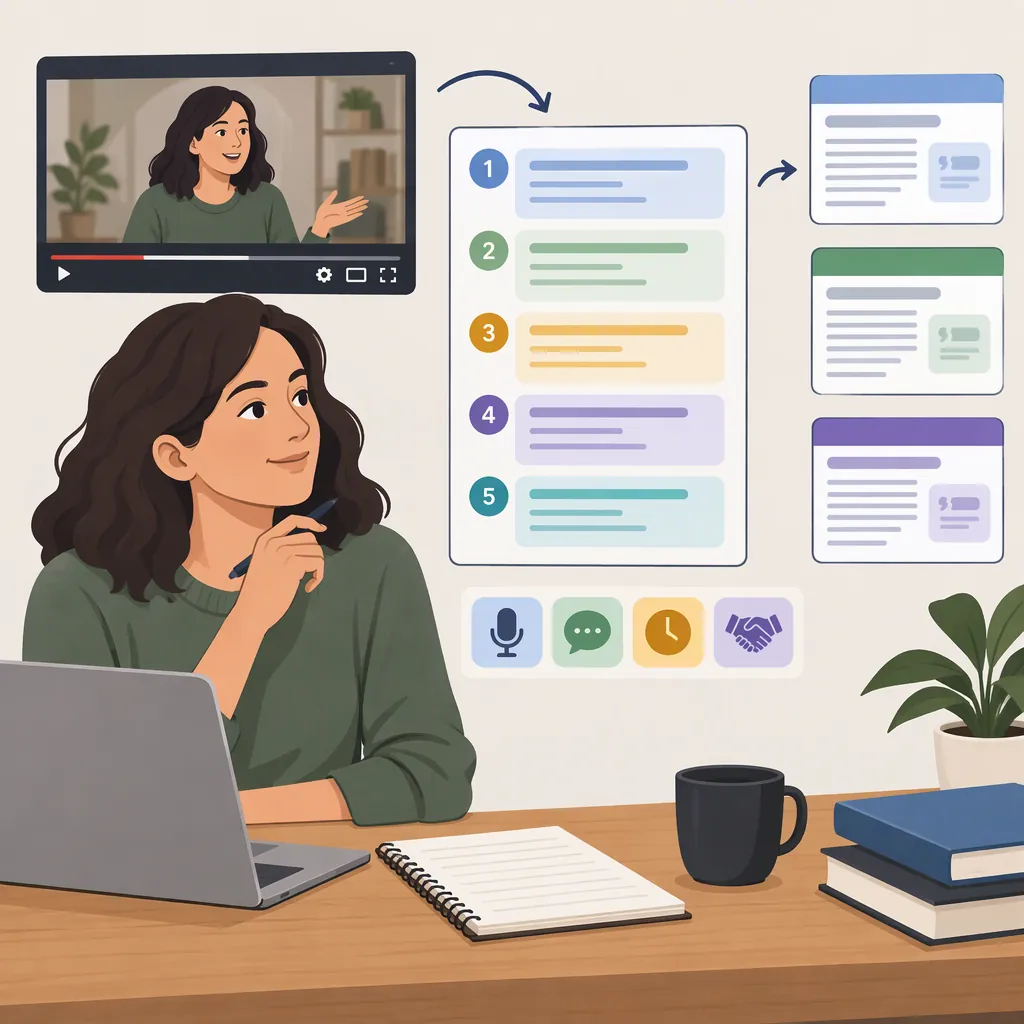
Use four parts as a drafting framework:
- Sponsorship statement: Identify the paid relationship directly rather than hiding it inside a transition.
- Topic connection: Explain why this segment belongs in this particular video. Avoid implying that every viewer needs the product.
- Verified explanation: Include only facts you can support. Separate product information from personal opinion or experience.
- Return to the video: End with a specific bridge to the next topic, demonstration, or chapter.
ThoughtLeaders advises brands to supply specific talking points while allowing creators to adapt the wording to their tone and style. That supports treating a brief as input for a script rather than automatically reading it verbatim. [source_1]
The sponsorship statement suggested here is an editorial starting point. The provided sources do not establish current legal disclosure requirements or YouTube’s platform requirements.
Four-Part Drafting Worksheet
Sponsorship statement: {Identify the sponsor and the actual relationship.}
Topic connection: {Explain the connection to this video's subject.}
Verified explanation: {Add one or two supported points, with evidence recorded separately.}
Return: {Name the next part of the video.}
Unresolved items: {List anything that must be confirmed before recording.}
Use Neutral, Fill-In Script Templates
These are original drafting examples, not transcripts or evidence of an actual sponsorship. Replace every placeholder before recording. Use the paid-sponsorship wording only when it accurately describes the relationship.
Keep the explanation factual rather than turning a placeholder into an unsupported promise. If a point cannot be verified, leave it out. These examples deliberately omit purchase prompts, discounts, and promotional claims.
Short Sponsor Segment
This video includes a paid sponsorship from {Sponsor}. This segment relates to today's topic because {specific, accurate connection}. {Sponsor or product} is {verified description}. For this segment, the relevant detail is {supported fact and any necessary qualification}. Now, back to {next topic}.
Sponsor Segment with a Demonstration
This section is a paid sponsorship from {Sponsor}. Before returning to {main topic}, I'll show {specific task or feature actually demonstrated}. In this recording, you can see {observable action or result}. This example covers {scope of demonstration}; it does not establish {broader outcome not tested}. Next, we'll continue with {next section}.
Adapt the Transition to the Placement
ThoughtLeaders describes sponsorships at the beginning, middle, or end of a video, as well as dedicated sponsored videos. [source_1] Use those categories to plan the surrounding narration, not to assume a universal script length.
- Beginning: Identify the sponsor without making the opening difficult to follow.
- Middle: Connect the segment to the topic immediately before it, then name where the main video resumes.
- End: Close the sponsor segment without promising another chapter that does not exist.
- Dedicated video: Make the sponsorship context clear and distinguish demonstrations, verified facts, and opinions throughout the outline.
As an editing exercise, read the draft aloud against the intended footage. Shorten repeated explanations before removing qualifications needed to understand a claim. The supplied sources do not establish an ideal word count or duration.
Transition Planner
Placement: {Beginning / middle / end / dedicated video}
Topic immediately before the segment: {Topic or not applicable}
Connection to sponsor segment: {One factual sentence}
Visuals needed: {List actual footage or demonstrations}
Topic immediately after the segment: {Topic or closing}
Repeated wording to remove: {List repetitions}
Check Every Claim Before Recording
Create a claim ledger alongside the script. This is a suggested editorial safeguard, not a process mandated by the references.
For each factual sentence, record its supporting material, applicable conditions, and verification status. Keep unresolved claims out of the recording draft. Brand approval alone should not be treated as a substitute for supporting evidence.
Pay particular attention to:
- Personal experience: Do not write that you used, bought, or benefited from something unless that is true.
- Comparisons: Remove unsupported language such as “best,” “only,” or “better than.”
- Numbers: Confirm what the number measures and whether it still applies.
- Demonstrations: Describe what the footage actually shows, not an untested general result.
- Relationship wording: Make sure the sponsorship statement matches the arrangement.
The darkSpyro forum thread contains user-posted sponsor-style scripts with personal-use assertions, product claims, numerical claims, and promotional offers. It is evidence that those examples were posted, not independent verification of their contents. Do not reuse those claims as facts. [source_2]
Claim Ledger
| Draft sentence | Claim type | Supporting material | Conditions or limits | Status |
| --- | --- | --- | --- | --- |
| {Exact sentence} | {Product fact / experience / comparison / number} | {Evidence location} | {Relevant qualifications} | {Verified / revise / remove} |
Review the Script and Its Limitations
Before recording, review the script as spoken language rather than as a document. Look for unclear references, abrupt transitions, and sentences that combine several unrelated claims.
Use the checklist below to separate a readable draft from a fully reviewed publication. Neither provided reference is an authoritative legal or platform-policy source. This article therefore does not certify disclosure compliance, prescribe required wording, or promise sponsorship results.
ThoughtLeaders is useful here for its discussion of alignment and placement. The forum is useful only as an example of why circulating scripts need scrutiny. Neither source establishes that copying a particular script will improve performance. [source_1] [source_2]
Pre-Recording Review Checklist
- The sponsorship statement accurately describes the relationship.
- All placeholders have been replaced or removed.
- Each factual claim has supporting material.
- No personal experience has been invented.
- Important qualifications remain in the spoken copy.
- The demonstration matches the narration.
- The transition matches the video's actual sequence.
- Any necessary legal and platform-policy review has been handled separately.
- Unresolved items are marked for revision, not treated as approved.
FAQ
How Long Should a YouTube Sponsor Script Be?
The provided sources do not establish an ideal duration or word count. As a drafting approach, use the agreed segment length and necessary information, then read the script aloud to check pacing. Preserve important qualifications when shortening it.
Can I Copy a Sponsor Script Posted Online?
Use posted scripts for structural analysis rather than importing their claims. The darkSpyro thread includes personal-use assertions, numbers, and offers that the thread itself does not independently verify. Write original wording and verify each factual statement separately. [source_2]
How Can a Sponsor Segment Sound Natural?
Connect it to the video's subject and use the creator's normal speaking style without obscuring the sponsorship. ThoughtLeaders recommends alignment with the creator's content and allowing creators to adapt supplied talking points to their tone. That is guidance about fit, not a guarantee of audience response. [source_1]