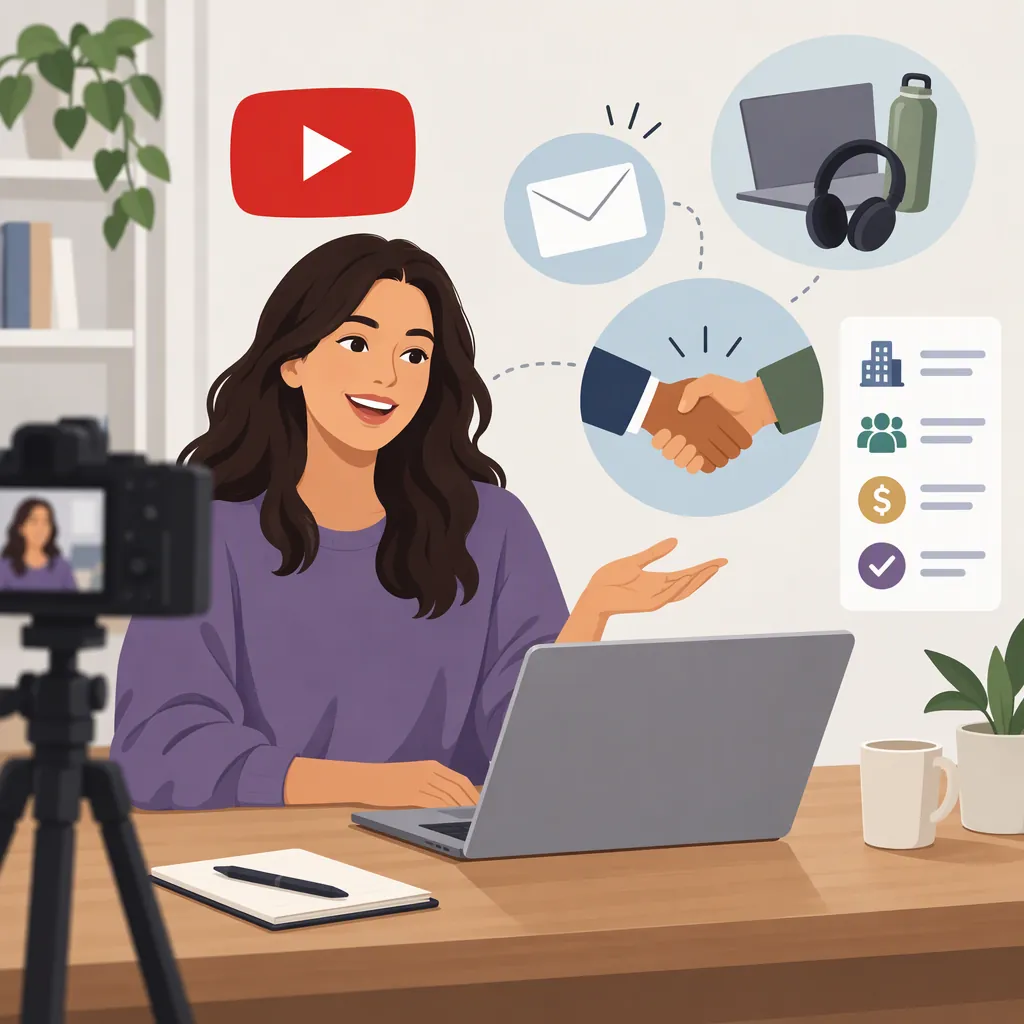
How to Get Sponsored on YouTube and Evaluate Brand Deals
To get sponsored on YouTube, define your audience, prepare a media kit with current channel data, and identify brands whose products fit your content. Look for opportunities through direct outreach, inbound inquiries, marketplaces, and agencies. Evaluate the compensation, workload, usage rights, and disclosure requirements before accepting. These are discovery routes, not guarantees of a deal. [src_1] [src_2]
Prepare Evidence of Your Channel’s Fit
Start with what a potential partner can actually assess: your content topic, audience, recent performance, and production style. Uscreen’s guide recommends understanding your niche and channel metrics, then assembling a media kit that summarizes your channel and audience. [src_2]
For a practical, evidence-led kit, include:
- A short description of your channel and the viewer needs it addresses.
- Representative videos that show your usual format and production quality.
- Recent views and engagement, with the measurement period clearly labeled.
- Audience information available in your analytics, without guessing missing demographics.
- Formats you can realistically produce and a business contact method.
Separate measured facts from interpretation. For example, comments asking about equipment may suggest interest in a topic; they do not prove that viewers will buy a sponsor’s product. Avoid presenting your best-performing upload as your typical result.
One-Page Media Kit Outline
Channel name and URL: [Insert]
Core topic: [Insert]
Viewer need addressed: [Insert]
Representative videos: [Insert URLs]
Analytics period: [Start date–end date]
Recent performance: [Insert verified metrics and definitions]
Audience information: [Insert available analytics; mark unknowns]
Available content formats: [Insert]
Production constraints: [Insert]
Business contact: [Insert]
Find Opportunities Through Multiple Routes
The supplied sponsorship guide describes four discovery routes: inbound brand inquiries, marketplaces, agencies, and creator-led outbound outreach. [src_1] Treat them as alternatives to investigate rather than a required sequence.
| Route | Practical Starting Point | What to Verify |
|---|---|---|
| Direct outreach | Research brands relevant to your planned videos. | The contact’s role and whether the brand is considering creator partnerships. |
| Inbound inquiries | Make a business contact method available on your channel. | The sender’s identity and the actual campaign terms. |
| Marketplaces | Review publicly available eligibility and participation information. | Current access rules, fees, and who handles the agreement. |
| Agencies | Identify organizations working in your content category. | Who they represent, their authority, and any commission obligations. |
Uscreen also recommends examining brands’ content and the creators they sponsor before personalizing outreach. [src_2] A public sponsorship mention is a research lead—not proof that the brand has an open campaign, an available budget, or interest in your channel.
Build a Shortlist Based on Audience Fit
Do not rank prospects solely by how often their names appear in sponsored videos. Uscreen recommends choosing brands that align with both the creator’s content and the audience’s needs. [src_2]
Use the following questions as an editorial screening framework, not a prediction of sponsorship success:
- Audience relevance: Does the product address a need connected to your content?
- Content compatibility: Can you discuss it naturally without distorting the video’s purpose?
- Recommendation integrity: Can you assess it honestly and avoid unsupported claims?
- Practical fit: Can you meet the likely production demands without disrupting your schedule?
- Evidence quality: Is your lead based on an identifiable public example, or only an assumption?
Keep uncertain prospects marked as uncertain. A strong audience match does not establish that a brand is currently hiring creators.
Sponsor Research Worksheet
Brand: [Insert]
Public evidence URL and date observed: [Insert]
What the evidence establishes: [Insert]
What remains unknown: [Insert]
Audience need the product may address: [Insert]
Possible video context: [Insert]
Product assessment needed: [Insert]
Verified public contact route: [Insert or mark unknown]
Potential conflicts or concerns: [Insert]
Decision: [Research further / Consider outreach / Exclude]
Reason for decision: [Insert]
Make Outreach Specific and Verifiable
Uscreen’s guide recommends personalized outreach supported by a media kit. [src_2] A useful approach is to explain the connection between the brand, a real audience need, and a feasible video concept.
Before sending a message, prepare these elements:
- Relevance: Why this brand belongs in your content, beyond its advertising budget.
- Concept: The topic, format, and proposed role of the product.
- Evidence: Dated channel metrics and representative work.
- Boundaries: Claims you cannot make, production constraints, and any existing conflicts.
Keep proposals conditional. Do not imply that a brand has approved the concept, promise sales you cannot substantiate, or claim product experience you do not have. If a contact route is uncertain, verify it before sharing sensitive documents or account information.
Evaluate the Offer Before Agreeing
An opportunity is not necessarily a cash-paid sponsorship. The supplied guide describes compensation arrangements including flat fees, view-based payments, affiliate commissions, product seeding, and hybrid models. [src_1] Ask what is guaranteed and what depends on results.
Review the offer as a complete package:
- Deliverables: Format, placement, publication date, and how long the content must remain available.
- Workload: Research, production, approval rounds, revisions, and reporting.
- Payment: Amount, trigger, due date, and any conditions or deductions.
- Performance terms: Attribution rules, measurement window, guarantees, and remedies.
- Usage rights: Where the brand may reuse your content, for how long, and whether paid advertising is included.
- Exclusivity: Which competitors or categories are restricted and for what period.
- Cancellation: What happens if production is canceled or the brief changes.
These topics appear in the guide’s contract checklist. [src_1] As a decision aid, compare guaranteed compensation against your estimated workload and costs separately from possible performance-based earnings. Resolve unclear obligations in writing; seek qualified legal advice for terms you do not understand.
Plan Disclosure and Recognize Source Limits
Plan disclosure before filming, rather than treating it as an upload-time detail. The supplied guide discusses clear sponsorship disclosures, affiliate disclosures, and YouTube’s paid-promotion setting. It also notes that noncash compensation can create disclosure obligations. [src_1]
Do not assume a platform setting alone satisfies every applicable requirement. Confirm the current platform policy and rules relevant to your situation before publication, especially for gifted products or affiliate arrangements.
Evidence limits: This article draws on commercial educational guides, not directly supplied regulator guidance or official YouTube documentation. Uscreen’s article was last updated in 2023; the OutlierKit guide is dated 2026. Their platform eligibility descriptions and market estimates are not treated here as verified current requirements or guaranteed outcomes. No universal subscriber threshold, sponsorship rate, or acceptance probability is established by this article.
FAQ
How Many Subscribers Do You Need to Get Sponsored?
This article does not establish a universal minimum. The supplied guides discuss opportunities for smaller channels, but a particular marketplace or campaign may have its own criteria. Present verified audience and performance evidence, and check each opportunity’s current requirements. [src_1] [src_2]
Can You Find YouTube Sponsors Without a Marketplace?
Yes. The supplied sponsorship guide also describes direct outreach, inbound inquiries, and agency-mediated opportunities. A practical starting point is researching relevant brands and public sponsorship examples, then verifying the contact route and current interest. [src_1]
Is a Free Product the Same as a Paid Brand Deal?
Not in terms of guaranteed cash compensation. The guide distinguishes product seeding from cash and commission-based arrangements. Clarify whether posting is required, what rights the brand receives, and what disclosure applies before accepting. [src_1]
What Should You Check Before Accepting a Sponsorship?
Check deliverables, approval rounds, payment conditions, usage rights, exclusivity, performance obligations, cancellation terms, and disclosure. A quoted fee is only one part of the agreement; compare it with the workload and restrictions you would accept. [src_1]