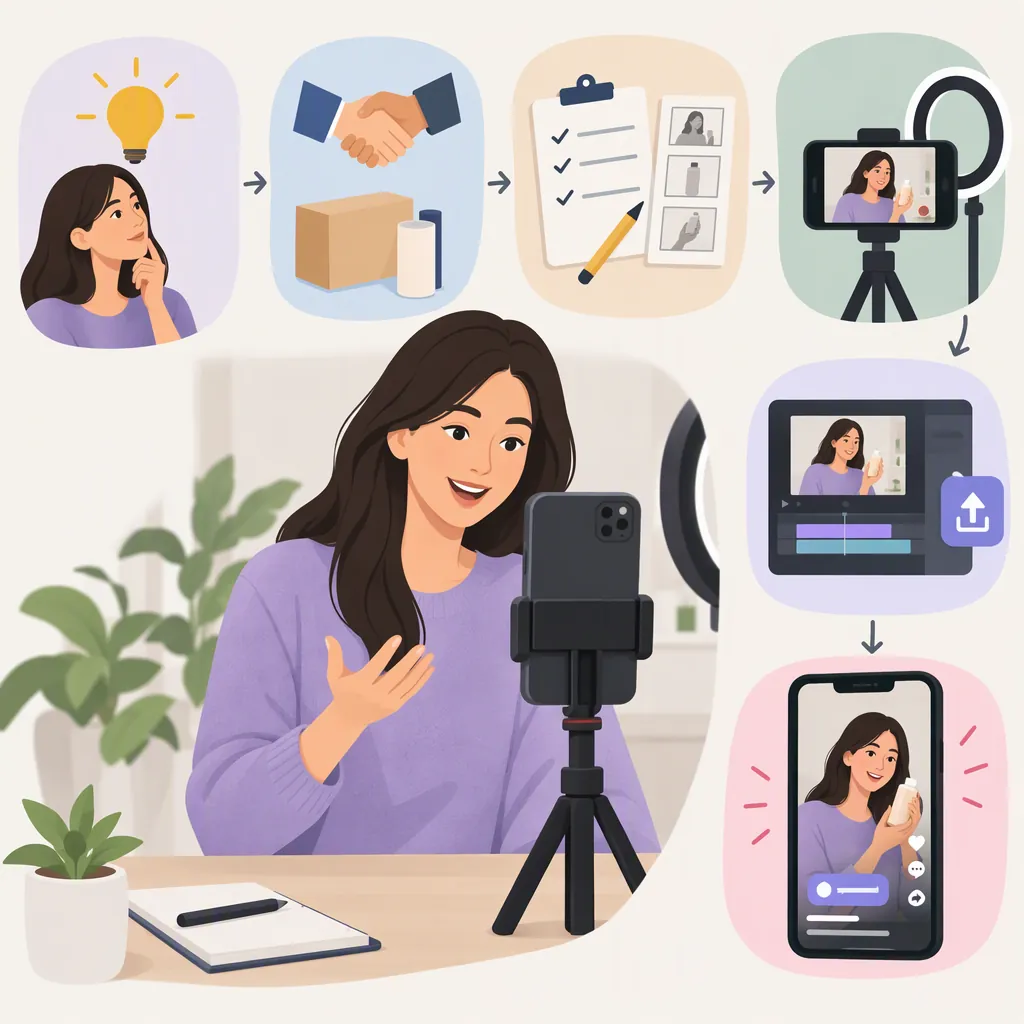
How to Make a Sponsored Video on TikTok: Find and Evaluate Brand Deals
To make a sponsored video on TikTok, find a brand that fits your content, agree in writing on payment, deliverables and usage rights, then film an honest video around an approved brief. Clearly disclose the sponsorship, check TikTok’s current disclosure requirements before publishing, and share the agreed performance data afterward. Linktree’s guide outlines this workflow, but it is not an authoritative source for current platform rules or U.S. disclosure law.
Understand What Kind of Deal You Are Making
A sponsored TikTok video is content made under a paid partnership between a creator and a brand. Linktree distinguishes this from affiliate promotion, where compensation depends on sales rather than simply producing a sponsored post. [c2]
Before discussing a concept, clarify which arrangement is proposed:
- Creator-posted sponsorship: You create and publish a video on your own account.
- Content production only: You deliver a video file for the brand to use; publishing on your account is not included unless agreed.
- Affiliate arrangement: Compensation depends on tracked purchases or another agreed action.
- A combined deal: A production fee, a creator post, affiliate compensation and advertising permissions may be negotiated separately.
Treat these as a checklist for defining the work, not interchangeable labels. Ask exactly what you must deliver and how you will be paid.
Buying ad placement is also a separate task. TikTok’s business site describes an Ads Manager workflow covering campaign objectives, audiences, budgets and video selection. That workflow does not itself explain how to negotiate a creator sponsorship. [c1]
Find Brands That Fit Your Content
Start with audience relevance rather than a long list of unrelated sponsors. Linktree recommends choosing a clear niche, preparing a media kit and researching brands already sponsoring creators through posts tagged #ad. It also recommends specific pitches rather than generic messages. [c2]
Use sponsored posts as research leads, not evidence that a brand is currently accepting applications. For each potential partner, record:
- The product or service and why it belongs in your content.
- A recent public example of a creator partnership, if available.
- A contact route found through the brand’s official channels.
- One video concept that would be useful to your viewers.
- Any concerns about the product, required claims or proposed terms.
Prepare a compact portfolio with relevant videos and accurately labeled account analytics. Clearly identify unpaid samples; do not present them as previous sponsorships. If audience demographic data is unavailable, say so rather than estimating it.
TikTok’s business site lists TikTok One among its creative tools, but the supplied page does not establish creator eligibility or an application process. Verify current availability separately rather than relying on a universal follower threshold. [c1]
Brand Research Worksheet
Brand: [name]
Official contact source: [source]
Audience fit: [specific reason]
Public partnership example: [URL or unavailable]
Proposed video idea: [concept]
Relevant portfolio example: [your video]
Compensation model to clarify: [fee, commission, product or combination]
Open concerns: [claims, rights, timing or suitability]
Status: [researching, contacted, reviewing or declined]
Evaluate the Offer Before Agreeing
Linktree recommends confirming deliverables, posting timelines, key messages, hashtags and usage rights in writing before filming. It also advises asking about the campaign budget and expected work. [c2]
Use a written deal summary to identify missing terms:
| Topic | What to Clarify |
|---|---|
| Deliverables | Number of videos, approximate length, captions, stills and raw files |
| Publishing | Who posts, on which account and by what date |
| Compensation | Fee, commission terms, expenses and payment timing |
| Approval | Who reviews the video, review deadlines and included revisions |
| Usage rights | Where the brand may reuse the video, for how long and whether paid advertising is included |
| Exclusivity | Which competing brands or categories are restricted and for how long |
| Claims | What supporting evidence is available for requested product statements |
| Cancellation | What happens if the project stops after work begins |
| Reporting | Which metrics are required and when they will be collected |
For your own pricing decision, assess the full workload and requested rights rather than follower count alone. No rate table can determine whether a particular offer is suitable for you.
As a precaution, verify an unexpected offer through a contact route independently found on the brand’s official channels. Do not share account passwords or verification codes to secure a collaboration.
Deal Clarification Message
Before I confirm, please clarify the deliverables, publishing account, campaign dates, compensation and payment schedule. Please also specify the approval process, included revisions, requested usage rights, any paid advertising permissions, exclusivity, cancellation terms and reporting requirements. For required product claims, please provide supporting evidence for review.
Turn the Brief into an Honest Video
Linktree recommends integrating the product into the creator’s usual content style rather than switching to a corporate tone. [c2] Use that as a creative principle, not a guarantee of performance.
A practical production sequence is:
- Choose one useful idea. Define the question or task the video will address.
- Separate facts from opinions. Identify which statements need evidence and which reflect your actual experience.
- Draft the opening and demonstration. Show the relevant product function without implying results you cannot support.
- Plan the disclosure. Include it in the production plan, not just as a last-minute caption addition.
- Review permissions. Confirm that music, images and other material are appropriate for the agreed commercial use.
- Submit the agreed draft. Keep a record of approved wording and requested changes.
If you have not used the product, do not script a personal testimonial. If the brand requests a claim you cannot verify, ask for a supported alternative or remove it.
Sponsored Video Planning Template
Audience question: [one question]
Video concept: [short description]
Opening: [relevant setup]
Sponsorship disclosure: [clear wording and placement to verify]
Demonstration: [what viewers will actually see]
Supported product facts: [facts and evidence]
Personal observations: [only genuine observations]
Limitations: [what the video cannot establish]
Closing: [neutral summary]
Approval deadline: [date]
Publishing date: [date]
Check Disclosure Before Publishing
Linktree advises using TikTok’s branded-content disclosure control and a clear caption disclosure such as #ad or #sponsored. It also says disclosures should be visible rather than buried in a long caption. [c2]
Source limitation: The provided references do not include TikTok’s detailed disclosure policy or an official U.S. regulatory guide. A hashtag or platform label alone should not be treated here as a guarantee of compliance. Verify the current platform requirements and applicable rules for your arrangement before publishing.
For a pre-publication review, check that:
- Viewers can readily understand the commercial relationship.
- The disclosure is easy to notice in the video and caption.
- Product claims match the evidence and approved brief.
- The final video uses only the permissions you have confirmed.
- Any request for advertising access matches the written agreement.
- The approved caption, account and posting date are correct.
Report Results Without Overclaiming
Linktree recommends sharing post-publication performance data such as views, likes, comments and shares with the brand. [c2]
Follow the reporting schedule in your agreement. Record the post URL, publication date, measurement date and metrics available from your account. Label screenshots and distinguish organic results from paid results when that information is available.
Do not equate views or engagement with sales. If conversion tracking was not agreed or is inaccessible, state that limitation. Report what you can observe rather than claiming the video caused purchases.
Close the project by documenting delivered work, approved changes, the report sent and payment status. For your own evaluation, note whether the brand fit your audience and whether the compensation covered the time and rights involved.
FAQ
How Many Followers Do You Need for a TikTok Sponsorship?
The supplied sources do not establish a universal minimum for direct brand deals. Linktree describes sponsorships across different creator sizes and emphasizes engagement and niche fit. Do not confuse a brand’s selection criteria with eligibility rules for a particular TikTok program.
Do You Need Ads Manager to Make a Sponsored TikTok Video?
A creator sponsorship and an advertising campaign are different arrangements. TikTok’s business page describes Ads Manager for creating and managing ad campaigns. For a sponsored creator post, clarify separately whether the brand also wants paid advertising use; do not assume that permission is included.
Can You Pitch a Brand Without Previous Sponsored Videos?
Linktree recommends including relevant unpaid content in a media kit. You can use clearly labeled samples to demonstrate a concept or filming style without implying an existing brand relationship. Never invent campaign results or describe an unpaid sample as a paid partnership.
Is #Ad Enough to Disclose a Sponsored TikTok Video?
Do not assume it is sufficient by itself. Linktree recommends a clear caption disclosure alongside TikTok’s branded-content control, but the provided sources do not establish the complete current platform or U.S. legal requirements. Verify those requirements and make the commercial relationship easy for viewers to understand.