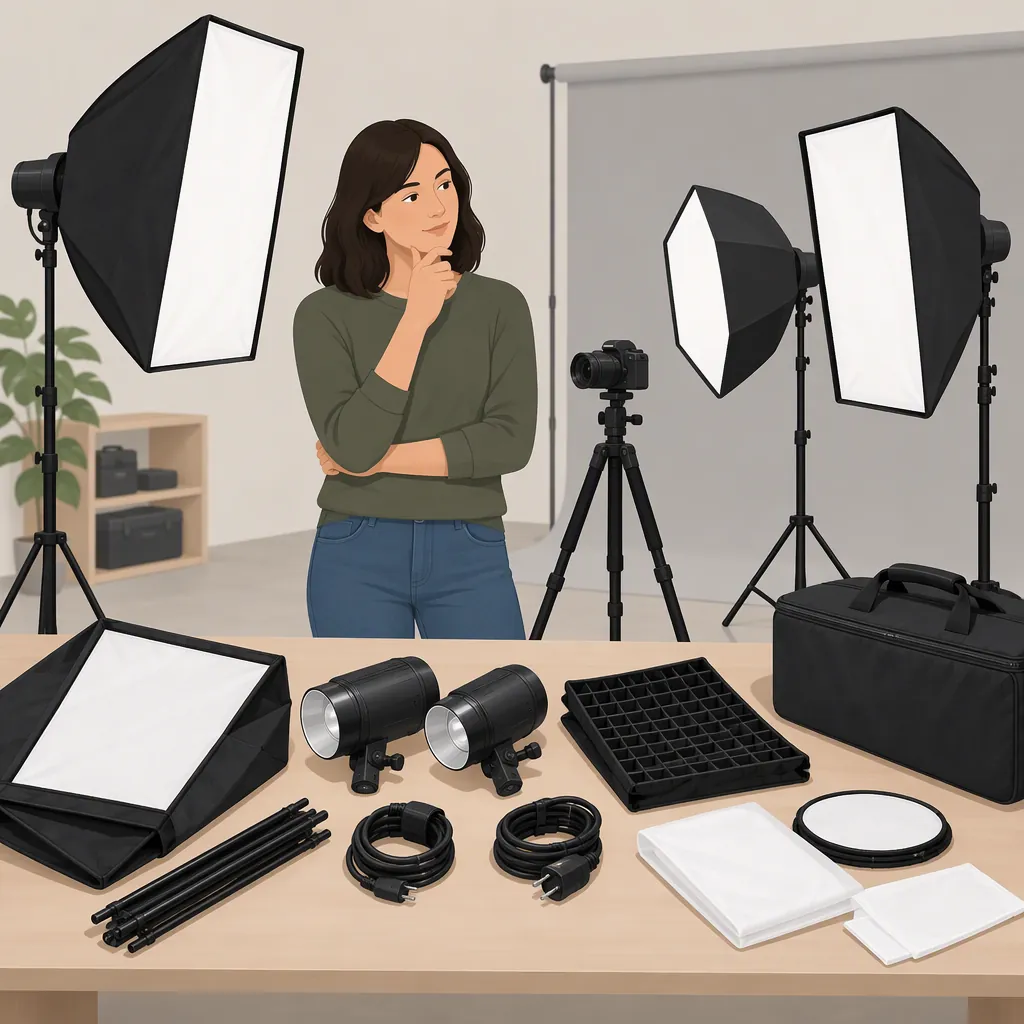
How to Choose the Best Softbox Lighting Kit for Photography
The best softbox lighting kit for photography is the one that fits your subject, intended lighting effect, and working space—not simply the kit with the largest softbox or the most accessories. Check the light type, modifier size, diffusion options, mount compatibility, and complete package contents before deciding.
This guide provides a selection method rather than a product ranking. Two Loves Studio’s product-photography tutorial offers a useful example of softboxes used as key and fill lights with additional diffusion, but it is not a comparative kit test. The article also discloses possible affiliate links. [softbox-guide]
Understand What Makes Light Soft
Soft light produces gradual transitions at shadow edges. A key relationship is the apparent size of the illuminated light source relative to the subject:
- A source that appears larger from the subject’s position generally produces softer shadow edges.
- A source that appears smaller generally produces harder shadow edges.
- Moving the same softbox closer makes it appear larger; moving it farther away makes it appear smaller.
This means softbox dimensions alone do not determine the result. Consider the modifier’s size, its distance from the subject, and how much of its diffusion surface is illuminated.
Soft light is not the same as even illumination. A setup can produce soft shadow edges while still lighting one side of a subject more brightly than another. Judge shadow softness and brightness distribution separately.
Diffusion is another part of the setup, not a complete quality score. Two Loves Studio discusses two diffusion layers for reducing harsh shadows and demonstrates additional diffusion for product photography. That example does not establish that more layers always produce a better result or that every kit includes them. [softbox-guide]
Choose Softbox Size Around the Subject and Space
The tutorial’s author recommends the biggest softbox you can comfortably work with in your space. Keep that framed as the author’s practical recommendation, not a universal rule to buy the largest available modifier. [softbox-guide]
Start with your intended composition. A setup for a small tabletop subject and one for a full-length portrait have different coverage and positioning needs. Ask whether the softbox can provide the shadow quality you want at a workable distance without entering the frame or obstructing movement.
Workspace Fit Checklist
- Measure the available shooting area.
- Mark the subject, camera, background, and intended light positions.
- Check the softbox’s assembled dimensions and depth.
- Include the stand’s footprint and adjustment range.
- Allow room to position the modifier closer to or farther from the subject.
- Check whether the setup blocks the camera or access to the subject.
- Record packed dimensions if storage or transport matters.
- Mark missing measurements as unresolved rather than assuming the kit will fit.
A larger modifier that cannot occupy the needed position may be less useful than a smaller one that you can place effectively.
Match the Light Type to Your Photography
A softbox is a modifier; the light inside or behind it is a separate selection decision. Verify whether a package includes a continuous light, a flash, or no light at all.
Use your requirements to narrow the choice:
| Your requirement | What to evaluate |
|---|---|
| Static subjects and a preference for seeing the lighting before capture | Whether a continuous-light setup provides sufficient exposure at your intended aperture, shutter speed, and ISO |
| Moving subjects | Whether continuous light permits the needed shutter speed, or whether a flash offers suitable flash duration and synchronization for the intended setup |
| A preview of light placement | Continuous illumination, or a flash’s modeling light if provided; confirm its capabilities rather than assuming it duplicates the final flash exposure |
| Shooting away from outlets | Battery compatibility, included batteries and chargers, and documented operating limits |
| Limited storage or frequent transport | Packed dimensions, total equipment weight, assembly requirements, and case contents |
Neither continuous light nor flash is automatically the best choice. For movement, light type alone is not enough: the usable settings and the particular light’s capabilities matter.
Write down your nonnegotiable requirements before comparing packages. That prevents an attractive accessory count from outweighing a missing essential component.
Check Diffusion and Test the Result
Confirm whether the exact package includes an inner diffuser, a front diffusion panel, or both. Do not infer contents from the word “softbox.” The reference discusses double diffusion, but does not verify every kit’s construction or accessories. [softbox-guide]
When you can evaluate a setup, compare only diffusion configurations permitted by the equipment instructions.
A Controlled Comparison
- Fix the setup. Keep the subject, camera, light position, light output, ambient light, and camera settings unchanged.
- Change one variable. Switch only the permitted diffusion configuration.
- Record brightness changes first. Note whether the image becomes darker or brighter before judging softness.
- Compare at similar image brightness. For a second comparison, adjust exposure without moving the light or changing its output. Record the adjustment.
- Inspect separate qualities. Compare shadow edges, brightness across the subject, visible reflections, and retained detail.
Do not treat a darker image as evidence of improved softness. Likewise, a softer shadow edge does not necessarily mean that illumination is even or that reflections suit the photograph.
Verify the Complete Kit
Evaluate the modifier and the package separately. These are verification questions, not claims about any particular product:
- Light: What exact light is included, if any?
- Compatibility: Does the softbox mount match the light? Is an adapter required and included?
- Diffusion: Which panels are explicitly listed?
- Support: Are the stand and attachment hardware included? Do their stated limits accommodate the intended equipment?
- Power: Which cables, power supplies, batteries, or chargers are required?
- Flash operation: If applicable, what triggering equipment and camera compatibility are needed?
- Assembly: Are instructions available for the exact combination?
- Storage: Are packed dimensions and a carrying case specified?
Treat missing information as unknown. A product photo is not confirmation of package contents, and a similar-looking mount is not proof of compatibility.
Candidate Comparison Worksheet
| Field | Record for each candidate |
|---|---|
| Intended use | Subject, composition, and desired shadow quality |
| Must-have conditions | Workspace fit, light type, compatibility, power, and essential accessories |
| Acceptable trade-offs | For example, longer assembly time or separately supplied storage |
| Softbox dimensions | Assembled size, depth, and packed size |
| Diffusion | Explicitly included panels and permitted configurations |
| Light and operation | Exact light, operating type, and relevant documented capabilities |
| Support and power | Included hardware and required operating accessories |
| Unresolved questions | Any missing information that could change the decision |
| Evaluation result | Shadow edges, brightness distribution, reflections, and exposure requirements |
Use these decision rules:
- Suitable: All must-have conditions are confirmed, and any known compromises fall within your acceptable trade-offs.
- Unsuitable: A confirmed characteristic conflicts with a must-have condition.
- Insufficient information: An unresolved question prevents you from confirming an essential requirement.
This produces a defensible shortlist without implying that one kit is best for every photographer.
FAQ
What Is the Best Softbox Lighting Kit for Photography?
Choose a kit that meets your subject, workspace, light-type, compatibility, and accessory requirements, then evaluate whether it produces the intended shadows and reflections. The referenced tutorial demonstrates a product-photography setup rather than establishing a best-performing kit. [softbox-guide]
Should I Choose the Largest Softbox Available?
Not automatically. Consider its apparent size at the intended working distance and whether the complete setup fits. The reference author recommends the biggest softbox that can be used comfortably in the available space, not the largest modifier regardless of circumstances. [softbox-guide]
Does Every Softbox Include Two Diffusion Layers?
Do not assume so. Confirm the inner diffuser and front panel in the exact package listing. The reference discusses two-layer diffusion, but does not establish the contents of every kit. [softbox-guide]
Does Adding Diffusion Guarantee Better Lighting?
No. The reference presents double diffusion as part of a soft product-lighting setup, not as a universal quality ranking. Evaluate shadow edges, exposure, brightness distribution, and reflections separately to decide whether a configuration suits your photograph. [softbox-guide]
Sources
- [softbox-guide] Softboxes For Product Photography: What You Need to Know.