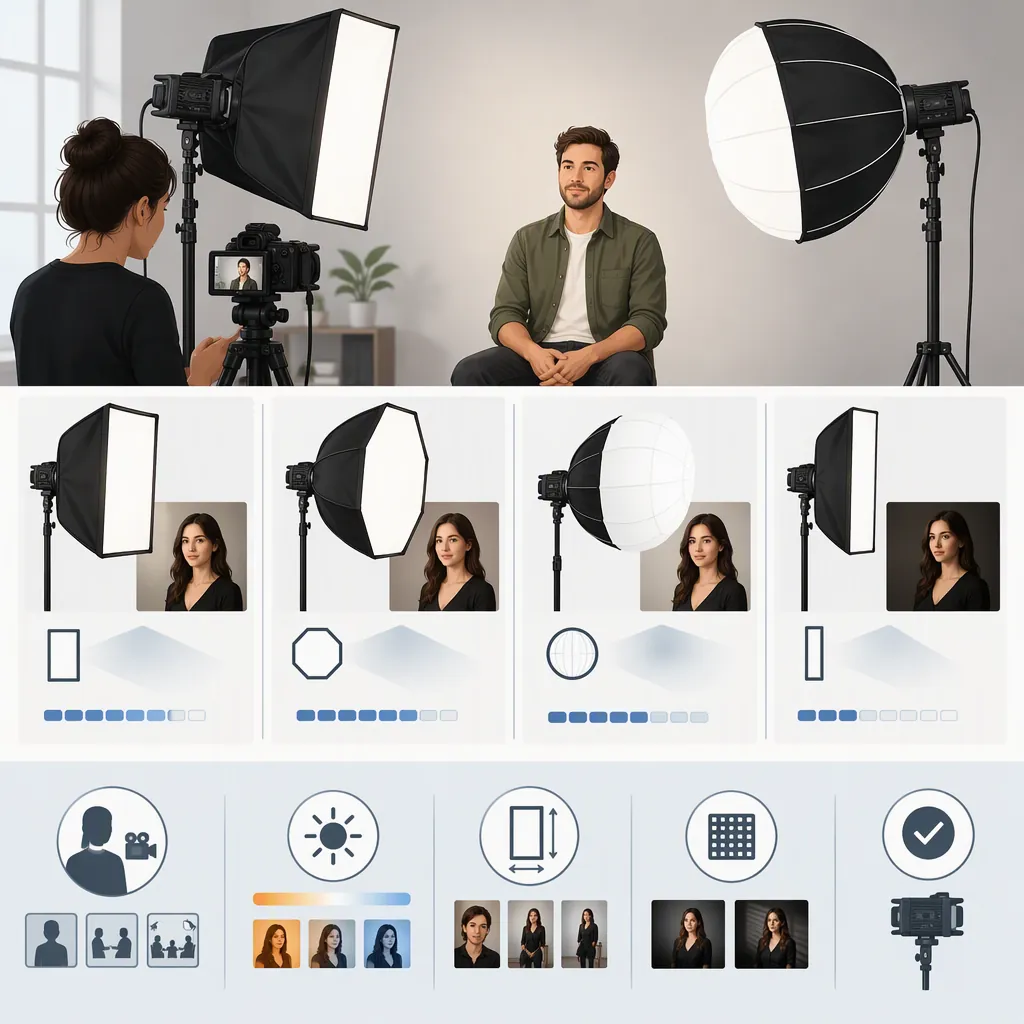
How to Choose a GVM Softbox for Video Lighting
Choose a GVM softbox by identifying your exact light model and its attachment system first, then assessing size, shape, and placement for your shot. The supplied sources describe both a Bowens-mount light kit and a model-specific panel softbox, so the GVM name alone is not enough to establish compatibility. Treat retailer specifications as listed information, not independent performance testing. [c1] [c2]
Check the Light Model Before the Softbox Shape
Start with the model label on your light rather than a search for “GVM softbox.” The supplied Amazon listing identifies its light as the SD80D and describes a Bowens mount. Separately, Mojo Cameras lists a softbox specifically for 680RS, 880RS, and 1000D LED panels, with no speed ring required. These descriptions point to different attachment arrangements; they do not establish that the accessories are interchangeable. [c1] [c2]
GVM’s general softbox guide makes a broad statement that all GVM softboxes use Bowens mounts. That statement should not replace model-specific verification, particularly given the separate panel-accessory listing. The provided material does not resolve attachment details for every GVM light or softbox. [c2] [c3]
Before selecting an accessory, record the light model, the softbox model, the stated mount, and any required adapter. Leave compatibility marked unconfirmed if the available documentation does not explicitly establish the pairing.
Compatibility Record
- Light model: Record the exact model label.
- Softbox model: Record the exact accessory name.
- Attachment: Record the stated mount or panel attachment.
- Adapter: Record any explicitly required adapter.
- Evidence: Record where the specific pairing is documented.
- Status: Mark confirmed or unconfirmed; do not infer fit from the brand name.
Choose Size and Shape Around the Shot
A softbox modifies light through a reflective interior and diffusion layers. GVM’s guide explains that size and distance affect softness: a larger source, positioned closer to the subject, generally produces softer shadow transitions. This is a planning principle, not a guarantee that a particular modifier will produce a particular look in every room. [c3]
For selection, separate two questions:
- How much space is available? Measure the intended modifier position, including clearance from the camera frame, ceiling, and subject.
- Where should the light go? Decide whether you want a subject-focused source or broader illumination of the scene.
GVM’s guide describes rectangular modifiers as useful for window-like lighting and lanterns as broad-distribution sources. It also discusses octagonal and deep modifiers for portrait-oriented setups. Treat these as starting points for testing, not a ranking of shapes or proof that one is inherently better. [c3]
Do not compare size labels without checking what they measure. The Mojo Cameras panel-accessory listing gives three dimensions, while the Amazon kit listing gives a diameter-style size for its lantern. Those descriptions alone do not establish equivalent illuminated surface area or lighting results. [c1] [c2]
Shot Planning Worksheet
- Shot: Describe the framing and subject movement.
- Desired background: Choose brighter, darker, or unchanged as the target.
- Available space: Record clearance at the proposed light position.
- Candidate modifier: Record shape and documented dimensions.
- Test criteria: Note the shadow transitions, background spill, and reflections you want to evaluate.
Separate Kit Contents from Performance Claims
Distinguish a standalone modifier from a complete light kit. The supplied Amazon page describes a light, lantern softbox, stand, and reflector package. The Mojo Cameras page describes a panel softbox accessory. Neither description should be used to infer the contents of another listing with a similar name. [c1] [c2]
Check the exact package for diffusion cloth, an inner baffle, a grid, mounting hardware, and storage accessories. Do not assume that a general guide’s discussion of included grids applies to every kit.
For brightness comparisons, retain the measurement conditions. The Amazon listing’s illumination figure is stated with a standard reflector, not with the lantern attached. It therefore does not establish how much light will reach your subject through that softbox. The supplied references contain no independent side-by-side softbox output test. [c1]
Likewise, listed wattage, color specifications, and control features are not sufficient to predict the finished image. Keep the practical question focused: can the complete setup meet your intended exposure and appearance under your filming conditions?
Evaluate the Setup with a Controlled Test
GVM’s guide suggests placing a softbox to one side of the subject and slightly above eye level for interviews. It also discusses using a reflector or fill light to adjust contrast, and a compatible grid to limit spill. Use these suggestions as initial test positions rather than fixed rules. [c3]
Once compatibility and assembly are verified, compare short recordings with one variable changed at a time. Evaluate the actual shot instead of relying on shape names or promotional descriptions. For assembly and support requirements, follow the documentation for the exact equipment; the supplied general guide is not a complete safety manual.
Controlled Lighting Test
1. Verify attachment and assembly against the equipment documentation before powering the setup.
2. Set the intended framing and keep camera exposure and white balance fixed during each comparison.
3. Record a baseline clip with the documented diffusion configuration.
4. Change only the light position, then compare shadow transitions and reflections.
5. If a compatible grid is available, compare clips with and without it for background spill.
6. Record the chosen position, diffusion configuration, light setting, and camera settings for repeatability.
FAQ
Will Any GVM Softbox Fit Any GVM Light?
Do not assume universal fit. The supplied sources describe a Bowens-mount SD80D kit and a separate softbox named for 680RS, 880RS, and 1000D panels. Verify the specific light-and-accessory pairing rather than relying on the brand alone. [c1] [c2]
Is a Lantern the Best Choice for an Interview?
Not automatically. GVM’s guide describes lanterns as broad-distribution modifiers. Consider one when broader scene illumination is the goal; if keeping light off the background is important, evaluate a more subject-focused setup and compatible spill-control accessories. The references do not establish a single best shape for every interview. [c3]
Can the Listed Lux Figure Predict Brightness Through the Softbox?
Not from the supplied listing. Its illumination figure is specified with a standard reflector, not the lantern. Softbox-specific measurements or a controlled test would be needed to evaluate the modified setup at your intended subject position. [c1]