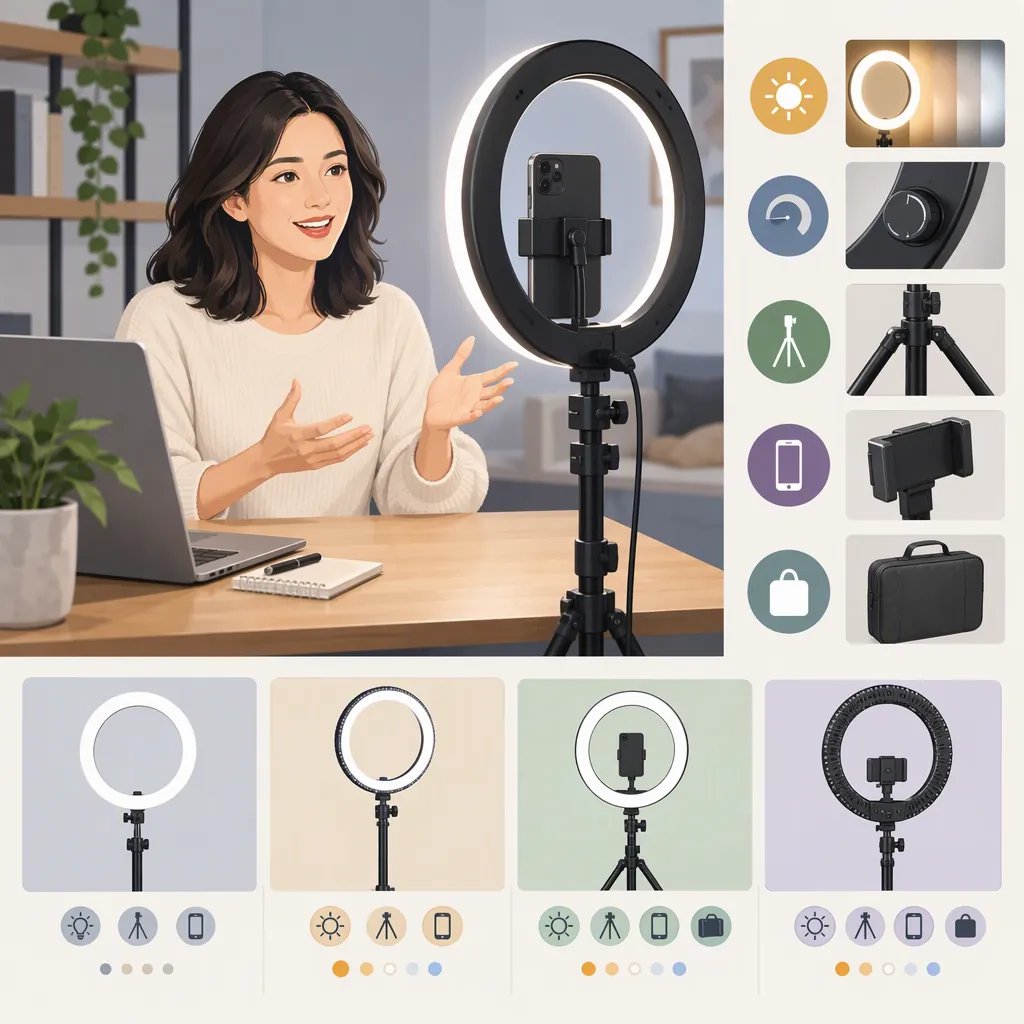
How to Choose a Ulanzi Ring Light for Filming
Choose a Ulanzi ring light by defining your shot first: the intended lighting style, phone or camera mounting, working distance, and recording duration. Ulanzi’s general guide distinguishes even close-up ring lighting from directional key lighting. [c1] Use those requirements to screen candidates, resolve missing information, and decide which setup to test—not to declare a best model.
This guide uses public manufacturer pages, not independent testing or hands-on experience. Model names identify candidates; they do not establish image quality, runtime, or compatibility with your setup.
Start with the Lighting Style
Before comparing models, decide what the light needs to do in the frame. Is the priority a clearly lit face for a close-up, or a deliberately directional look?
Ulanzi’s collection guide describes ring lights as providing even illumination with few shadows. It contrasts that approach with a key light whose direction can be changed for more dramatic effects. These are general lighting descriptions, not proof of a particular model’s results. [c1]
Use that distinction to describe the appearance you want rather than treating either lighting style as inherently more “professional.”
Shot Brief
Complete this brief before reviewing listings:
- Recording device and case:
- Subject and framing:
- Intended light-to-subject distance:
- Desired look: even frontal illumination or directional shadows
- Existing room light:
- Orientation: portrait or landscape
- Support: handheld or fixed
- Planned recording duration:
- Necessary conditions: requirements the setup must meet
- Preferences: features you could compromise on
Separating necessary conditions from preferences makes the later decision clearer. For example, a required mounting arrangement should be resolved before a preference about portability.
Identify the Exact Listing
Ulanzi’s supplied collection page lists the Ulanzi U200 Ring Light Video Rig 2245 and Ulanzi LM19 MagSafe LED Selfie Ring Light L049GBB1. [c1] Each has a separate product page. [c2] [c3]
For each candidate, record the exact model, selected package or variant, mounting arrangement, and included accessories. Do not assume that a collection label or photograph establishes what comes in every package.
Listing Verification Worksheet
The model identifiers below are supported by their respective product pages. [c2] [c3] The remaining cells are recording prompts, not findings about what those pages do or do not disclose.
| Item to record | Ulanzi U200 Ring Light Video Rig 2245 [c2] | Ulanzi LM19 MagSafe LED Selfie Ring Light L049GBB1 [c3] |
|---|---|---|
| Selected package or variant | To record | To record |
| Included mount or holder | To check | To check |
| Exact device and case compatibility | To check | To check |
| Required support accessories | To check | To check |
| Documented brightness and color-temperature controls | To record | To record |
| Power and charging requirements | To record | To record |
| Fit against necessary shot conditions | To assess | To assess |
| Unresolved questions | To record | To record |
After reviewing a listing, replace each prompt with a finding and its basis. Use distinct labels:
- Documented: the exact listing explicitly states the detail.
- Not found in the reviewed information: you looked, but did not locate it.
- Needs setup verification: documentation alone does not resolve the question for your device or scene.
A blank worksheet is unfinished work; a missing detail is an unresolved question. Neither means the candidate is incompatible.
Check Fit, Control, and Session Needs
Ulanzi’s general buying guidance identifies size, brightness adjustment, color-temperature adjustment, portability, and camera or smartphone compatibility as selection considerations. [c1]
Translate those categories into questions tied to your shot brief:
- Fit: Can the intended device, case, holder, and support be assembled in the required orientation?
- Control: What brightness and color-temperature adjustments does the exact listing document?
- Placement: Can the planned arrangement position the light where the shot requires it without obstructing the frame?
- Session needs: What power and charging information is documented? What remains uncertain for your recording duration?
- Transport: Which parts must be carried and assembled for the complete setup?
Keep documented information separate from assumptions. Do not fill a gap using another model’s specifications.
Turn the Checks into a Decision
Use these rules for each necessary condition in your shot brief:
| Finding | Decision |
|---|---|
| A necessary mounting or setup condition is clearly incompatible | Exclude that candidate for the current setup, unless the setup itself changes. |
| Critical compatibility, accessory, or power information is missing or ambiguous | Pause the decision and verify the exact configuration. |
| Documented conditions match the brief, with no unresolved critical gaps | Move the candidate to a test shot. |
| Only a preference remains unmet | Keep it under consideration and record the compromise. |
Passing the documentation check means ready to evaluate, not proven suitable. If no candidate clears the necessary conditions, revisit the mounting arrangement or lighting approach rather than choosing the least uncertain option.
Use a Test Shot to Resolve Uncertainty
If equipment is available to evaluate, test it at the intended camera position and under the room conditions you expect to use. Ulanzi’s general setup guidance recommends adjusting brightness, color temperature, angle, and distance, then checking for reflections or glare. [c1]
Repeatable Test-Shot Checklist
- Record the setup. Note the device, framing, room lighting, light position, and settings.
- Keep the subject and camera positions consistent. If testing light angle or distance, move the light rather than the camera or subject.
- Record camera behavior. Where the device allows, fix exposure and white balance for the comparison. Otherwise, note that automatic modes remain active.
- Record a baseline with the added light off.
- Record with the light on. Note its settings and position.
- Change one light variable per comparison clip: brightness, color temperature, angle, or distance. Keep the others unchanged where possible.
- Inspect the result. Check face exposure, shadows, glasses, reflective objects, and background appearance.
- Save the decision. Record the preferred setup, unmet requirements, and any limitations.
Automatic camera adjustments can complicate a comparison. If exposure or white balance remains automatic, treat the clips as a check of the complete recording setup, not an isolated measurement of the light.
Compare the result with the shot brief. Keep a setup that meets the necessary conditions; revise and retest one that may be correctable; set aside one that still fails a required condition.
FAQ
Should I Choose a Ring Light or a Directional Key Light?
Start with the desired appearance. Ulanzi’s general guide associates ring lights with even close-up illumination and key lights with directional effects. [c1] If directional shadows are central to your shot brief, evaluate that lighting approach rather than assuming a ring light is the right starting point.
What Should I Do If Mounting or Compatibility Information Is Missing?
Treat it as an unresolved requirement, not a confirmed mismatch. Device compatibility is one of Ulanzi’s general selection considerations. [c1] Identify the exact device, case, holder, package, and support, then seek documentation for that configuration. Pause the selection if a necessary condition remains unclear.
What Can I Conclude If I Cannot Test the Light?
You can conclude that a candidate matches the documented requirements, provided critical gaps have been resolved. Its appearance in your scene remains untested. Ulanzi’s general guidance calls for adjusting placement and settings and inspecting reflections or glare—checks that a listing alone cannot complete for your shot. [c1]
Which Ulanzi Ring Light Is Best for Filming?
The supplied pages identify the U200 and LM19 but do not establish a comparative winner. [c1] [c2] [c3] Use the same shot brief and decision rules for both: exclude confirmed mismatches, pause unresolved critical questions, and test candidates that meet the documented requirements.