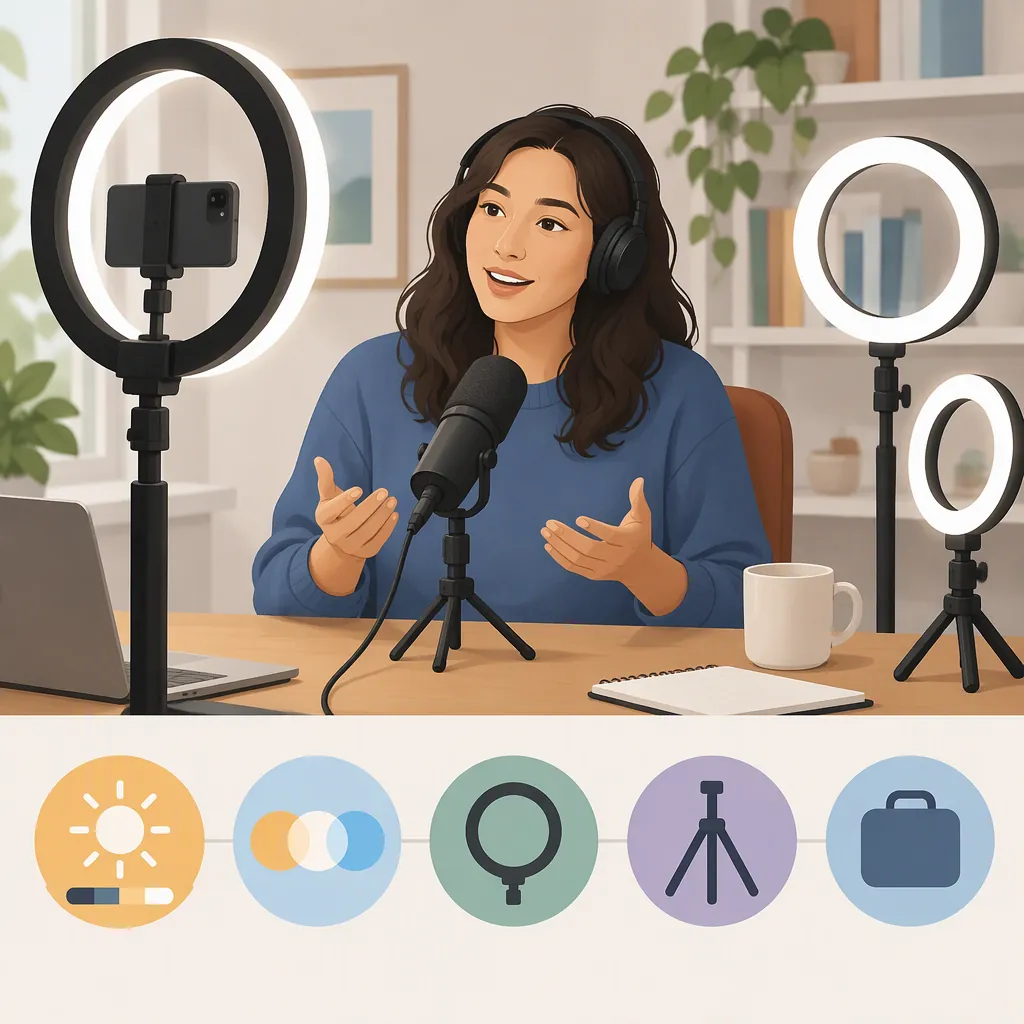
How to Choose the Best Ring Light for Your Video Podcast
The best ring light for a podcast depends on your framing, available space, and number of speakers—not a universal product ranking. A ring light can suit a single-person, close-up remote recording setup; a softbox-diffused light is worth considering for wider shots or multiple people. The supplied guide supports those use-case distinctions, but it does not establish a verified best model through comparative testing. [c1]
When a Ring Light Fits Your Podcast
Start with the shot you intend to record. The supplied podcast-lighting guide describes ring lights as compact and quick to set up for remote or travel recording, particularly with close-up framing. It also notes two visual tradeoffs: circular reflections in the eyes and flatter facial lighting when the light sits directly behind the camera. [c1]
For a wider desk shot or a conversation with several people, consider a softbox-diffused light instead. The guide favors that approach for wider and multi-person frames, while acknowledging that a softbox takes more space. This is a use-case distinction, not proof that every softbox outperforms every ring light. [c1]
Evidence limit: This article draws on one supplied educational guide. It is not a hands-on review, a measured product comparison, or a ranked buying list.
What to Check Before Choosing
Evaluate a candidate light against your actual recording position rather than treating size, price, or advertised brightness as a complete answer.
Use the checklist below as an evaluation worksheet, not as a set of verified product specifications. Its placement and lighting checks follow the supplied guide's emphasis on distance, angle, diffusion, and consistent color temperature. [c1]
Ring Light Evaluation Worksheet
- Recording format: single-person close-up, wide shot, or multiple speakers?
- Available space: can the light and its stand fit outside the intended frame?
- Placement: can you position it slightly above eye level and off the camera axis?
- Brightness control: can you adjust the light until the face is visible without distracting highlights?
- Color setting: can you use a setting consistent with the other lights in the shot?
- Visual result: are the circular eye reflections acceptable for your intended look?
- Recording check: does the setup still look acceptable when the speaker turns toward the microphone?
- Decision: keep the ring-light approach, adjust placement, or test a diffused alternative?
Set up and Test a Single Ring Light
Use the source's suggested placement as a starting point: approximately two to three feet from the face, at or slightly above eye level, and about 20–30 degrees to one side of the camera. The guide recommends moving a centered ring light off-axis to avoid an overly flat appearance. These are starting positions, not guarantees for every fixture or room. [c1]
The guide suggests matching dedicated lights around 5000–5600K and switching off competing room lights. Treat that range as its recommended starting point rather than a universal requirement; inspect the recorded image before settling on a setup. [c1]
Record a short test with the actual camera framing and microphone position. Compare the face, shadows, and background before and after each adjustment. Change one variable at a time so the comparison remains useful.
Short Lighting Test Procedure
1. Set the camera and microphone in their intended recording positions.
2. Check for a bright window behind the speaker; close the blind or change the seating direction if needed.
3. Place the ring light slightly above eye level and to one side of the camera.
4. Record a brief sample while speaking and turning naturally.
5. Review facial brightness, eye reflections, shadows, and background visibility.
6. Change only the light's angle, distance, or brightness, then record another sample.
7. Note the preferred position and settings for the next recording.
Fix the Setup Before Adding More Lights
If the face looks dark against a bright background, check for a window behind the speaker. The supplied guide suggests facing the window or blocking it rather than leaving the subject backlit. [c1]
If facial lighting looks flat, try moving the ring light off-axis. If skin tones have inconsistent warm and cool areas, check for mixed light sources. For wider framing or several speakers, reconsider whether a softbox-based arrangement better fits the shot. [c1]
A second light is not an automatic solution. Define the problem first: a fill light reduces shadows, while a backlight helps separate the person from the background. Those roles are different from the main light that illuminates the face. [c1]
FAQ
Which Ring Light Model Is Best for a Podcast?
The supplied evidence does not establish a best model through comparative testing. Choose by recording format, available space, placement flexibility, and the result in your actual shot. The guide supports ring lights for close-up remote recording, but that does not justify a universal product winner. [c1]
Can One Ring Light Be Enough for a Video Podcast?
Yes, a single ring light can be a workable starting point for a close-up, single-person recording. The supplied guide emphasizes placement and controlling competing room light; wider or multi-person shots may call for a different arrangement. [c1]
Should I Use a Ring Light or a Softbox?
Consider a ring light when portability and close-up framing matter most. Consider a softbox-diffused light for wider framing or multiple people if you have space. The supplied guide describes this tradeoff, but it does not provide controlled measurements comparing individual products. [c1]