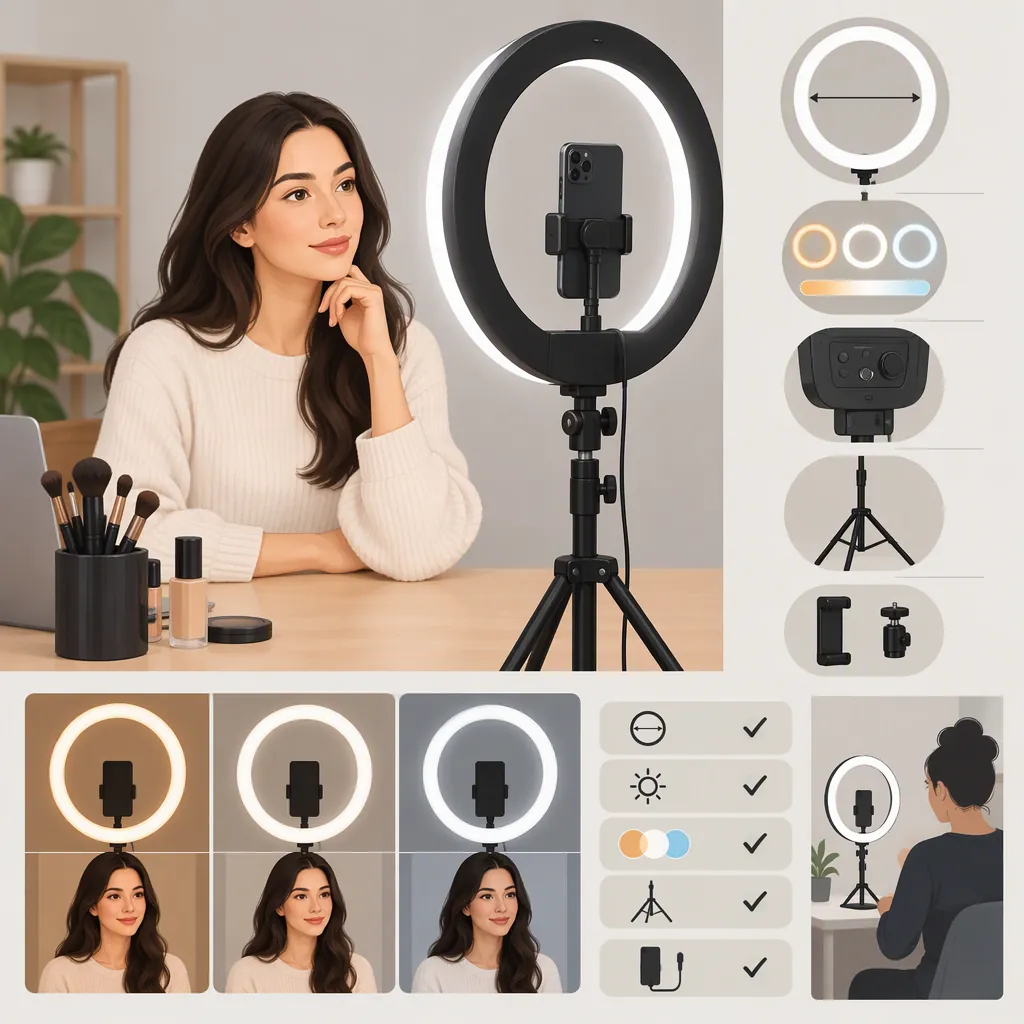
How to Evaluate a Neewer 20-Inch Led Ring Light for Filming
Start by verifying the exact model and its stated diameter. The supplied references do not establish specifications for a particular NEEWER 20-inch LED ring light, so they cannot support a model-specific recommendation. Use them as a starting point for checking size, brightness controls, color temperature, power, and mounting—not as proof that a particular kit will suit your filming setup. [c1] [c2]
Verify the Model and Size Units
The search phrase “neewer 20 inch led ring light” is not enough to identify a particular product. The supplied Walmart reference is a brand-filtered category page, while the NEEWER reference is a manufacturer selection guide covering several ring lights. Neither establishes a specific 20-inch model in the provided material. [c1] [c2]
Pay particular attention to inches versus centimeters. The manufacturer guide includes a size written as “8-inch (20 cm)”; that is not a 20-inch diameter. Treat a bare “20” in a listing as unresolved until its unit is clear. [c2]
For any candidate, record its exact model identifier, stated diameter and unit, and whether the measurement describes the outer ring or another dimension. Do not transfer specifications from a similarly named light.
Model Verification Record
- Exact model identifier: ______
- Diameter and unit: ______
- Measurement definition: ______
- Model-specific documentation checked: ______
- Included kit components confirmed: ______
- Unresolved details: ______
Define the Shot Before Comparing Lights
NEEWER’s guide identifies size and brightness as selection factors and distinguishes close-up work from wider framing. It is manufacturer guidance, not independent comparative testing or evidence of a particular 20-inch model’s coverage. [c2]
Write down your intended framing: a seated face shot, a head-and-shoulders presentation, or a wider standing shot. Then note the planned subject-to-light distance, camera position, available floor or desk space, and whether the subject will move.
Use these requirements to frame an evaluation rather than choosing by diameter alone. A useful acceptance question is: Can the candidate produce the intended exposure and coverage at the position where it must actually sit? If no relevant demonstration or test is available, leave that question unresolved.
Filming Requirements Worksheet
- Intended framing: ______
- Camera position: ______
- Subject-to-light distance: ______
- Seated or standing subject: ______
- Subject movement: ______
- Available mounting space: ______
- Existing room or window lighting: ______
- Coverage requirement to verify: ______
Check Controls, Power, and Mounting
The manufacturer guide also recommends considering color temperature, power source, portability, and accessories. Those are useful comparison categories, but its descriptions of other lights should not be assigned to an unverified 20-inch model. [c2]
For the exact candidate, check:
- Brightness control: What adjustment range is documented, and can you reach the control while filming?
- Color temperature: Is it fixed or adjustable? Does the documentation distinguish electronic adjustment from removable filters?
- Power: What supply is required, and does it match the planned filming location?
- Mounting: Are the stand, phone holder, and camera adapter actually included? Check their documented compatibility and limits.
- Positioning: Can the documented stand height and tilt range accommodate the planned shot?
Mark each answer as confirmed, unclear, or absent. Do not assume that an accessory shown in a general guide is included in every listing.
Candidate Comparison Template
| Requirement | Documented Detail | Status |
| --- | --- | --- |
| Exact model and diameter | Enter detail | Confirmed / unclear / absent |
| Brightness adjustment | Enter detail | Confirmed / unclear / absent |
| Color-temperature method | Enter detail | Confirmed / unclear / absent |
| Required power supply | Enter detail | Confirmed / unclear / absent |
| Stand height and mounting limits | Enter detail | Confirmed / unclear / absent |
| Included holders and adapters | Enter detail | Confirmed / unclear / absent |
Evaluate the Intended Recording Setup
If a candidate is available for evaluation, use a repeatable recording check rather than relying on a product label. This is a proposed workflow, not a report of firsthand testing.
- Set the intended framing and subject position.
- Keep camera exposure and white balance settings consistent during comparisons, where possible.
- Record at the light settings you expect to use.
- Inspect face exposure, visible reflections, background appearance, and any flicker in the recording.
- Repeat with the expected subject movement and room lighting.
- Record unresolved issues rather than assuming a different setting will fix them.
The supplied sources are a retailer category page and a manufacturer guide. They do not provide independent testing of a specific 20-inch candidate. Accordingly, this article makes no model-specific brightness, color-accuracy, durability, or performance recommendation. [c1] [c2]
FAQ
Do These Sources Confirm a Neewer 20-Inch Model?
No. The provided material does not establish a specific 20-inch model or its specifications. An exact model identifier and model-specific documentation are needed before making a product-level comparison. [c1] [c2]
Is a 20 Cm Ring Light the Same as a 20-Inch Ring Light?
No. The manufacturer guide labels one size as 8-inch (20 cm). Check the unit explicitly; the number 20 alone does not establish a 20-inch diameter. [c2]
What Should I Check Besides Diameter?
Check brightness adjustment, color-temperature controls, power requirements, mounting compatibility, and included accessories. These categories appear in the manufacturer’s selection guidance, but each detail must be verified for the exact candidate. Also define your framing and working distance before evaluating suitability. [c2]