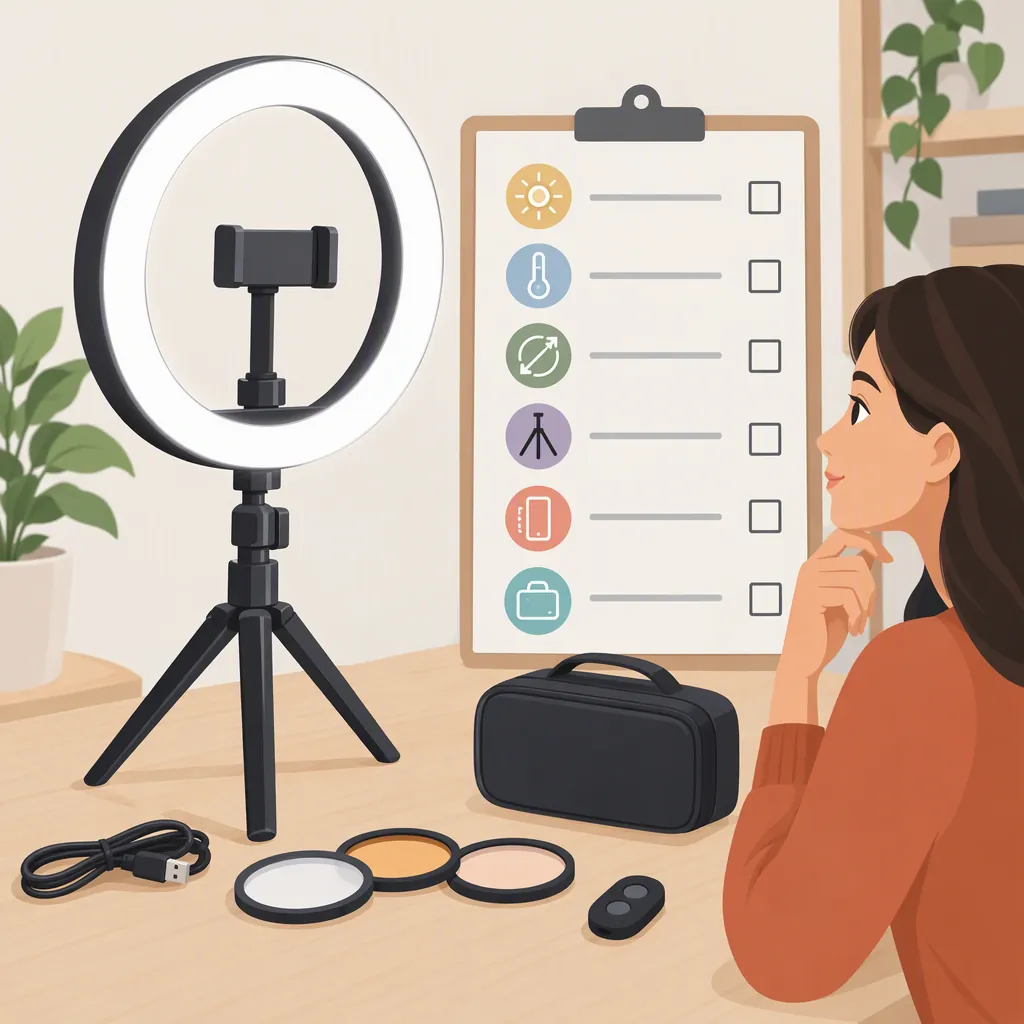
How to Choose an Embellir Ring Light for Filming
To choose an Embellir ring light, match the exact model’s documented mounting options, stand dimensions, power requirements, and lighting controls to your filming setup. First rule out candidates that cannot meet essential requirements, then compare preferences such as adjustment options and storage needs. If critical details are missing, keep the choice unresolved rather than assuming compatibility.
This guide provides a selection process, not a recommendation for a specific Embellir model.
Start with Your Filming Setup
Before comparing models, separate must-have requirements from preferences. A compatible device mount is a requirement; a more convenient storage arrangement may be a preference.
Write down what the light needs to accommodate:
- Framing: Will you film a close-up, a seated presentation, or a wider shot?
- Recording device: Will you use a phone or camera, and where will it sit relative to the light?
- Space: What floor area and height can you allocate to the stand?
- Power: Where is the available outlet, and what cable route avoids your walking area?
- Existing lighting: Will you keep room lights on or use daylight during filming?
- Storage and transport: Will the light stay assembled, or will you move and store it between recordings?
Use these answers as selection criteria. Do not choose from the product name or ring diameter alone.
Filming Setup Worksheet
Complete before comparing models:
- Recording device, case, and orientation: ______
- Intended framing: ______
- Available stand footprint: ______
- Required light height: ______
- Planned light-to-subject distance: ______
- Available power source and cable route: ______
- Other lights in use: ______
- Portability or storage needs: ______
- Must-have requirements: ______
- Preferences: ______
Check the Exact Model Details
For each candidate, look for documentation tied to the exact model number. Record missing information as unverified, rather than assuming similarly named listings describe the same product.
| Item to check | What to verify | How to use the information |
|---|---|---|
| Device mounting | Holder dimensions, mounting interface, supported orientation, and any weight limit | Exclude a candidate if its documented limits do not accommodate your device in its intended configuration. Keep compatibility unresolved if essential details are missing. |
| Stand dimensions | Stand footprint and height-adjustment range | Exclude a candidate if it cannot fit your available space or reach the required position. |
| Power | Required input, adapter, cable details, and included power components | Confirm a documented power arrangement that works in your space. Keep the choice unresolved if necessary power information is missing. |
| Lighting controls | Documented brightness adjustment and color-temperature settings | Check any controls you marked as must-haves first; compare additional adjustment options as preferences. |
| Ring dimensions | Clearly stated dimensions | Compare them with your planned placement and storage space, not as a stand-alone measure of lighting suitability. |
| Included parts | Individually listed stand, holder, adapter, and other accessories | Identify any missing components needed for your setup. Do not assume pictured accessories are included. |
| Safety and setup | Assembly instructions and operating precautions | Confirm that you can assemble and use the model as instructed before treating it as suitable. |
Do not use a brightness figure by itself as proof of suitability. Where possible, check its measurement conditions or assess the light at your intended filming distance.
Turn the Checklist into a Decision
Assign each candidate one of three statuses:
- Does not meet requirements: At least one documented detail conflicts with a must-have, such as holder compatibility or stand footprint.
- Unresolved: A critical detail is missing, or a necessary suitability check remains incomplete.
- Meets documented requirements: All must-haves are supported by exact-model documentation. This does not establish how the light will look in your recording.
Compare preferences only after checking the must-haves. Extra adjustment options or convenient storage should not outweigh an incompatible mount or an unsuitable power arrangement.
Model Comparison Record
Copy once per candidate:
- Exact model number: ______
- Documentation location: ______
- Device-holder compatibility: ______
- Stand height range and footprint: ______
- Power requirements and included components: ______
- Brightness controls: ______
- Color-temperature settings: ______
- Ring dimensions: ______
- Included accessories: ______
- Setup instructions and precautions available: ______
- Must-have requirements not met: ______
- Critical details still unverified: ______
- Preferences satisfied: ______
- Decision: does not meet requirements / unresolved / meets documented requirements
- Reason for decision: ______
Evaluate a Test Recording
If testing is possible, use the recording device, framing, and room lighting you intend to use. Follow the model’s assembly and operating instructions.
- Position the light and recording device for your intended shot.
- Record a short clip at a comfortable starting brightness.
- Review the clip for exposure, visible reflections, unwanted shadows, and any flicker or banding.
- Change one variable at a time, such as brightness, distance, or angle, and record another clip.
- Check that the holder keeps the device in position and that the stand and cable arrangement suit the space.
Record whether the setup produces an acceptable result for your filming needs. Treat this as a practical suitability check, not a calibrated measurement of brightness or color accuracy.
If testing is unavailable, distinguish between meeting documented requirements and verified recording suitability. If critical specifications are also missing, leave the comparison unresolved.
Evidence Limits for This Guide
The available reference is a Pinterest pin titled Ring Light 19" Tripod Stand Pink | Ring light tripod, Camera holder, Camera stand. Its supplied excerpt contains that title and interface text, but no Embellir model identifier or technical specification sheet. It therefore does not verify an Embellir model’s size, brightness, color temperature, accessories, compatibility, or performance. [ref1]
Use it as a discovery reference only. Base model-specific decisions on documentation for the exact candidate.
FAQ
Which Embellir Ring Light Is Best for Filming?
The available evidence does not support naming a best model. [ref1] Start by checking exact-model mounting compatibility, stand dimensions, and power requirements against your must-haves. Then compare lighting controls and storage preferences, and assess a test recording if possible.
Should I Choose by Ring Size Alone?
No. Treat ring size as one comparison field alongside stand dimensions, mounting compatibility, lighting controls, power requirements, and intended framing. A stated diameter does not resolve those other requirements.
How Should I Check Whether My Phone Will Fit?
Compare the exact holder’s documented dimensions with your phone in its intended configuration, including its case. Check supported orientation and any stated weight limit. If essential information is missing, mark compatibility as unresolved rather than assuming the phone will fit.
What Should I Do If a Listing Is Missing Specifications?
Identify whether the missing detail affects a must-have or a preference. Keep the candidate unresolved when essential mounting, stand, power, or setup information is unavailable. Do not fill gaps using a similar product name, a photograph, or another model’s specifications.
Is a Test Recording Enough to Verify Performance?
A test recording can help you judge suitability for your own setup, but it is not a calibrated measurement of brightness or color accuracy. Keep the result specific to the device, framing, room lighting, and settings you tested.