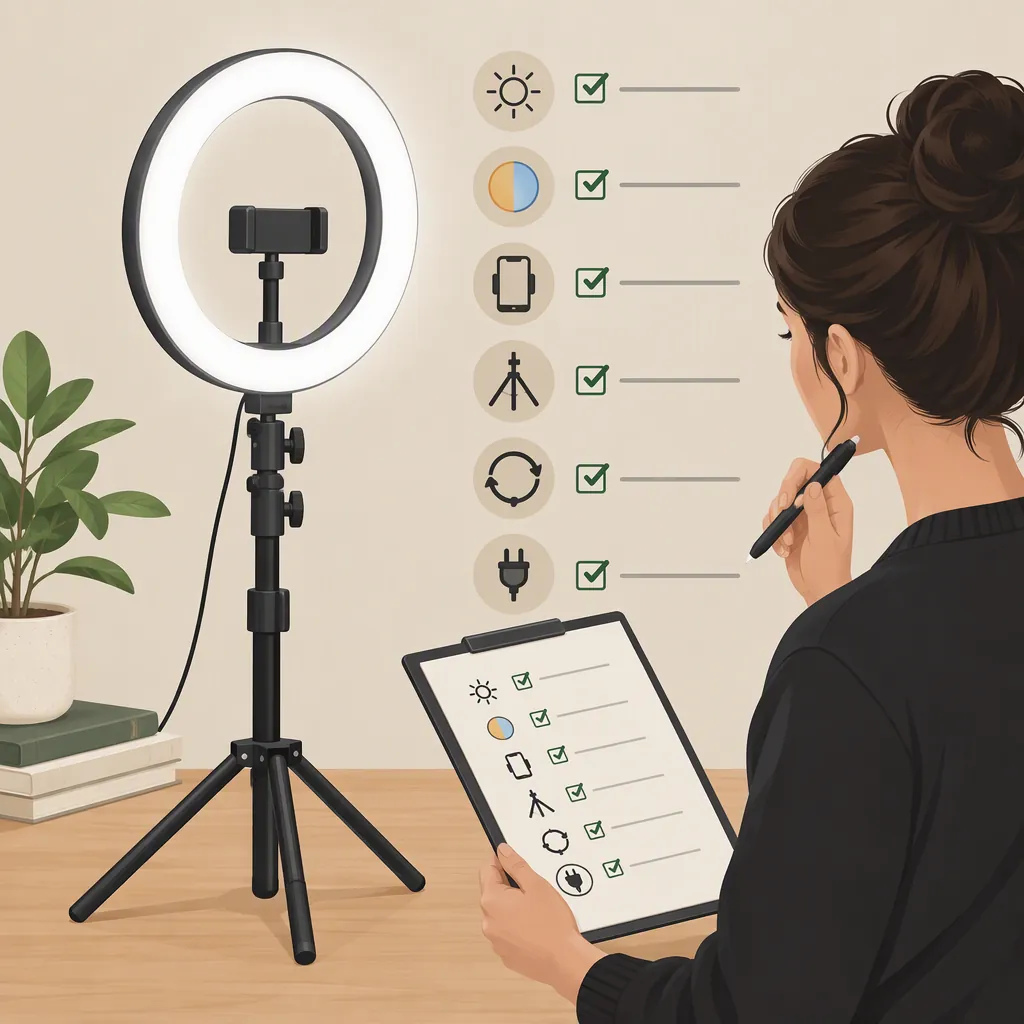
How to Choose an Elitehood Ring Light for Filming
Evaluate an Elitehood ring light by matching the exact model’s mounting, positioning, space requirements, power connection, and controls to your filming setup. Resolve essential specifications before judging fit, then use a repeatable recording test to assess the result. The available Mercado Libre reference shows an account-verification page rather than product specifications, so it does not verify any Elitehood model’s features or included accessories. [ref_1]
What Is—And Is Not—Verified
The accessible reference asks visitors to sign in or create an account; it provides no product specification sheet. [ref_1] This guide therefore cannot confirm an Elitehood ring light’s dimensions, brightness, color controls, power requirements, stand height, device compatibility, or package contents. Nor does it establish performance, durability, or value compared with other lights.
The guidance below is a method for evaluating a particular model, not a description of verified Elitehood features.
Match the Light to Your Filming Setup
Start with the shot you need rather than the brand name alone. Record whether you film seated or standing, use a phone or camera, and need a fixed setup or equipment you can move between locations.
Separate essential requirements from preferences. For example, a compatible device mount might be essential, while a particular control layout might be a preference. Use your own workflow to decide which conditions are necessary.
Check these areas for the exact model:
- Mounting: Compare the documented attachment type, holder dimensions, and load limits with your recording device. Do not assume a holder or adapter is included.
- Positioning: Check whether the stated height and adjustment range would place the light where your shot needs it.
- Space: Compare the light dimensions and stand footprint with the available filming area. Include room for cables and normal movement.
- Power: Identify the required power source, connection, and adapter. Check these against what is available in your setup.
- Controls: Confirm which brightness or color adjustments are documented, then compare them with the adjustments your workflow needs.
- Package contents: Separate explicitly included items from optional accessories or objects shown only in photographs.
Verify the Exact Model Before Filling in the Details
Use this verification sequence:
- Record the complete model identifier. Do not rely on the brand name or a similar-looking product alone.
- Look for publicly accessible documentation. Check a model-specific manual, specification page, and package-content list where available.
- Match each document to the same model. Keep details from different models or package versions separate.
- Distinguish specifications from images. Use explicit dimensions, connection requirements, and inclusion lists rather than inferring them from photographs.
- Leave conflicts unresolved. If documents disagree or do not clearly identify the model, mark the affected detail as unknown until the discrepancy is resolved.
Record where each detail came from so you can revisit it. These steps are a verification method; they do not imply that particular documents or accessories exist for an Elitehood model.
Model Verification Worksheet
Keep evidence status separate from suitability. A specification can be verified while still failing your requirement.
| Item | Your Requirement | Essential? | Documented Model Detail | Evidence Status | Meets Requirement? |
|---|---|---|---|---|---|
| Exact model identifier | Record the model being evaluated | Yes | Not yet verified | Unknown | Undetermined |
| Device mounting | Record device dimensions and attachment needs | Set for your setup | Not yet verified | Unknown | Undetermined |
| Positioning range | Record the required light position | Set for your setup | Not yet verified | Unknown | Undetermined |
| Available space | Measure the filming area | Set for your setup | Not yet verified | Unknown | Undetermined |
| Power connection | Record available power sources and connections | Set for your setup | Not yet verified | Unknown | Undetermined |
| Light controls | Record the adjustments your workflow needs | Set for your setup | Not yet verified | Unknown | Undetermined |
| Package contents | List essential accessories | Set for your setup | Not yet verified | Unknown | Undetermined |
Use Verified or Unknown for evidence status, and Yes, No, or Undetermined for whether a requirement is met. Replace “Not yet verified” only with information explicitly documented for the exact model. Keep missing or conflicting details marked Unknown.
Turn the Checklist into a Decision
Apply these rules to the setup you recorded:
- A verified detail fails an essential requirement: The model is not suitable for that configuration as documented.
- An essential detail remains unknown: Defer the suitability decision. An undocumented feature is not evidence of compatibility.
- All essential requirements are verified and met: Proceed to a recording test if the light is available. Passing the checklist does not establish the quality of the footage.
- Only preferences are unmet: Record the trade-offs separately rather than treating them as essential compatibility failures.
If you change the setup—for example, by using a different mount—update the requirements and verify the revised arrangement rather than assuming the change resolves the issue.
Use a Repeatable Recording Test
If a light is available to evaluate, use a short recording test rather than treating specifications as proof of a suitable result.
- Set up the recording device, background, and framing you normally use.
- Record a baseline clip without the candidate light.
- Add the light and note its position and any available settings.
- Record another clip with the same framing. Keep exposure and white balance fixed if your device permits; otherwise note that automatic adjustments may complicate the comparison.
- Review the clips for facial detail, distracting reflections, unwanted shadows, and visible bands or pulsing.
- Change one setting or position at a time and record the result.
Include glasses, reflective objects, and your usual background when relevant. Note comfort and whether the stand or cables obstruct your working area.
Judge the result against your intended shot: does the tested arrangement provide the appearance and working space you need? If a problem remains, record it as unresolved rather than assuming a different setting will fix it. A successful clip supports suitability for those test conditions—not long-term reliability or every filming situation.
Recording Test Log
- Recording device:
- Framing and background:
- Camera settings, or automatic settings used:
- Light position:
- Light settings, if available:
- Visible reflections:
- Shadow appearance:
- Visible bands or pulsing:
- Comfort during the test:
- Stand or cable obstructions:
- Change made for the next clip:
- Result compared with the baseline:
- Unresolved questions:
FAQ
What Elitehood Ring Light Specifications Are Verified Here?
None. The accessible Mercado Libre reference does not provide product specifications. [ref_1] Use the checklist to evaluate documentation for the exact model; do not treat this guide as confirmation of its features.
Will an Elitehood Ring Light Hold My Phone or Camera?
Compatibility is not established by the supplied reference. [ref_1] Compare your device’s dimensions, attachment needs, and weight with the exact model’s documented holder dimensions, attachment type, and load limits. Also verify whether the required holder or adapter is included. If an essential mounting detail is missing, leave compatibility undetermined.
What Should I Prioritize When Choosing a Ring Light?
Prioritize essential requirements for your shot: device mounting, light position, available space, power access, and needed adjustments. Separate verified specifications from whether those specifications meet your needs. Once essential requirements are confirmed, use a consistent recording test to assess the footage and working arrangement.
What If Specifications, Photographs, and Package Contents Disagree?
Check that each item refers to the same model and package version. Do not count an accessory as included merely because it appears in a photograph. If explicit documentation still conflicts, keep the affected detail marked unknown and defer any decision that depends on it.
Does a Successful Recording Test Prove the Light Is a Good Choice?
It supports suitability for the setup and settings you tested. It does not establish long-term reliability or results under different conditions. Record unresolved issues and repeat the test for other filming arrangements that matter to your workflow.
Sources
- [ref_1] Mercado Libre