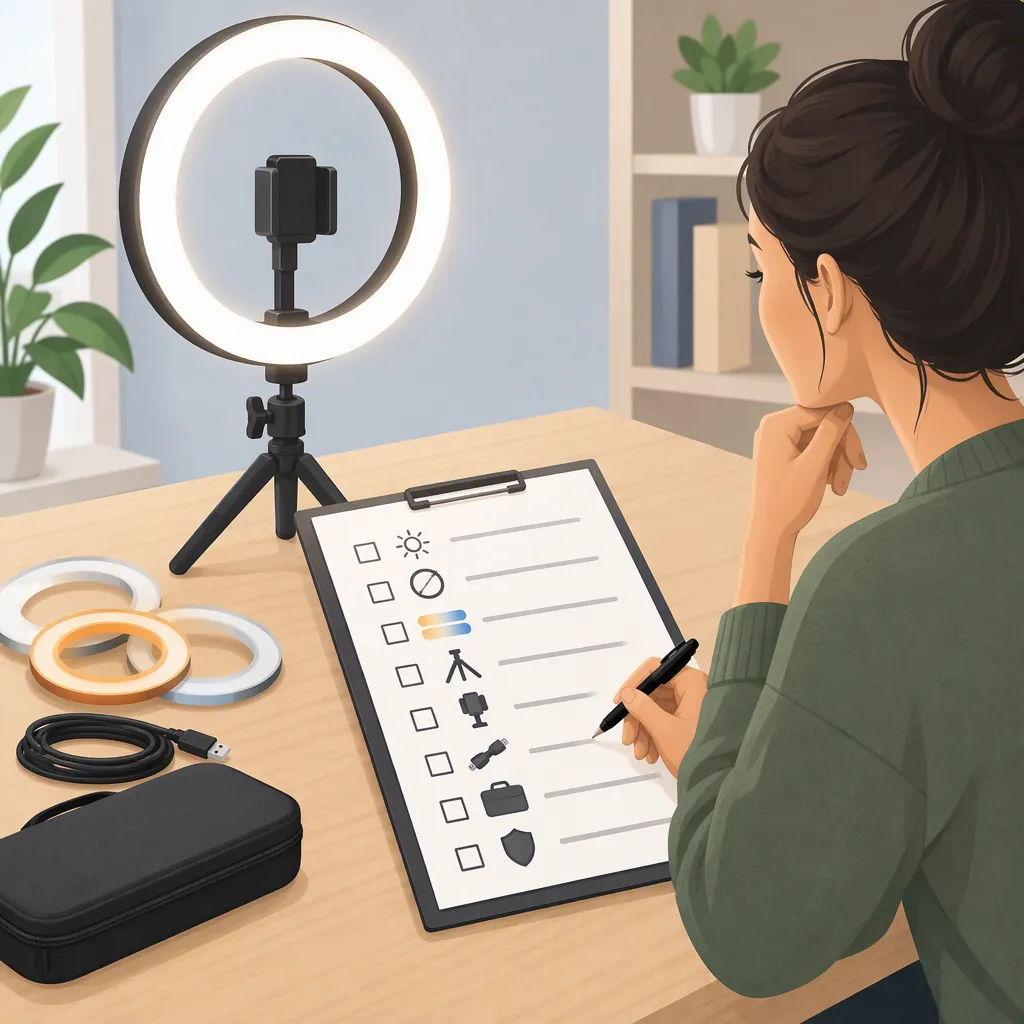
How to Choose a Craphy Ring Light for Filming
To evaluate a CRAPHY ring light, confirm the exact model, check its documented power and mounting requirements, and compare its controls and kit contents with your filming needs. Then, if the light is available for evaluation, test it in your intended recording setup. The Amazon.es search-page text cited here does not verify a CRAPHY model, so it cannot support a specific product recommendation. [ref_1]
What the Available Evidence Establishes
The captured text from the cited Amazon.es search page shows a search for “CRAPHY,” but the visible lighting result is labeled NEEWER RP19H. That result’s advertised specifications must not be attributed to CRAPHY. The evidence does not establish a CRAPHY model’s dimensions, brightness, color performance, power supply, accessories, warranty, or current availability. [ref_1]
This guide therefore provides a selection method, not a product review or a ranking of CRAPHY models.
Confirm the Exact Model First
Treat model identity as the first decision gate. For a candidate described as a CRAPHY ring light, look for agreement between:
- The brand and model shown on the product label.
- The product title and model identifier.
- Photographs showing the actual item and its connections.
- Model-specific instructions or specifications.
- The exact kit description, including accessories.
Keep missing or conflicting details marked as unresolved. Do not substitute specifications from another brand or a similar-looking light.
Model Verification Worksheet
| Item to verify | Documented information |
|---|---|
| Brand on the product label | ______ |
| Exact model identifier | ______ |
| Matching model-specific documentation | ______ |
| Required input voltage and power connection | ______ |
| Included adapter or other power equipment | ______ |
| Ring dimensions | ______ |
| Stand height range and footprint | ______ |
| Mounting interface | ______ |
| Included phone or camera holder | ______ |
| Holder dimensions and stated load limits | ______ |
| Missing or conflicting details | ______ |
Decision rule: If model identity or power requirements remain unresolved, leave the candidate unevaluated rather than assuming compatibility.
Match the Light to Your Filming Setup
Before comparing candidates, define the shot you need. Record your device, whether you will sit or stand, the intended camera position, the framing, and the available floor or desk space.
Use those requirements to make a decision—not merely to collect specifications.
| Check | What to compare | Decision rule |
|---|---|---|
| Device mounting | Your phone or camera, including its case and attached accessories, against the holder’s documented fit and limits | If the device does not fit or exceeds any relevant component’s stated limit, the configuration is not compatible. Missing limits remain unresolved. |
| Stand and placement | Required light position against the documented stand height range and footprint | Exclude a configuration that cannot reach the intended position or fit within the available space. |
| Power | The model’s required supply against the adapter and power equipment you intend to use | Proceed only when compatibility is documented. A connector’s appearance is not enough to identify the required supply. |
| Controls | Documented brightness and color-temperature controls against your workflow | If an essential control is absent, the candidate does not meet that requirement. If its availability is unclear, mark it unresolved. |
| Kit contents | The listed light, stand, holder, adapter, and other necessary parts | Do not assume pictured accessories are included. Mark unclear contents unresolved and identify what else the setup would require. |
These are general evaluation criteria, not claims that a CRAPHY model has any particular feature.
How to Evaluate Ring Size
Start with placement rather than a preferred diameter:
- Establish the camera position and framing.
- Decide where the light would sit relative to the camera and subject.
- Measure the space available for both the ring and its support.
- Compare those measurements with the exact candidate’s documented dimensions.
- If available for evaluation, check whether the assembly allows the intended framing and access to controls.
If you plan to position a device inside the ring, verify the usable opening and holder arrangement rather than relying on the advertised outer diameter.
A ring that cannot fit your mounting space is unsuitable for that configuration. One that fits is only a candidate for further evaluation: do not treat ring diameter alone as proof of brightness or lighting results.
Use a Repeatable Filming Test
If a candidate is available for evaluation, follow its model-specific instructions and stay within documented power and mounting limits. Test it with the device and framing you intend to use.
Keep the camera position, subject position, and other light sources consistent. Where your device permits, fix exposure and white balance across clips so that automatic adjustments do not complicate the comparison. If you cannot disable automatic adjustments, record that limitation and avoid treating the footage as a strict brightness or color comparison.
Short Recording Test
- Record the configuration. Note the model identifier, device, camera settings, light position, and selected light controls. Include whether exposure and white balance are fixed or automatic.
- Record a baseline. Film a short clip without the candidate light, keeping the intended framing and other lighting conditions unchanged.
- Add the candidate light. Record another clip in the intended operating position.
- Change one variable at a time. Where documented controls permit, adjust one setting and record another clip. Keep the remaining setup consistent.
- Review the footage. Check facial exposure, reflections in glasses, distracting shadows, color appearance, and visible brightness variation. Note any camera automation or environmental changes that limit the comparison.
- Check practical fit. Confirm that mounting, framing, stand placement, and control access meet your needs.
- Record a bounded conclusion. Mark each requirement as met, not met, or unresolved. Keep the result specific to the tested configuration.
A useful outcome is not simply “the light looks good.” It is a record of which requirements the setup meets and which remain uncertain. A successful test of one configuration does not establish performance for other CRAPHY models.
Make the Selection Decision
Separate compatibility from preferences:
- Not compatible: A documented power, mounting, load, height, or space requirement conflicts with your setup.
- Unresolved: Model identity, required equipment, compatibility limits, or an essential feature cannot be confirmed.
- Suitable for the tested setup: Required compatibility checks are satisfied, and the recording test meets your stated needs.
Keep optional preferences—such as a preferred control layout—separate from essential requirements. Do not let a convenient feature override an unresolved power or mounting question.
FAQ
Does the Cited Search Page Verify a Craphy Ring Light Model?
No. The captured Amazon.es search-page text shows a CRAPHY search, but its visible lighting result is labeled NEEWER RP19H. It is not a verified CRAPHY model-specific specification sheet. [ref_1]
Which Craphy Ring Light Size Should I Choose?
No specific size is supported by the cited evidence, which does not verify CRAPHY ring dimensions or performance. [ref_1] Choose a candidate size by checking your camera position, framing, mounting arrangement, and available space against exact model documentation. If it fits, evaluate the recorded result; diameter alone is not a sufficient selection criterion.
Can I Assume a Stand and Phone Holder Are Included?
No. The cited evidence does not establish CRAPHY kit contents. [ref_1] Confirm the accessories for the exact model and kit, then check their compatibility separately. If a required item’s inclusion is unclear, mark it unresolved.
What If My Camera Cannot Lock Exposure or White Balance?
You can still assess framing, mounting, control access, and whether the footage meets your practical needs. Keep other conditions consistent and note that automatic adjustments were active. Avoid using those clips to make strict brightness or color comparisons between configurations.
What Should I Do When Specifications Conflict?
Do not resolve the conflict by choosing the more favorable number or borrowing specifications from a similar product. Check the product label and matching model-specific documentation. Until the conflict is resolved, keep the affected requirement—and any selection decision that depends on it—unresolved.
Sources
- [ref_1] Amazon.es : CRAPHY