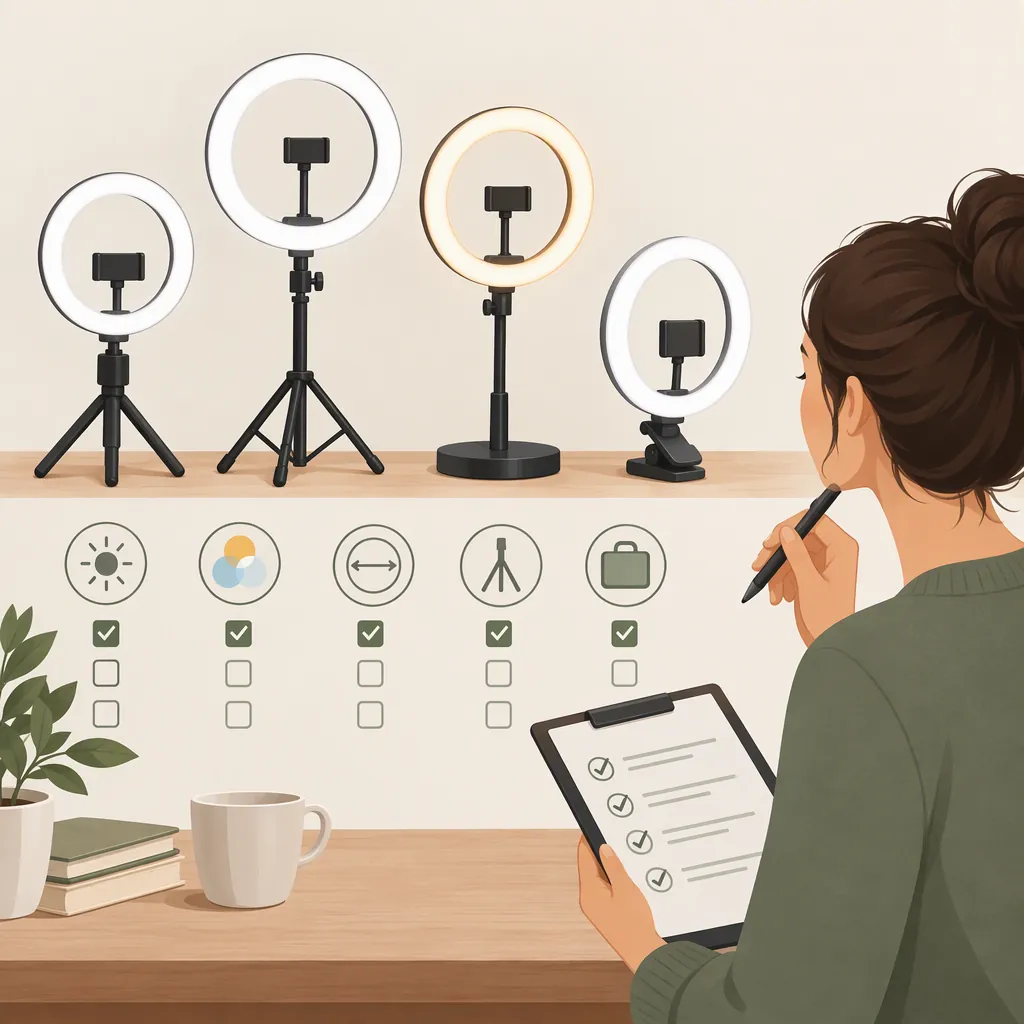
How to Evaluate an Aureday Ring Light for Your Setup
To evaluate an Aureday ring light, identify the exact model, then check its documented dimensions, mounting arrangement, power requirements, and controls against your filming setup. The provided sources include an Aureday catalog and a page titled “Aureday 14'' Selfie Ring Light with 62'' Tripod Stand,” but they do not establish independently tested lighting quality or a best model. Use them as listing information, not proof of performance. [c1] [c2]
Identify the Exact Listing
Start with the full product title and source URL rather than the search phrase “aureday ring light.” The provided Aureday catalog pages contain several ring-light and tripod entries, so the brand name alone does not identify one configuration. [c1] [c3]
One supplied detail page is titled “Aureday 14'' Selfie Ring Light with 62'' Tripod Stand.” Treat that title as a listing identifier, not as confirmation that another similarly named listing contains the same equipment. [c2]
Record the model title, included components, and any unresolved differences between the detail page and the listing you are evaluating. Do not transfer specifications from one entry to another without matching documentation.
Listing Identification Worksheet
- Exact product title: __________
- Product page URL: __________
- Model or item identifier, if stated: __________
- Listed package contents: __________
- Differences from other listings: __________
- Information still needing confirmation: __________
Check Fit Before Comparing Features
Define your filming arrangement before deciding which listed features matter. For a seated call, sketch the desk, chair, camera position, and available floor space. For a standing recording, mark the intended camera height and subject position. For overhead work, confirm that the documented mounting arrangement supports the orientation you need; do not assume it does.
Compare your measurements with the exact model's documentation. Check the stand footprint, adjustment range, phone-holder fit with your case attached, and clearance around the light. If a dimension or supported load is missing, record it as unknown rather than estimating it from a product photograph.
The supplied detail page describes a stand, phone holder, and adjustment features. These are manufacturer descriptions, not independent verification of stability or compatibility with your equipment. [c2]
Workspace Fit Checklist
- Intended recording position: seated / standing / overhead
- Required camera height: __________
- Available floor or desk area: __________
- Phone dimensions with case: __________
- Required portrait or landscape orientation: __________
- Stand clearance and cable route checked: yes / no
- Unsupported or undocumented mounting needs: __________
Read Lighting and Power Details Cautiously
Use the exact model's documentation to check the required power source, available controls, and any stated lighting specifications. Keep a distinction between a listed setting and a demonstrated result in your filming environment.
The supplied detail page includes brightness, color, and power information, but its wording is not fully consistent: it describes brightness as both 10%–100% and 0%–100%, and it uses different color-setting descriptions in separate passages. Those discrepancies should remain visible rather than being combined into one supposedly verified specification. [c2]
If a minimum brightness setting, particular color setting, or power arrangement is essential to your workflow, mark it as unresolved until supported by clear documentation. The provided sources do not establish comparative performance, measured output at your working distance, or independently verified color accuracy. [c1] [c2] [c3]
Evaluate Results with Your Camera
If a unit is available for evaluation, use a repeatable recording procedure rather than relying on promotional descriptions. Keep the camera position, framing, background, and room lighting consistent. Note whether exposure and white balance are automatic or fixed.
Record short clips at several available settings and positions. Review facial highlights, visible shadows, reflections in glasses, background appearance, and any visible flicker. Also check whether the controls and cable placement suit your recording routine.
Treat those observations as results for that particular setup, not as universal findings about Aureday products. This article provides no hands-on test results; its source material consists of the supplied catalog and product pages. [c1] [c2] [c3]
Repeatable Recording Test
1. Record the exact model and camera settings.
2. Mark the camera, subject, and light positions.
3. Keep room lighting and framing unchanged.
4. Record a baseline clip, then change one light setting or position at a time.
5. Review highlights, shadows, reflections, background appearance, and visible flicker.
6. Note cable placement and control usability.
7. Label findings as specific to this setup, including any unresolved issues.
FAQ
Which Aureday Ring Light Is Best?
The provided sources do not support a best-model ranking. They identify listings and provide manufacturer descriptions, but no independent comparison. Define your required workspace fit, mounting arrangement, power source, and camera results before evaluating a specific model. [c1] [c2] [c3]
Will the Listed Phone Holder Fit My Phone?
The supplied detail page describes a phone holder and makes a broad compatibility claim, but that is not verification for your phone and case. Compare your device's dimensions with the documented holder range and leave compatibility unresolved if the information is insufficient. [c2]
Can I Rely on the Listed Brightness Settings?
Treat them as manufacturer-provided information. The supplied detail page gives both 10%–100% and 0%–100% brightness descriptions, so the minimum setting is not unambiguous in the provided text. A listed percentage also does not establish the camera result in your setup. [c2]