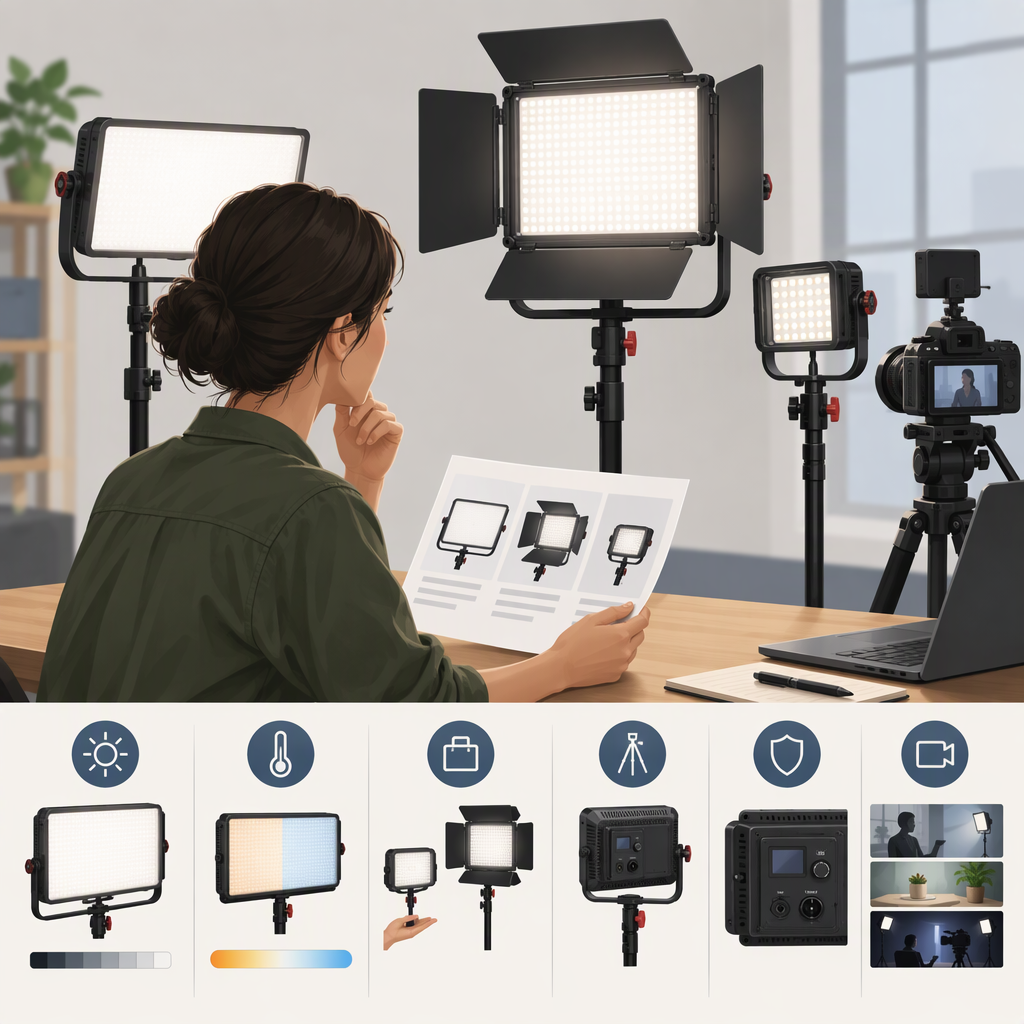
How to Choose a Tolifo Led Light for Filming
If you’re choosing a Tolifo LED light for filming, start with the shot—not a model name or a single headline specification. Write down what you’re lighting, how far the light will be from the subject, how much space you need to cover, and whether you’ll have reliable power. Then compare those needs with the documentation for the exact Tolifo model you’re considering. This guide offers a neutral selection process; it does not rank or recommend Tolifo products.
1. Turn Your Filming Setup into a Short Requirements List
Answer these questions before comparing lights:
- What are you filming? A single presenter, a product, or a wider scene may need different coverage and light control.
- How far away will the light be? Look for output figures measured at a distance close to your working setup—not just a wattage or a brightness number without conditions.
- What light is already in the scene? Window light or room lighting may affect how much extra output you need and whether you need to match the existing color.
- How should the light fall? Check whether the beam, reflector, diffuser, or other modifier can give you the coverage and control you want.
- Will you move the setup? If so, account for the fixture, power supply, stand or mount, cables, and any modifiers—not just the light’s size.
- How will you power and position it? Verify the available power options, mounting method, controls, and any accessories your setup requires.
These are questions to use when comparing candidates, not claims about any Tolifo model. Manufacturer photometric references can help organize the comparison: for example, ARRI’s photometric app lists output, beam diameter and angle, and properties such as power draw, weight, and mounting. That is an example of useful specification categories, not Tolifo documentation. (arri.com)
2. Compare Only the Specifications That Affect Your Shot
Output at distance: Look for a measured output value at a stated distance and configuration. A reflector, lens, or diffuser can change the beam and the amount of light reaching your subject, so compare like with like. If a listing gives only wattage, treat it as power information—not as a direct answer to how much light reaches your subject. ARRI’s reference separates luminous output from beam measurements and reports photometric information by configuration. (arri.com)
Beam and coverage: A wider beam can cover more area; a narrower or more controllable beam can help concentrate light. The right choice depends on your frame, distance, and whether you want spill on the background. Check which modifiers are included, which are compatible, and whether the measurement applies with or without them.
Color temperature and color rendering: If you need to match daylight, indoor lighting, or another source, check the available color-temperature settings and how they are specified. Also look for color-rendering measurements, such as CRI or TLCI, and compare the same metrics across candidates. These figures describe different aspects of a light’s color performance; a single score does not guarantee that every subject or camera will render color exactly as you want. Aputure’s educational material distinguishes measuring light energy from measuring color response, while ARRI lists color temperature and CRI among fixture properties. (help.aputure.com)
Power, portability, and mounting: A light that suits a fixed desk setup may be inconvenient for location work if its power arrangement, weight, mounting, or required accessories don’t suit your workflow. Choose based on the complete setup you can actually carry, power, and position—not portability in isolation.
Controls: Check whether the on-unit controls provide the adjustments you need. App or wireless control may matter if you need to change settings from the camera position; otherwise, it may be an extra feature you don’t use.
3. Work Through a Hypothetical Example
Suppose you film one presenter in a small room, usually at a fixed distance from the camera, and sometimes move to another room. Your shortlist could prioritize: usable output at the planned light-to-subject distance; coverage that suits a single-person frame; a way to match the room’s color; a practical power option; and a mount that fits your stand. If travel matters, compare the packed weight of the complete setup, including power supply and modifiers.
That list narrows what to verify, but it does not identify a Tolifo model or guarantee a particular result. If you later change to a wider shot, greater distance, or a location without convenient power, revisit the coverage, output, and power requirements.
4. Verify the Exact Tolifo Model Before Relying on a Comparison
For each candidate:
- Match the exact product name and model or version in the listing to the manufacturer’s specification sheet or manual.
- Check the output conditions: distance, color-temperature setting, beam configuration, and whether a modifier was used.
- Confirm the color settings and the reported color-rendering metrics you care about.
- Verify power requirements, mounting, controls, compatible modifiers, and which accessories are included.
- If a detail affects your decision but is absent or unclear, treat it as unconfirmed rather than assuming it is included or compatible.
Do not compare numbers measured under different conditions as if they were directly equivalent. Technical references commonly separate measurements by distance and configuration; Aputure’s published photometric tables, for instance, state measurement distances and configurations, illustrating why those conditions matter. That source is not evidence for a Tolifo product. (help.aputure.com)
Bottom line: Choose a Tolifo LED light by matching your filming distance, required coverage, color needs, power, and mounting to verified documentation for the exact model. Without that model-specific evidence, a neutral comparison can identify what to check—but should not claim which Tolifo light is best.