Techrater Led Light: What Its Recommendation Shows—And How to Choose a Filming Light
Direct Answer: What Can Be Verified About Techrater?
Techrater.in has published content about ring lights for video creators, including a post titled “Ring Light For Video Creator” and a separate post about a mobile selfie ring light. The creator-focused post describes three lighting modes; the mobile-light post describes three brightness modes and a rechargeable battery. These are descriptions from Techrater’s pages, not independent performance tests. (techrater.in)
Those pages do not establish a current, single “best LED light,” or let me verify a specific model as Techrater’s current pick. Treat them as older, use-case-specific ring-light content—not as a current recommendation for every filming setup. If you meant a different Techrater or a particular review, its channel or article would be needed to attribute a pick accurately.
Choose for the Shot, Not the Product Category
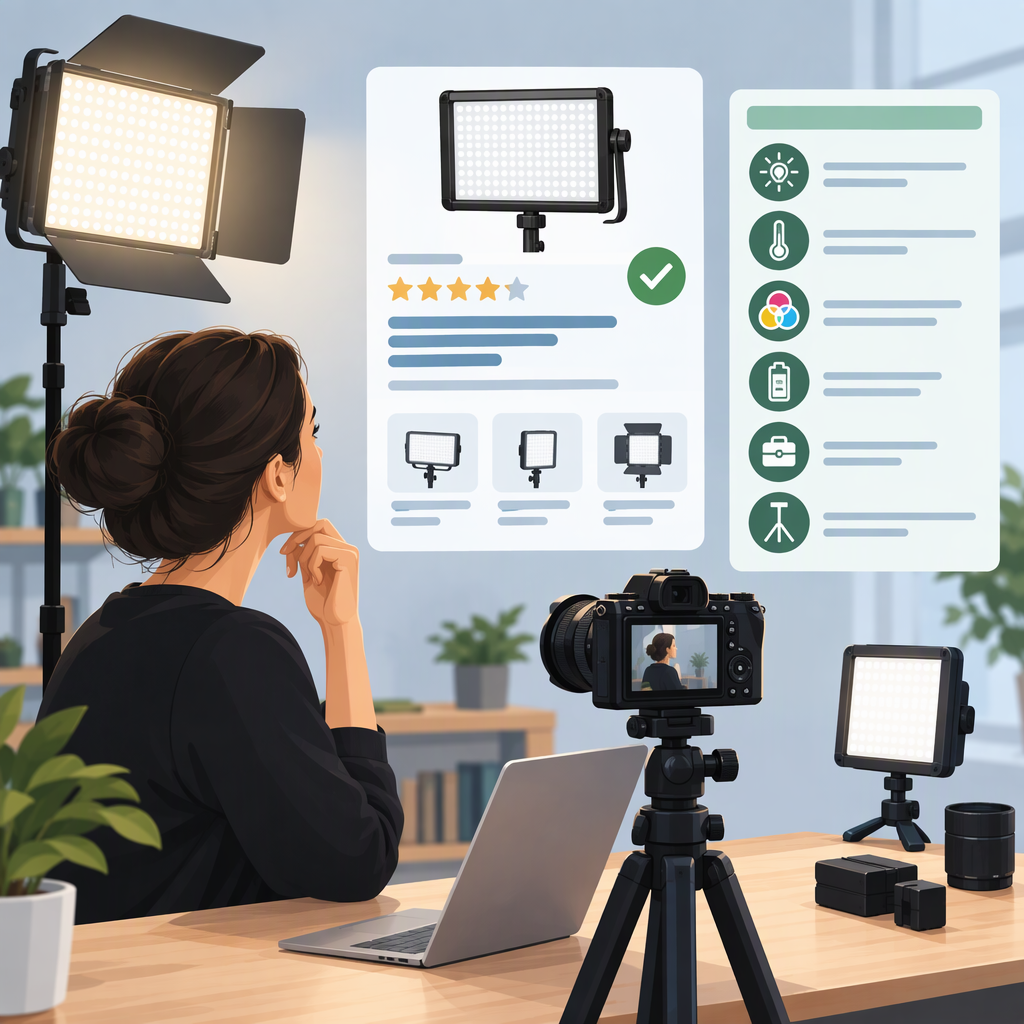
Before comparing lights, write down four things: what you are filming, how far the light will be from the subject, how much space you have, and whether you will record while moving or stay in one place. Then compare candidates against the conditions you will actually use.
| What to compare | What to look for | The trade-off to consider |
|---|---|---|
| Output at your working distance | A brightness measurement at a stated distance, ideally with the modifier you plan to use. Ask for the measurement conditions if they are missing. | A headline wattage alone does not tell you how much light reaches your subject in your setup. A rating measured without your intended modifier may not describe the setup you will film with. |
| Color and adjustment | A stated color-temperature range if you need to match daylight, room lighting, or a chosen look. For color rendering, compare published CRI and, where available, TLCI data. | Adjustable color temperature is useful for matching different surroundings, but a range by itself does not establish color accuracy. The EBU’s TLCI method assesses colorimetric performance for television use by simulating a camera-and-display chain; it is a useful comparison metric, not a guarantee that every camera will render every scene identically. (tech.ebu.ch) |
| Shape and control | Check what diffusion or other light-shaping options are included or supported, and whether the light can be aimed and placed where your shot needs it. | A small, simple setup may favor fewer parts; more control can mean more equipment to carry, mount, and adjust. Judge the result using the actual setup you intend to use. |
| Camera compatibility | Look for flicker information at the frame rates, shutter settings, brightness levels, and power mode you expect to use. If the details are not stated, record a test clip using those settings and inspect it for flicker or bands. | A broad “flicker-free” label, without test conditions, may not answer whether the light works with your specific recording settings. A test clip is a practical check, not a substitute for published test data. |
| Power, mounting, and sound | Check whether the stated power options, battery runtime, mounting method, and operating-noise information fit your shoot. For a microphone-nearby talking-head setup, check noise under the brightness and power conditions you will use. | Battery operation can help when you need to move around, while a fixed setup may prioritize a suitable mains-power option. Extra mounting or power accessories may add bulk. |
For camera color, the EBU explains that TLCI is calculated using a model of a television camera and display, and recommends a measurement method for identifying potential colorimetric problems in luminaires. That makes a documented TLCI result more directly relevant to camera use than relying on a general claim such as “natural color” alone; it still does not replace judging footage from your camera and workflow. (tech.ebu.ch)
Apply the Checklist to Your Setup
Fixed desk or talking-head video: Start with the distance between the light and your face, the space available for a stand, and whether you need to match existing room lighting. Compare output at that distance, color information, mounting, and operating noise if your microphone is nearby. A ring light is one possible form factor, but Techrater’s older ring-light posts do not establish that it is the right choice for your room or camera.
Product close-ups: Compare output and light control at the product’s position, then record a short sample with the product colors and camera settings you actually use. If accurate color matters, include TLCI or other documented color data in the comparison; the EBU’s work explains why camera-oriented color assessment can be useful for television lighting. (tech.ebu.ch)
Moving or on-location filming: Prioritize the stated power arrangement, battery information, mounting compatibility, and a test under the intended camera settings. Decide how much setup time and extra gear you are willing to carry before choosing features that may not help your particular shoot.
These are comparison examples, not tests of specific lights. They do not imply that any particular product will deliver a particular result.
A Neutral Comparison Checklist
For each candidate, record:
- Intended use: subject, shooting distance, room or location, and whether the camera is stationary or moving.
- Output: the published measurement, distance, and any modifier used for that measurement.
- Color: available adjustment range and any stated CRI or TLCI result, including the source and test conditions where provided.
- Camera behavior: available flicker information and the result of a short recording test at your intended frame rate, shutter setting, brightness, and power mode.
- Practical fit: power option, stated runtime if battery-powered, mounting, portability, and operating-noise information if relevant.
- Evidence quality: label each item as a manufacturer-stated specification, a Techrater statement, or your own camera test. Do not treat those evidence types as interchangeable.
Bottom line: Techrater.in has published creator-focused ring-light content, but the available pages do not verify a current, universal Techrater LED-light pick. Choose by comparing documented specifications and footage from your own camera under your intended filming conditions.