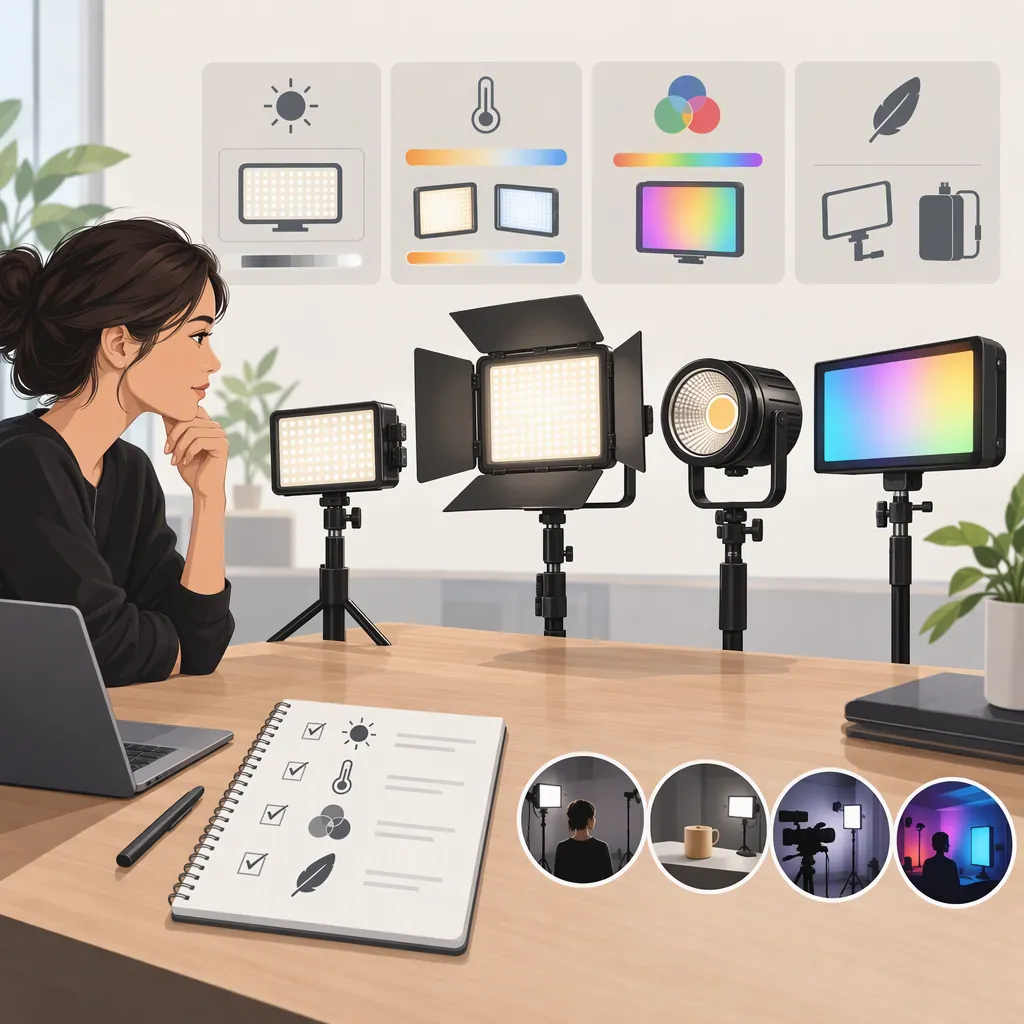
How to Choose a Samtian Led Video Light
Choose a SAMTIAN LED video light by matching its exact model to your recording setup—not by the brand name alone. Compare documented output, color controls, power, mounting, and package contents, then test at your intended camera settings if possible. The available references establish a product category and a kit-related name, but do not support a model recommendation or verified performance claims. [s1] [s2]
What the Available Sources Establish
The Amazon store reference is labeled “SAMTIAN: LED VIDEO LIGHT.” The Amazon Live reference is titled “SAMTIAN LED Video Light-TL-160S 2 KIT.” These identify a category and a model-related package label, not a verified specification sheet. [s1] [s2]
The supplied reference text does not document:
- Brightness or output measurement conditions
- Color temperature range or color-rendering measurements
- Battery compatibility or runtime
- Cooling noise or flicker-test results
- Mounting requirements or an itemized accessory list
Do not infer these details from the model name or the phrase “2 KIT.” The guidance below is a general selection process, not a ranking or a claim about any SAMTIAN model’s capabilities.
Define Your Recording Requirements First
Before comparing models, describe the scene you need to light. Separate necessary conditions from preferences: a compatible power source may be essential, while a smaller carrying case may simply be preferable.
For a desk recording, focus on placement, control access, cable routing, and noise near the microphone. For a wider scene, seek output documentation relevant to your planned light-to-subject distance. For mobile recording, verify the power arrangement and the total load of the light, supports, batteries, and accessories.
Treat these as requirements to investigate, not features that any SAMTIAN model is assumed to have.
Recording Requirements Worksheet
- Subject and framing: ______
- Planned light-to-subject distance: ______
- Available space for the light and support: ______
- Intended frame rate and shutter setting: ______
- Other lights or windows in the scene: ______
- Recording duration: ______
- Available power source: ______
- Microphone position: ______
- Portability requirements: ______
- Necessary conditions: ______
- Preferences: ______
Compare Exact Models and Package Contents
Record the exact model and package identifier for every candidate. Keep the supporting document or test result alongside each entry. Mark missing information as unknown rather than borrowing specifications from a similar-looking product.
How to Interpret the Key Specifications
Output: Compare output figures only when the measurement distance and test conditions are comparable. Note the brightness setting and any modifier used. A figure measured under different conditions does not, by itself, establish which candidate will meet your scene’s exposure needs.
Color controls: Check whether the documented settings suit the appearance you want and the other light sources in the scene. If you need to match an existing light, verify that the candidate offers the relevant adjustment; do not assume adjustable color temperature from the brand or model name. Treat color-rendering measurements, when available, as separate from the list of color settings.
Dimming: Confirm the available brightness controls, then assess whether the settings you expect to use provide suitable exposure without unwanted recording artifacts. A documented dimming range alone is not a recording-test result.
Power: Verify the exact input requirements and any supported battery or adapter. For longer recordings, seek runtime information for the proposed power configuration and brightness setting, or test that configuration for the required duration. Battery compatibility alone does not establish adequate runtime.
Mounting and support: Check the light’s mounting interface and the support system’s stated compatibility and load limits. Account for the light and attached accessories, not just the bare fixture. Also confirm that the arrangement fits your space and allows the intended position.
Package contents: Keep included items separate from compatible optional accessories. The supplied “TL-160S 2 KIT” reference does not provide an itemized inventory, so it cannot establish whether stands, adapters, batteries, chargers, or modifiers are included. [s2]
Model Comparison Checklist
Fill each candidate column with a documented value, a test result, or “unknown.”
| Check | Judgment basis | Candidate A | Candidate B |
|---|---|---|---|
| Exact model and package | Documents match the configuration being evaluated | Unknown | Unknown |
| Output | Comparable distance, settings, and test conditions; suitable for the planned scene | Unknown | Unknown |
| Color controls | Available settings suit the intended look and other lighting | Unknown | Unknown |
| Dimming | Usable settings meet exposure and recording needs | Unknown | Unknown |
| Power and runtime | Compatible supply covers the intended recording duration | Unknown | Unknown |
| Mounting and support | Interfaces, load limits, and placement requirements are satisfied | Unknown | Unknown |
| Dimensions and weight | Complete setup fits the space and carrying requirements | Unknown | Unknown |
| Included items | Package inventory lists each required item individually | Unknown | Unknown |
| Model-specific manual | Instructions apply to the exact model | Unknown | Unknown |
| Unresolved questions | Missing evidence is identified before a decision | Not recorded | Not recorded |
Use a Repeatable Recording Test
If testing is possible, use your intended camera, lens, microphone, and recording settings. Keep exposure and white balance fixed during each comparison so automatic adjustments do not introduce another variable.
- Set the scene. Use the planned light position, subject distance, and power source.
- Record the expected brightness settings. Capture a short clip at each setting you expect to use.
- Review image and sound. Look for visible bands, brightness changes, distracting reflections, and unwanted color appearance. Listen for noise captured by the microphone.
- Check the complete configuration. Repeat with your planned diffusion or other modifier, using only accessories confirmed compatible with the light.
- Check duration separately. If sustained operation is essential, evaluate the proposed power arrangement over the required recording period, following the model’s operating instructions.
Record the conditions alongside the results. A satisfactory test in one setup is not proof of performance at every frame rate, shutter setting, distance, or power configuration.
Test Log
- Exact light model and package: ______
- Camera, lens, and microphone: ______
- Frame rate, shutter, exposure, and white balance: ______
- Light distance, position, and brightness setting: ______
- Other light sources present: ______
- Power source and compatible modifier used: ______
- Visible bands or brightness changes: ______
- Subject appearance and reflections: ______
- Audible noise: ______
- Test duration: ______
- Unresolved conditions: ______
- Result: Meets this setup’s requirements / Does not meet them / Unresolved
Make the Selection Against Necessary Conditions
Use the worksheet, documentation, and test log to classify each candidate:
- Meets the requirements: Every necessary condition has supporting documentation or an appropriate test result. Compare preferences only after this check.
- Does not meet the requirements: A documented limitation or test result conflicts with a necessary condition. Do not let an attractive optional feature outweigh that conflict.
- Unresolved: Evidence for a necessary condition is missing or not applicable to your setup. Identify the specific document or test needed before deciding.
This approach allows a limited conclusion: whether a particular model and configuration suit a defined recording setup. It does not establish a universally best SAMTIAN LED video light.
FAQ
Which Samtian Led Video Light Is Best for Filming?
The available references do not support a best-model recommendation. [s1] [s2] Start with an exact-model manual and specification sheet, then compare the necessary conditions for your scene. A candidate with an unresolved essential requirement is not yet a confirmed fit.
What Is Included in the Tl-160s 2 Kit?
The supplied Amazon Live reference names the kit but does not list its contents. [s2] Check an itemized package description for the exact configuration. Distinguish “included” items from accessories described only as compatible, especially batteries, chargers, stands, and modifiers.
Do These References Verify Flicker-Free Performance?
No. The supplied reference text contains no flicker measurements or recording-test results. [s1] [s2] Seek model-specific test information that states the conditions, and, where possible, check your intended frame rates, shutter settings, brightness levels, and power source. A clean clip under one set of conditions does not verify all others.
What If Two Models’ Output Figures Use Different Test Conditions?
Do not rank them by the numbers alone. Seek measurements taken at comparable distances and settings, with modifiers identified, or test both in the same recording setup. If comparable evidence is unavailable, mark the output comparison as unresolved.