How to Choose the Best Portable Led Light for Video
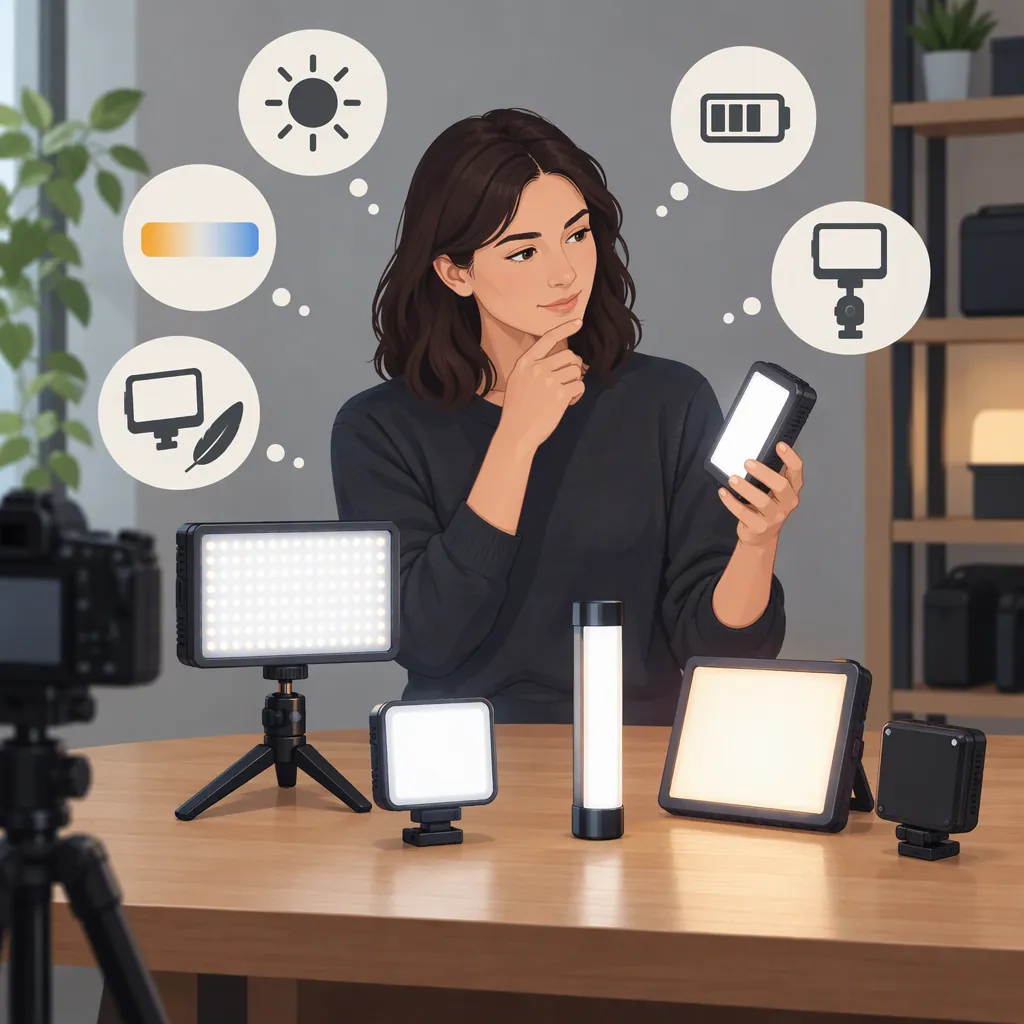
The best portable LED light for video is the smallest complete setup that meets your lighting needs at the distance you actually film. For phone video, prioritize secure mounting, adjustable white light, and manageable power needs. For interviews, also consider diffusion and support equipment. Pocket lights have limits: the supplied Fstoppers review describes a small light as useful for close-range and low-ambient-light work, not as a replacement for powerful studio lighting. These sources do not establish a universal best model. [c1]
Choose the Lighting Role First
Start with the job the light must do, rather than a ranked product list. The supplied sources cover pocket lights, panels, tubes, and compact COB lights—different formats grouped under the same portable-light label. The Lume Cube collection illustrates that range, but it is a retail catalog, not a controlled comparison. [c3]
Use these as starting points for evaluation, not guaranteed performance categories:
| Filming Situation | Format to Evaluate | Main Question |
|---|---|---|
| Handheld phone video | Small panel or pocket light | Can the phone rig support it comfortably? |
| Seated phone interview | Light on a separate support | Can it illuminate the subject with the intended diffusion? |
| Travel footage at dusk | Compact battery-powered light | Is its output useful at your working distance? |
| Colored background accent | RGB pocket light or tube | Does it produce the desired effect in the actual scene? |
A light intended to add a small amount of fill should not automatically be treated as a main interview light. The Fstoppers review specifically distinguishes pocket-light uses from high-output studio lighting. [c1]
Compare Brightness Under Matching Conditions
Do not choose from a wattage label or a brightness number alone. In the supplied GVM guide, brightness testing is described at a specified distance, both bare and with a reflector. That makes distance and modifier configuration relevant details when reading its results; the manufacturer's testing claims are not independently verified here. [c2]
For your own comparison, use the same subject position, framing, camera settings, and room lighting. Evaluate each light at the distance where it will actually sit, with the diffuser or reflector you intend to use.
Also assess the look of the light, not just exposure. The Fstoppers review notes that a pocket-sized source does not inherently provide very soft light and discusses using an umbrella or another modifier when ambient light permits. [c1]
For outdoor filming, avoid assuming that a pocket light will compete with direct sun. The reviewed light's limited usefulness in strong daylight is explicitly noted; that observation is not a measured verdict on every portable light. [c1]
Same-Scene Brightness Check
1. Mark the subject and light positions.
2. Keep room lighting and camera settings unchanged where your camera app permits.
3. Record each candidate at the intended working distance.
4. Repeat with the intended diffusion or reflector.
5. Review the face, shadows, and background—not just the apparent brightness of the fixture.
6. Record the distance and modifier used beside each result.
Evaluate the Whole Phone Rig
Treat mounting as a requirement to verify, not an accessory detail to resolve later. Before choosing a light, list everything sharing the phone rig: phone clamp, microphone, light bracket, cables, and any external battery.
Check whether the proposed arrangement leaves the lens unobstructed, permits portrait and landscape framing, and keeps controls accessible. Confirm the actual mounting interface and included adapters rather than assuming that a light described as on-camera will attach directly to a phone.
For stationary filming, compare a phone-mounted setup with a separately supported light. Choose based on the framing, light placement, and handling you need—not simply the smaller fixture.
The supplied references do not provide a phone-by-phone compatibility matrix. Compatibility with a particular phone, case, cage, or clamp therefore remains an item to verify.
Phone Rig Fit Checklist
- Phone, case, and clamp: __________
- Light mounting interface and required adapter: __________
- Microphone position: __________
- Lens and screen unobstructed: yes / no
- Portrait and landscape framing checked: yes / no
- Charging cable route checked: yes / no
- Controls accessible while mounted: yes / no
- Complete rig comfortable to hold: yes / no
Check Color, Power, and Recorded Results
Separate adjustable white light from creative color effects. The Fstoppers review describes both white color-temperature adjustment and RGB modes, while GVM includes color reproduction and power options in its stated evaluation process. These are distinct comparison dimensions, not proof that any listed model will suit your footage. [c1] [c2]
For a practical assessment, record a face and a familiar neutral object under the light. Where possible, keep white balance fixed during comparisons. Evaluate the recorded result rather than relying only on the light's display or published color scores.
For power planning, record the brightness setting, required session length, charging method, and any external battery or adapter. GVM says it assessed runtime at different brightness settings, so do not treat a single runtime claim as covering every operating condition. [c2]
Include a short recording check at your intended resolution and frame rate. Inspect the footage for visible pulsing or bands, and listen for unwanted operating noise. This is a proposed acceptance test, not a claim that the supplied sources establish flicker-free or silent operation across devices.
Recording Acceptance Test
Record a short clip using the intended phone, camera app, resolution, frame rate, light setting, and mounting arrangement. Review color, shadow appearance, visible pulsing or bands, and recorded noise. Then run the light for the planned session length at the chosen setting. Note any interruptions, setting changes, or power limitations.
Use Rankings as Leads, Not Final Answers
The evidence here has clear limits:
- Fstoppers: A 2019 review of one pocket light, useful for understanding its reported applications and limitations, but not a current market-wide comparison. [c1]
- GVM: A manufacturer-published guide that ranks its own products alongside others. Its tables and prose contain inconsistencies, including model names and specifications, so this article does not adopt its numerical rankings. [c2]
- Lume Cube: A retail collection showing available lighting formats, not independent comparative testing. [c3]
None establishes the best portable LED light for every phone or filming environment. A more defensible choice is the setup that passes your mounting, image-quality, runtime, and handling checks with the fewest unnecessary components.
Portable Light Decision Sheet
Lighting role: __________
Working distance and ambient conditions: __________
Required diffusion or reflector: __________
Phone mounting and support requirements: __________
Required recording duration: __________
Complete kit contents: __________
Unverified specifications or compatibility questions: __________
Acceptance-test result: pass / needs adjustment / unsuitable
FAQ
What Is the Best Portable Led Light for Phone Video?
The supplied sources do not establish one winner. Start with the lighting role, then verify mounting, usable output at your filming distance, and runtime. For close-range fill, a pocket format is worth evaluating; for an interview, assess the light together with its diffusion and support. The Fstoppers review illustrates why pocket-light portability does not imply studio-light output. [c1]
Do I Need RGB for Ordinary Talking-Head Videos?
Treat RGB as an optional creative requirement rather than a default priority. For a straightforward talking-head setup, first evaluate the recorded face under the light's white-light settings. The Fstoppers review describes RGB background effects separately from adjustable white illumination. [c1]
Can a Pocket Led Light Replace a Larger Light Outdoors?
Do not assume it can. The Fstoppers review explicitly notes that its reviewed pocket light cannot overpower strong sunlight. That is a model-specific observation, not a universal measurement. Test any candidate in the intended outdoor conditions before relying on it as the main light. [c1]