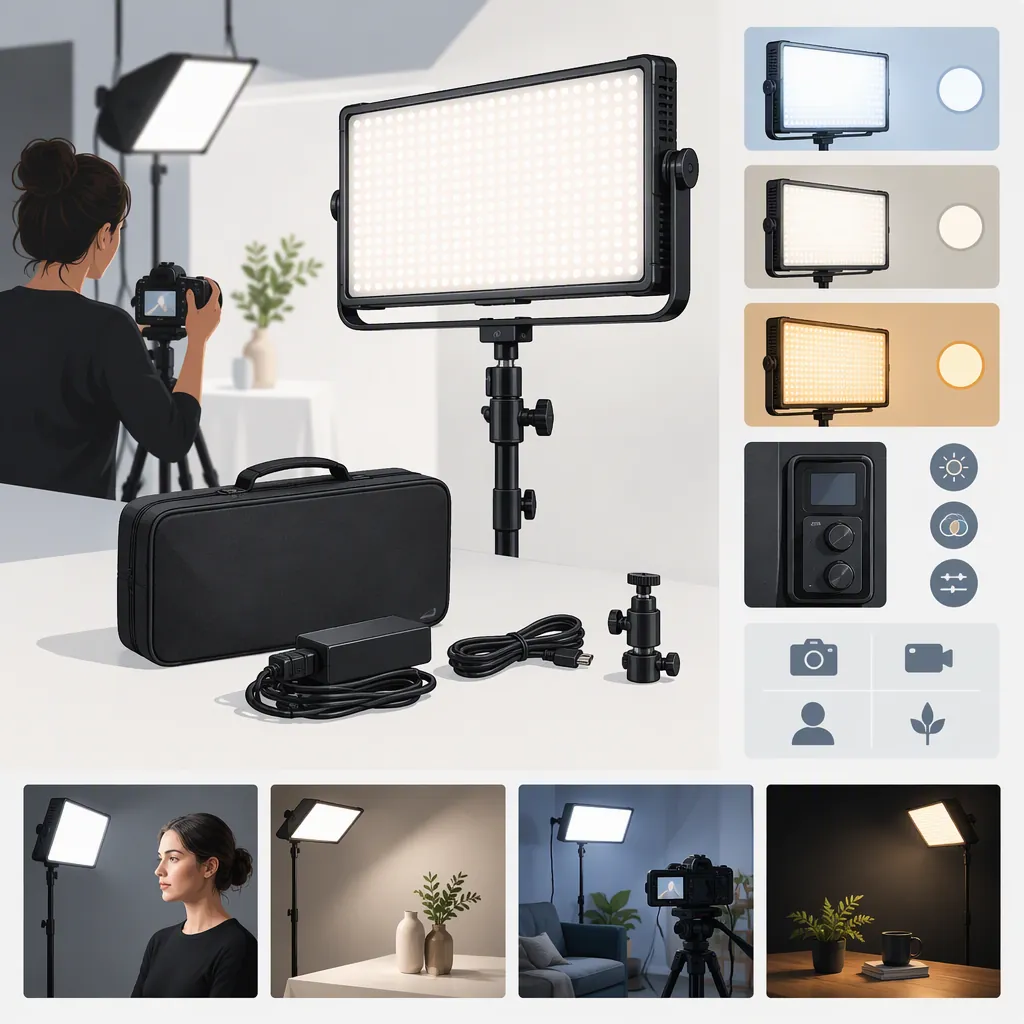
Phottix Nuada R3 Ii Led Light: Choosing It for Filming
To evaluate the Phottix Nuada R3 II LED light for filming, define your working distance, camera settings, coverage needs, and power requirements; verify the exact configuration; then test it against those requirements. The Phottix USA Light Kits collection identifies a Nuada R3 II twin-kit listing, but the collection text used here does not establish its performance or detailed contents. This is a selection guide, not a product review or a finding that the light suits a particular shoot. [c1]
What Is Known—And What Remains Unverified
The public references used for this guide support listing identification, not a performance verdict.
| Reference | What it establishes | What it does not establish |
|---|---|---|
| Phottix USA Light Kits collection | Lists Phottix Nuada R3 II LED Light Twin Kit Set and Phottix Nuada R3a Video LED Light Twin Kit Set as separate entries. [c1] | The collection text used here does not provide output measurements, color performance, flicker behavior, power requirements, or detailed kit contents. It does not establish that the two models have interchangeable specifications or accessories. [c1] |
| Pitman Photo Supply product URL and retrieved text | The URL identifies a Nuada R3 II product page. [c2] | The retrieved page text contains no usable model specifications, so it cannot support claims about brightness, dimensions, color accuracy, controls, or accessories. [c2] |
These limits apply to the material available for this guide; they do not establish that specifications are unavailable elsewhere.
Define Your Filming Requirements First
Before comparing the R3 II with another candidate, write down what a usable lighting setup must accomplish. Treat these as your scene requirements, not as assumed product capabilities.
- Subject and framing: Specify the subject, composition, and any movement the lighting must accommodate.
- Coverage and placement: Record the area that needs illumination and the available light-to-subject distance.
- Camera settings: List every essential frame rate, shutter setting, exposure setting, and white balance.
- Ambient light: Identify whether the setup must work with daylight, room lighting, or a controlled darkened space.
- Appearance: Define acceptable shadows, reflections, background spill, and color appearance.
- Power and handling: Note outlet access, required recording duration, space for stands and cables, transport limits, and setup time.
Evaluate the complete working configuration, including support equipment and power accessories. Do not assume an accessory is included merely because the listing is described as a kit.
Filming Requirements Worksheet
| Requirement | Your planned conditions or acceptance criteria |
|---|---|
| Subject, framing, and movement | ____ |
| Required illuminated area | ____ |
| Available light-to-subject distance | ____ |
| Camera, frame rate, and shutter setting | ____ |
| Exposure and white balance | ____ |
| Ambient conditions | ____ |
| Acceptable shadows, reflections, and spill | ____ |
| Power access and required recording duration | ____ |
| Support equipment, packed size, and setup time | ____ |
Set acceptance criteria before testing. For example, specify whether the entire presenter’s movement area must remain usable or whether a fixed seated position is sufficient. There is no universal numerical pass threshold in this guide.
Verify the Exact Model and Configuration
Seek documentation that explicitly names Nuada R3 II and matches the unit or kit being evaluated. Record the document title and version so you can distinguish confirmed information from assumptions.
| Item to verify | Information to record |
|---|---|
| Output | Measurement distance, settings, and test conditions—not just an isolated output figure |
| Color settings and rendering | Available settings and the conditions behind any stated measurements |
| Dimming and video behavior | Controls and any documented flicker limitations |
| Power | Required inputs, compatible accessories, and stated operating limits |
| Physical setup | Dimensions, weight, mounting requirements, and support compatibility |
| Kit contents | Exact included items and anything required separately |
Mark missing information as unverified. Do not fill gaps with R3a specifications: the Phottix USA collection lists R3a and R3 II separately and does not establish equivalence. [c1]
For power and mounting, obtain exact-model compatibility information before operating an evaluation setup. A camera test is not a substitute for confirming those requirements.
Run a Repeatable Camera Test
If an evaluation unit is available, test the configuration you would actually use. The following is a proposed procedure, not a report of testing the R3 II.
- Recreate the planned placement. Position the light at the intended distance and angle, with representative ambient conditions.
- Fix camera settings. Set exposure and white balance manually so automatic adjustments do not obscure comparisons.
- Record the intended scene. Include the actual framing and any subject movement required by the shoot.
- Check every essential video setting. Record at each planned frame rate and shutter setting, using the light settings you expect to need.
- Inspect the footage. Look for visible banding, brightness variation, unwanted color changes, inadequate coverage, distracting shadows, reflections, and background spill.
- Check the required duration. Within confirmed operating limits, run a session representative of the planned recording time and log interruptions or changes.
Compare candidates under the same conditions where practical. If you change placement, camera settings, or accessories to solve a problem, record the change and repeat the affected tests.
Camera Test Log
| Test field | Record |
|---|---|
| Exact model, configuration, and accessories | ____ |
| Position, distance, angle, and ambient conditions | ____ |
| Camera, lens, frame rate, and shutter setting | ____ |
| Exposure, white balance, and light settings | ____ |
| Coverage and exposure against requirements | ____ |
| Visible banding or brightness variation | ____ |
| Color appearance, shadows, reflections, and spill | ____ |
| Session duration and interruptions | ____ |
| Result: Pass / Fail / Unverified | ____ |
| Untested conditions or unresolved requirements | ____ |
Turn the Results into a Selection Decision
Use your written scene requirements—not an assumed R3 II performance standard—to classify the result.
- Pass for the tested scene: The configuration meets your exposure, coverage, appearance, and continuous-recording requirements; every essential camera setting has been checked; and necessary power and mounting compatibility are confirmed.
- Fail for the tested scene: A required setting produces unacceptable banding, coverage is insufficient, or another essential requirement remains unmet after adjustments that are practical for the shoot.
- Unverified: An essential setting has not been tested, necessary configuration or power information is missing, or the evaluation does not represent the planned scene.
A pass applies only to the tested configuration and conditions. It does not establish performance at every distance, dimming level, frame rate, or environment.
If You Cannot Access an Evaluation Unit
Separate questions that documentation can answer from questions that still need footage or hands-on evaluation.
Exact-model documentation can help confirm kit contents, power compatibility, mounting requirements, and stated measurement conditions. For footage-based questions, look for material that identifies the model, camera settings, light settings, placement, and ambient conditions. A sample without those details should not resolve a setting-specific requirement.
Keep critical unknowns marked unverified. If an essential filming requirement cannot be confirmed, leave suitability unresolved rather than treating missing evidence as a pass.
FAQ
Is the Phottix Nuada R3 Ii Suitable for Filming?
Suitability depends on the shoot. The Phottix USA Light Kits collection text used here identifies an R3 II twin kit but does not establish the performance needed for a specific filming setup. Use exact-model documentation and representative camera tests to reach a scene-specific decision. [c1]
Can I Use R3a Specifications or Assume What the R3 Ii Twin Kit Includes?
No equivalence is established by the Phottix USA collection: it lists R3a and R3 II separately and does not provide detailed R3 II kit contents in the text used here. Confirm specifications and accessories against documentation for the exact R3 II configuration. [c1]
What Should I Test First?
Start at the intended working distance and framing, using an essential frame rate and shutter setting with fixed exposure and white balance. Check whether coverage and exposure meet your requirements and whether visible banding is acceptable. Then repeat for every other essential setting and the required recording duration.
What If Specifications or a Test Unit Are Unavailable?
Keep unresolved requirements marked unverified. The Pitman Photo Supply page text retrieved for this guide contains no usable model specifications; it cannot fill those gaps. Seek exact-model documentation, and do not treat an undocumented sample clip or similar model’s specifications as confirmation. [c2]