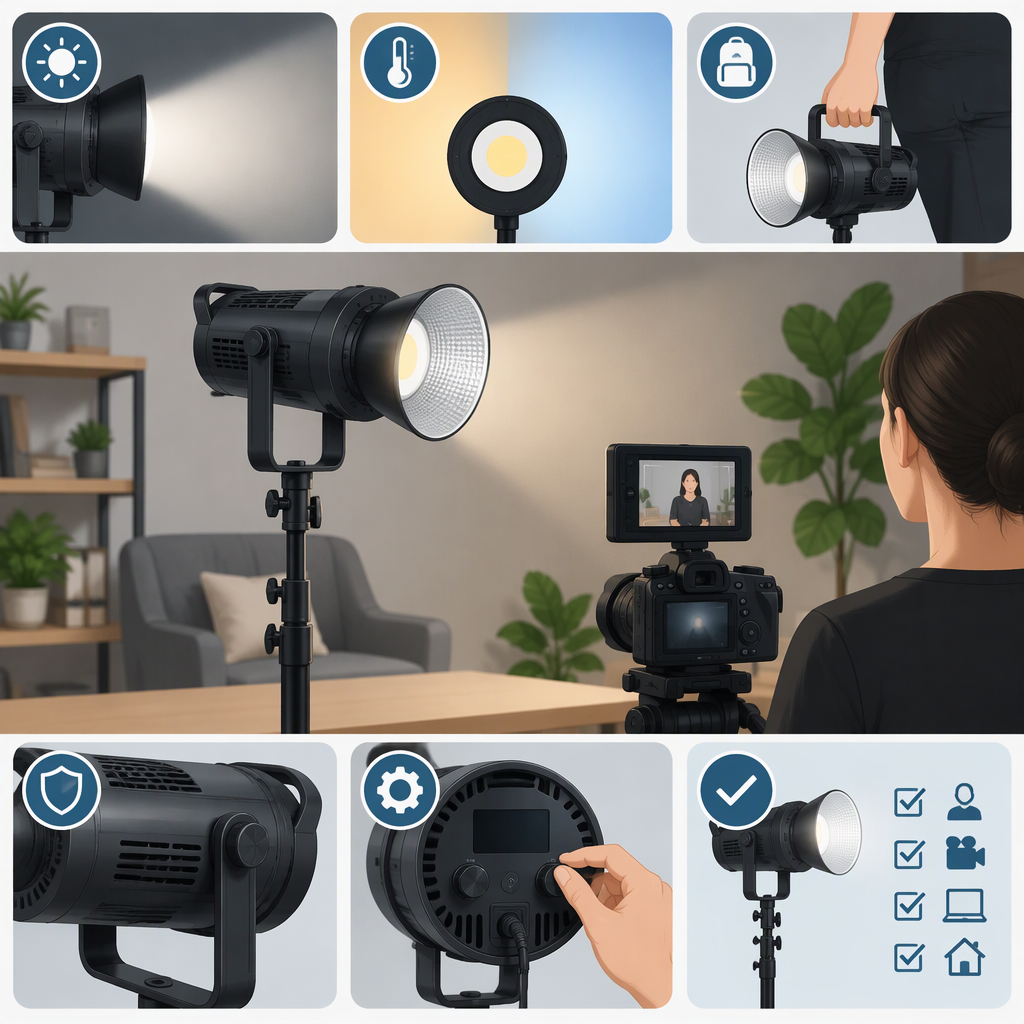
How to Evaluate the NeEwer Cb60 for Your Filming Setup
If you’re considering the NEEWER CB60, start with the shot you need to light—not the product name or a wattage figure in a search query. Note your subject distance, framing, existing light, and any modifier you plan to use. Then compare those requirements with information in the exact listing. If a decision-critical detail is missing, verify it before deciding; this guide does not establish CB60 specifications or judge its performance.
1. Define the Shot You Need to Light
Write down four things before comparing lights:
- Subject distance: Where would the light need to sit relative to your subject in the actual space?
- Framing: Are you lighting one person or a wider area? Where does the light need to reach?
- Ambient light: What light will already be present, and do you need to work with it or change its influence on the scene? Lighting references discuss both measuring light on the subject and managing exposure relationships between light sources. (sekonic.com)
- Planned modifier: Will you use diffusion, a softbox, or another attachment? Check both whether it can be used with the exact light and how that setup affects the light you need at the subject. Modifier configurations can affect measured output: for example, Manfrotto reports a two-stop loss for a particular softbox setup using its inner and outer diffusers. That figure applies to that stated setup, not to the CB60 or to modifiers generally. (manfrotto.com)
These details help you define what to verify instead of relying on a headline wattage or an output number without context. Lighting technical materials can report illuminance at specified distances and in specified configurations, so compare figures only when their conditions are clear and relevant to your setup. (arri.com)
2. Check the Exact Listing—Not Just the Search Term
Use the listing for the particular item you’re considering and ask:
- Identity: Does the model or version match the one you intend to evaluate? Are accessories or package contents clearly identified?
- Output information: Is a light-output figure provided? If so, what unit, distance, beam or operating mode, and attachments does it refer to? If those conditions are absent, treat the number as incomplete for your comparison. Manufacturer photometric materials illustrate why context matters: ARRI presents output figures alongside factors such as distance, color temperature, and beam angle. (arri.com)
- Color information: Does the listing provide the color settings or color-rendering information you need for your camera and footage? If color consistency is important, note exactly what is stated and what is not; don’t infer performance from a label alone.
- Power and control: Are the power arrangements and control options described, and do they fit how and where you film?
- Mounting and modifiers: Does the listing specify the mounting method and compatible attachments you plan to use? Confirm the exact combination rather than assuming compatibility.
- Included items: Is each item you need for your setup explicitly included, or would you need to source it separately?
The keyword “60w” is not, by itself, verification of a specification, output at the subject, or performance in a particular setup. If the listing does not answer a question that matters to your shot, record it as unknown rather than filling in the gap.
3. Weigh the Constraints That Matter Most
A useful comparison is between your actual requirements and what the listing documents—not between product names in isolation.
- Distance and space: If your room forces the light farther from the subject than you would prefer, look for output information measured under conditions relevant to that placement. If the listing does not provide enough context to assess it, verify the detail or compare another lighting approach.
- Modifier and intended look: If you plan to diffuse or reshape the light, verify both compatibility and information about the resulting configuration. A bare-light figure may not answer the question you have about a modified setup. The example of a particular diffuser combination losing two stops illustrates why the configuration needs to be specified; it is not a prediction for this product. (manfrotto.com)
- Color and control: If you need a particular color setting or a specific way to adjust the light, check that the exact listing documents it. Balance those needs against how simple you want your filming setup to be; the page alone should not lead you to assume undocumented controls or color characteristics.
- Location and power: If you film away from a convenient power source or need to move equipment often, make power arrangements, mounting, and included accessories part of your decision. Verify those details in the listing rather than assuming what a package contains.
4. Choose a Next Step
Use this conditional decision path:
- Possible fit to investigate: Your shot requirements are clear, and the exact listing documents the information you need to compare. That gives you a basis to consider the option for your setup; it is not proof of a result.
- Verify first: A decision-critical detail—such as output conditions, modifier compatibility, power, or included items—is missing or ambiguous. Look for reliable documentation for the exact listing before relying on it.
- Compare another approach: The documented details do not answer your needs, or the setup constraints point elsewhere. Compare approaches using the same shot, placement, modifier, color, and power criteria; this guide does not rank products.
Hypothetical example: Suppose a creator first plans a close, tightly framed talking-head shot, then changes to a wider frame in a larger room and decides to add diffusion. Those are different evaluation conditions. The creator should reassess the needed coverage and placement, then look for listing information that addresses the intended modified setup. If it does not, the next step is to verify the missing information or compare another approach—not to assume the light will or will not work.
Bottom Line
Evaluate the NEEWER CB60 in relation to your shot and the evidence in the exact listing. Define distance, framing, ambient light, and modifiers first; check output conditions and the practical details that matter to your location; and treat missing information as unknown. That supports a reasoned next step without making an unsupported claim that the CB60 is suitable or unsuitable.