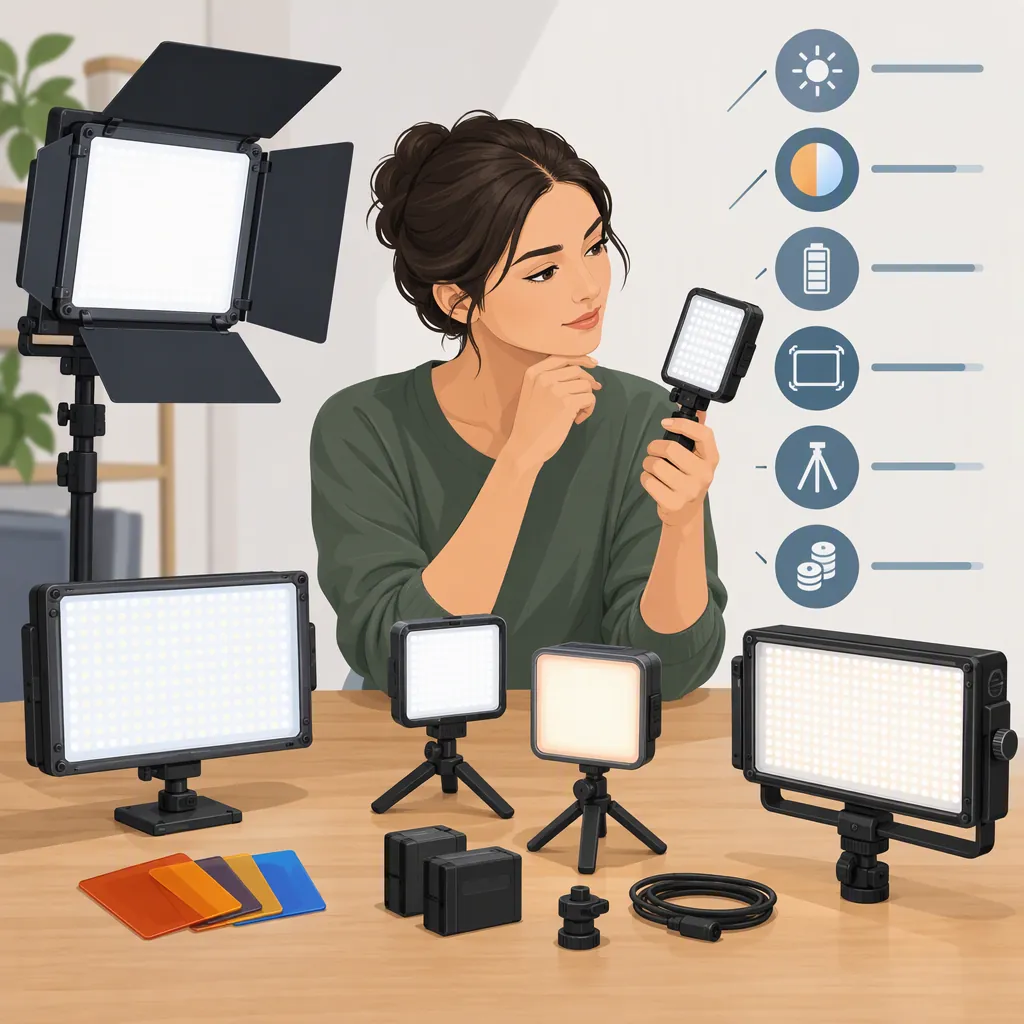
How to Choose the Best Led Video Light for Your Shoot
Choose the best LED video light for the job it must do: illuminate a subject, provide fill, or add a background accent. For a main light, prioritize usable output with your intended modifier, then check color settings, mounting, power, and recorded noise. PetaPixel’s guide separates subject lighting from set decoration and discusses different fixtures for those roles; it does not establish one universal winner. [c1]
Define the Light’s Job First
Before comparing fixtures, describe the shot: how many people appear, how much of each person is visible, where the light can stand, and whether it must travel.
Separate the main light from decorative lighting. A fixture chosen to appear in the background does not automatically meet the requirements of a light aimed at a presenter. PetaPixel’s guide explicitly distinguishes lighting a subject from designing a set, and describes bulbs and tubes with accent-oriented uses. [c1]
For a main-light shortlist, require evidence relevant to your framing and available placement. For an accent-light shortlist, focus on the intended appearance, positioning, and controls. Avoid comparing these two roles as though they were interchangeable.
Shoot Requirements Worksheet
- Primary role: main light / fill / rim / background accent.
- Framing: close-up / seated presenter / full body / multiple people.
- Available light position and distance: ____.
- Intended modifier: ____.
- Recording duration: ____.
- Available power: ____.
- Maximum total kit budget: ____.
- Transport and storage limits: ____.
Compare Formats and Modifier Compatibility
Use fixture format as a starting point, not a quality ranking. PetaPixel describes single-source COB (chip-on-board) lights as adaptable to different modifiers, while also covering compact panels, tubes, and practical bulbs. [c1]
If your plan includes a softbox or another modifier, verify the exact mount and compatibility before selecting a fixture. Include the modifier’s dimensions in your space plan, rather than measuring only the light itself.
For a compact panel, check how it mounts and how you will position or modify it. For a tube or bulb, decide whether it needs to illuminate the subject or simply contribute to the scene. The source’s examples show that some small fixtures are discussed primarily as rim, fill, or accent lights; those examples are not a rule for every product in the format. [c1]
Format Comparison Checklist
- Does this fixture suit the assigned lighting role?
- Is the intended modifier explicitly compatible?
- Will the assembled light, modifier, and stand fit the space?
- Can the mount support the intended orientation?
- Are any required adapters or brackets included?
- Is there relevant evidence for this setup, rather than only an unrelated use case?
Evaluate Output, Power, and Sound Together
Compare evidence that resembles your intended setup. PetaPixel discusses output in relation to a softbox, presenter framing, and the size of the set, rather than presenting one output level as sufficient for every shoot. It also addresses fan noise and battery-duration limitations in individual examples. [c1]
Treat these as separate checks:
- Usable output: Seek a demonstration or measurement with the intended distance and modifier. Mark comparisons with different test conditions as uncertain.
- Color: Check the available color-temperature settings and look for camera footage relevant to skin tones or the objects you film.
- Sound: Listen to a recording with the light operating near the microphone position you expect to use.
- Power: Verify runtime at the intended setting and whether external power supports your planned recording duration.
- Complete setup: Count the stand, modifier, power accessories, and mounting hardware in the total kit cost.
These are selection checks, not performance guarantees. The supplied material does not provide standardized comparative testing across all candidates.
Candidate Evidence Log
For each candidate, record:
- Model and exact version: ____.
- Relevant output evidence and test conditions: ____.
- Intended modifier compatibility: verified / unknown.
- Color evidence: ____.
- Recorded sound evidence: ____.
- Runtime or external-power evidence: ____.
- Complete kit cost: ____.
- Unresolved requirements: ____.

Keep unknowns visible instead of assigning them a passing score.
Use a Repeatable Test, Not an Old Ranking
If you can evaluate a candidate, use your actual camera, microphone, framing, and intended light position. Keep camera settings consistent during the comparison, record a short clip, and inspect the picture and sound. Repeat at the dimming levels you expect to use, noting any visible brightness variation or unwanted recorded noise.
This is a proposed evaluation workflow, not a report of firsthand testing.
The substantive supplied reference is PetaPixel’s guide dated July 7, 2023. Its role-based discussion is useful context, but it does not verify current availability, pricing, or the best model in 2026. [c1] This article therefore offers selection criteria rather than a current product ranking.
Practical Comparison Procedure
1. Assemble the intended stand, fixture, and modifier according to their instructions.
2. Set the intended subject position, framing, and microphone placement.
3. Record the camera settings and light settings.
4. Capture a short clip at each intended brightness level.
5. Review exposure, color, shadows, visible brightness variation, and recorded sound.
6. Check whether power and controls fit the planned session.
7. Record pass, fail, or unknown for each requirement before comparing candidates.
FAQ
Is There One Best Led Video Light for Every Shoot?
The provided evidence does not support a universal winner. PetaPixel separates subject lighting, practical bulbs, set decoration, tubes, and compact panels into different categories. Choose against a defined shooting requirement rather than combining all those uses into one ranking. [c1]
Can a Small Led Light Serve as a Main Light?
Possibly, but verify it in the intended setup. PetaPixel describes output limitations for some compact bulbs and tubes while also discussing a compact panel. Size or format alone is not enough evidence that a fixture will meet your framing and exposure needs. [c1]
What Should I Check Besides the Light Itself?
Check modifier compatibility, mounting, power arrangements, controls, and recorded noise. The supplied guide discusses modifier mounts, mounting options, fan noise, and battery or external-power considerations in its examples. Confirm each requirement for the exact fixture you are considering. [c1]