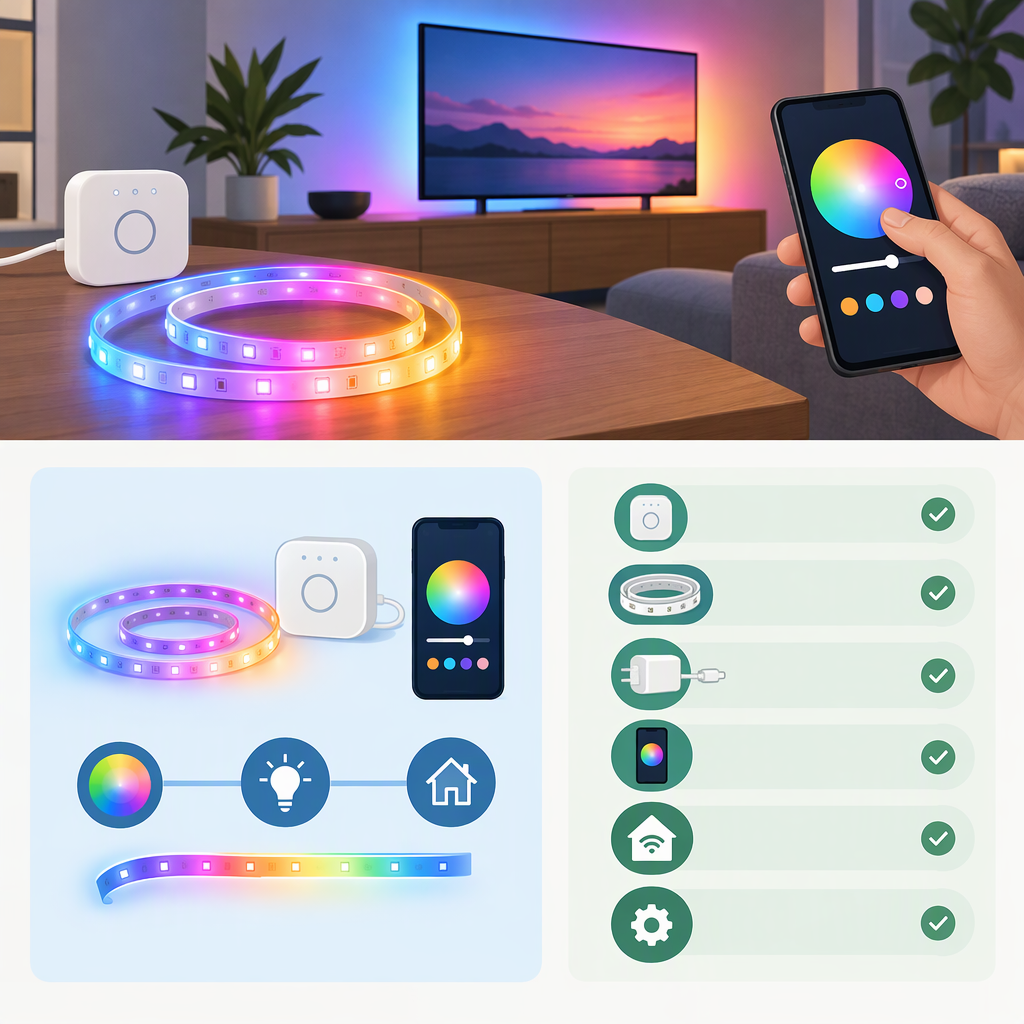
Hue Led Light Strip: What It Means and What to Check
A search for “Hue LED light strip” most likely concerns a Philips Hue smart light strip for home lighting—for example, accent lighting around shelves, cabinets, or a TV. The English-language results reviewed for this article leaned toward Hue product listings and home-lighting information, rather than filming or stage-lighting guidance. Philips Hue’s US site describes its strips for home settings and lists several product types, so the exact model matters. (philips-hue.com)
Before deciding whether a strip fits your needs, identify its exact name and model, then check its intended location, dimensions, power arrangement, and any cutting, extension, or control requirements in that model’s documentation. Don’t assume those details carry across the Hue range.
First, Identify Which Kind of Light Strip You Mean
“Hue LED light strip” is a broad search phrase, not a specific model name. Philips Hue’s US range includes different kinds of strips, including products described for home accent lighting, outdoor use, and TV-related setups. The manufacturer’s support page also lists separate questions about cutting strips, extending them, connecting different types, and choosing a strip for a TV or monitor. Those distinctions are a reason to start with the exact product label—not with a general claim about what every Hue strip can do. (philips-hue.com)
If your goal is ordinary room or accent lighting, focus on the strip’s installation context and documented features. If you mean lighting for filming, that is a different question: the results reviewed here do not establish that filming is the main intent behind this search, or provide enough evidence to assess a particular strip’s performance as a key light. A strip used as a decorative background element and one intended to illuminate a person or scene have different requirements. Don’t infer on-camera suitability from a home-lighting description alone.
What to Verify Before Choosing a Hue Led Strip
Use this checklist for the specific model you are considering. It identifies what to look up; it does not assume that any particular model has a given feature.
- Exact product name and model. Record the full name and model or product number from the listing, packaging, or device label. Similar names can refer to different product types or generations.
- Intended location. Check whether the documentation describes the product for indoor or outdoor use and whether its installation guidance matches your planned location. Don’t treat an indoor model as suitable for outdoors unless its documentation says so.
- Length and layout. Measure the path where the strip will go, including corners and gaps. Compare that plan with the model’s listed length and installation instructions.
- Cutting and extensions. If you need a custom length, verify whether that exact strip can be cut, where its marked cut points are, and whether any remaining section can be reused. If you need more length, confirm which extension—if any—is compatible. Hue’s support center treats cutting, extending, and connecting different strip types as separate model-specific questions. (philips-hue.com)
- Power and controls. Check what is included, where the power supply must sit, and which control method or Hue system components the model requires. Confirm requirements in the documentation for that exact product rather than generalizing from another Hue strip.
- The effect you want. Look for the manufacturer’s description of light distribution and intended placement. For instance, a product described for concealed, indirect accent lighting may not match a plan for an exposed strip or a different lighting task. The Hue comparison page distinguishes strip types by factors such as light distribution and placement. (philips-hue.com)
A Quick Example
Suppose you want to add lighting behind a bookcase. First measure the intended route and note where the power outlet is. Then match those constraints against a specific model’s length, installation guidance, and power arrangement. If the route is longer than the listed strip, check the manufacturer’s compatibility guidance before assuming an extension will work. This example is a planning method, not a claim that a particular model will fit your bookcase.
Where to Confirm the Details
Use the manufacturer’s page for the exact model and its accompanying documentation. The Philips Hue US site has a strip-light product catalog, a product comparison page, manuals, and a support section that specifically addresses common questions about cutting, extensions, compatibility, and TV or monitor placement. These are useful starting points, but the answer still needs to match the model you have identified. (philips-hue.com)
Bottom line: “Hue LED light strip” generally points to Philips Hue home-lighting products, but it does not identify one particular strip. Choose what to investigate by first confirming the exact model and intended use, then checking that model’s documented fit, installation, power, and compatibility details. If your real question is about filming, look for sources and criteria specific to filming rather than treating home accent-lighting information as proof of camera-lighting performance.