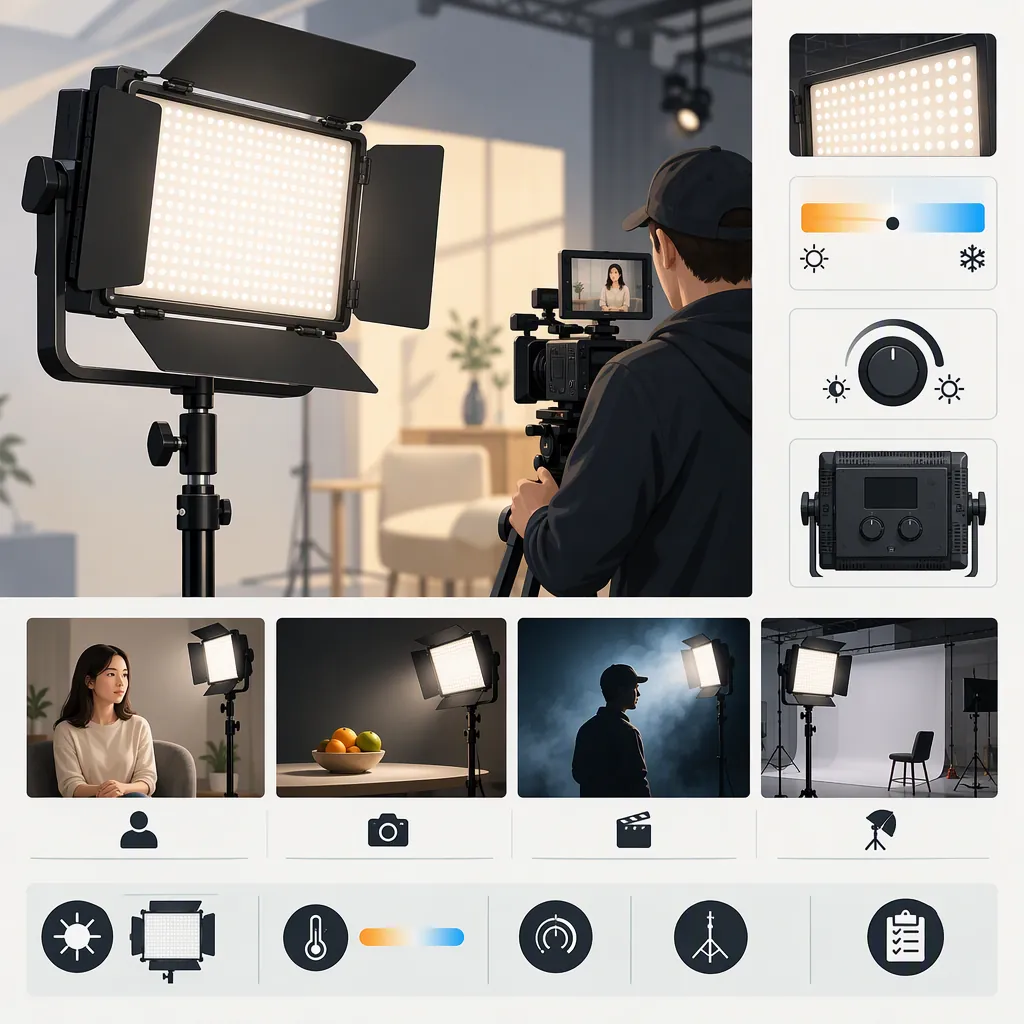
How to Evaluate a GVM Led 480Ls for Your Filming Setup
Evaluate the GVM LED 480LS against your intended shot rather than treating the model name as a guarantee of suitability. First confirm the exact model and kit: the supplied collection page uses GVM-480LS, while the comparison article discusses GVM-480LS-B. Then assess placement, exposure, color, recording behavior, power, and accessories. These manufacturer sources are not independent performance tests. [c1] [c2]
Confirm the Exact Model and Kit
The supplied GVM collection page names a GVM-480LS two-light kit. The supplied comparison article instead discusses GVM-480LS-B and identifies single-, two-, and three-panel configurations. Do not assume those names establish identical hardware or package contents. [c1] [c2]
Before evaluating suitability, record the full model designation, kit identifier, and itemized contents for the particular package under consideration. Treat battery inclusion, stands, modifiers, adapters, and control compatibility as details to verify—not assumptions based on a family name.
This guide does not establish output, color accuracy, runtime, flicker performance, or accessory compatibility for a particular unit.
Model Verification Worksheet
- Exact model designation: ______
- Kit identifier: ______
- Number of panels required: ______
- Included stands and mounting hardware: ______
- Included modifiers and power accessories: ______
- Documentation matches the exact model: Yes / No / Unclear
- Unresolved differences between listing and documentation: ______
Define the Shot Before Choosing Lights
Start with a lighting brief rather than a preferred number of panels. Identify the subject, framing, background, available placement space, and whether the setup must accommodate movement.
For a seated interview, begin by planning one main light position and evaluating the resulting image. Add a separate fill or background-lighting requirement only when the intended look calls for it. For tabletop filming, specify which surfaces and reflections must remain visible. For location work, include transport, access to power, and setup time in the brief.
Use these requirements as evaluation criteria, not as evidence that the 480LS will meet them.
Shot Requirements Checklist
- Subject and framing: ______
- Intended main-light position and distance: ______
- Available floor space and stand clearance: ______
- Window and existing room-light conditions: ______
- Desired shadow and background appearance: ______
- Camera frame rate, shutter setting, aperture, and ISO: ______
- Required recording duration: ______
- Acceptable setup and transport burden: ______
Evaluate the Light with Your Camera
If a unit is available for evaluation, use a repeatable camera test rather than relying on promotional descriptions. Keep camera settings fixed during each comparison, and record the light position and settings for every take.
Test the intended working distance and modifier arrangement. Inspect the footage for usable exposure, shadow appearance, distracting reflections, color differences, and visible banding. Repeat at the frame rates and shutter settings you intend to use. Record quiet-room audio with the light operating to check whether the setup introduces an audible problem.
Treat any result as specific to the tested unit, camera, settings, and environment. A satisfactory clip does not establish performance under every recording condition.
Repeatable Evaluation Procedure
1. Reproduce the intended framing and room-light conditions.
2. Set manual exposure and white balance; record the settings.
3. Position the light at the intended working distance.
4. Record a short clip with the planned modifier arrangement.
5. Change only one light setting or position at a time.
6. Repeat at each planned frame rate and shutter setting.
7. Review exposure, color, shadows, reflections, banding, and audio.
8. Label each requirement Pass, Fail, or Not Tested, with notes.
Separate Documentation from Demonstrated Suitability
Both supplied references are hosted on GVM's shop domain: one is a collection listing, and the other is a manufacturer comparison article. Their descriptions provide documentary context, not independent verification of performance. [c1] [c2]
For a decision, separate three categories: what the exact package documentation states, what an evaluation demonstrates, and what remains unknown. Keep untested requirements visible—especially operation across the full recording session, control compatibility, and the complete support-and-power arrangement.
If testing is unavailable, make a conditional assessment rather than declaring the light suitable. The references alone do not establish whether it meets a particular production's requirements.
Decision Record
- Requirement: ______
- Exact-model documentation available: ______
- Evaluation performed and conditions: ______
- Result: Pass / Fail / Not Tested
- Remaining uncertainty: ______
- Overall assessment: Meets tested requirements / Does not meet requirements / Insufficient evidence
FAQ
Are GVM-480ls and GVM-480ls-B Interchangeable Names?
The supplied collection page uses GVM-480LS, while the comparison article uses GVM-480LS-B. This guide does not establish that they identify identical hardware. Match the exact designation to the relevant documentation before applying specifications or compatibility information. [c1] [c2]
Should I Choose One, Two, or Three Lights?
Plan the lighting roles first. Evaluate the main-light arrangement, then identify whether the shot requires separate fill, background, or separation lighting. Select the panel count from those requirements rather than assuming a larger kit is necessary.
Do the References Prove That the 480Ls Is Suitable for My Filming Setup?
No. They provide manufacturer descriptions, not independent testing for your camera and environment. Suitability remains conditional until the exact configuration is checked against your exposure, placement, color, recording, power, and handling requirements. [c1] [c2]