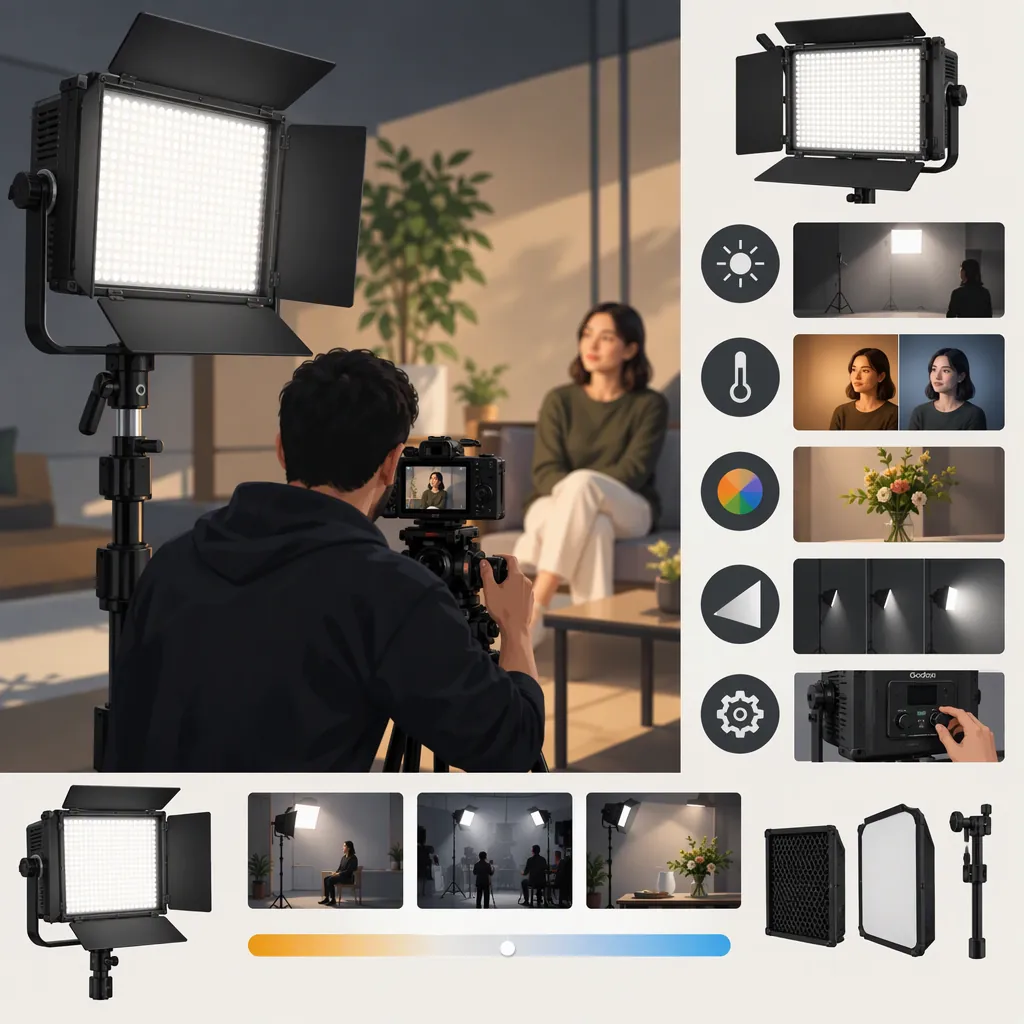
Godox Led1000w: How to Choose a Light for Filming
To evaluate a light listed as “godox led1000w,” first confirm its exact model, then check whether the complete setup meets your filming requirements. Woodland Hills Camera identifies an LED1000D II, while Focus Camera identifies an LED1000Bi II. These listings do not verify a model explicitly named LED1000W or establish its specifications. [source_1] [source_2]
Base your selection on the intended shot, documented power and mounting requirements, and footage recorded under your planned conditions—not on the search term alone.
Confirm the Model Before Comparing Specifications
Record the full model designation from the fixture label, including suffixes and generation numbers. Compare it with the listing title and documentation for that exact unit. The two retailer listings name different models, so keep their specifications attached to those models rather than treating them as interchangeable. [source_1] [source_2]
Do not interpret “1000w” in the search phrase as verified wattage. If the label, listing, and documentation disagree, leave the identity unresolved rather than filling the gap with specifications from a similarly named light.
Model Identification Record
- Search term: godox led1000w
- Exact model on fixture label: ______
- Exact model in listing: ______
- Generation and suffix: ______
- Documentation matches the fixture: Yes / No / Unconfirmed
- Unresolved discrepancies: ______
Define What the Light Must Do
Write a short lighting brief before comparing fixtures. Specify whether the light will serve as a key, fill, background, or accent, and identify the space available for the fixture, stand, and any modifier.
Define an acceptable result for the actual shot:
| Filming situation | What to include in the test | Selection question |
|---|---|---|
| Controlled interview | Face, background, intended framing, and microphone recording | Can the setup produce acceptable exposure, facial shadows, and audio? |
| Tabletop filming | Reflective surfaces, product details, and close-up framing | Can you control reflections and shadows without compromising the shot? |
| Mixed-light scene | Subject and existing light sources together | Are subject colors acceptable at the intended white balance? |
| Location shoot | Available outlets, stand space, cable routes, and recording duration | Can the complete setup operate within the location’s constraints? |
These are general evaluation criteria, not performance claims about LED1000W.
Filming Requirements Brief
- Shot type and framing: ______
- Intended lighting role: ______
- Subject-to-light distance: ______
- Planned modifier or diffusion: ______
- Existing light sources: ______
- Planned camera settings: ______
- Available power and placement space: ______
- Required recording duration: ______
- Acceptable exposure, color, shadows, and audio: ______
Check Power, Support, and Included Accessories
The Woodland Hills Camera and Focus Camera listings contain power, mounting, and accessory information for their respective named models. Those details do not confirm the contents or requirements of an LED1000W package. [source_1] [source_2]
For the exact unit under consideration, verify:
- Power: Required adapter, electrical specifications, and documented battery compatibility.
- Support: Mounting interface, fixture weight, support equipment’s load rating, and assembled stability.
- Modifiers: Compatibility of the intended diffusion or other light-shaping accessory.
- Package contents: Which adapters, cables, mounts, and accessories are actually included.
- Location fit: Whether stand placement and cable routing are practical for the shot.
Keep compatibility separate from inclusion: an accessory that works with a fixture is not necessarily part of the package. If battery runtime matters, test the intended battery at the operating settings you plan to use rather than assuming a duration from another model’s listing.
Setup Verification Checklist
- Exact-unit power requirements checked: ______
- Adapter and cable contents confirmed: ______
- Battery compatibility and inclusion checked: ______
- Mounting interface and support rating checked: ______
- Intended modifier compatibility checked: ______
- Cable route and stand placement reviewed: ______
- Required runtime tested or still unverified: ______
Run a Repeatable Camera Test
If a test unit is available, use the camera, lens, framing, light placement, and modifier intended for the shoot. Establish a baseline before making adjustments.
For comparisons, hold the camera position, subject position, light distance, ambient lighting, exposure, and white balance constant unless one of those is the variable being tested. Change one variable at a time and record the change. Avoid automatic exposure or white-balance changes during controlled comparisons.
- Record the baseline. Note the exact model, power source, modifier, brightness, available color setting, and camera settings.
- Film the intended subject. Include relevant faces, surfaces, background details, and reflections.
- Compare operating settings. Test the brightness and color settings you expect to use, where available, while keeping other conditions fixed.
- Check motion artifacts. Record each planned frame-rate, shutter, and dimming combination separately. Review for visible banding or flicker.
- Check audio. Record with the intended microphone position and the light operating. Note any unwanted noise without assuming its cause.
- Check duration. Run the intended power arrangement for the required recording period and record interruptions or changes.
- Adjust and retest. If a problem appears, document one adjustment and repeat the relevant test.
When testing a different frame rate or shutter setting, record it as a separate condition rather than treating it as equivalent to the baseline. If an exposure adjustment is also necessary, document that change.
Camera Test Log
- Exact model: ______
- Camera and lens: ______
- Frame rate and shutter setting: ______
- Exposure and white balance: ______
- Light distance, brightness, and color setting: ______
- Modifier and power source: ______
- Ambient-light conditions: ______
- Variable changed in this test: ______
- Visual observations: ______
- Audio observations: ______
- Test duration and power observations: ______
- Adjustment made: ______
- Retest result: ______
- Untested conditions: ______
Turn the Results into a Selection Decision
Use the following conditions to interpret your notes. They are general selection rules, not conclusions about the performance of an unverified LED1000W unit.
| Observation in the planned setup | Next step | Decision |
|---|---|---|
| Required exposure, color, shadow control, audio, and duration are acceptable; power and support are verified | Record the successful configuration and its limits | Meets brief for the tested setup |
| Required exposure cannot be reached at the planned distance with the intended diffusion | Test a permitted change in placement, modifier, or lighting arrangement; consider another fixture if the shot’s constraints cannot be met | Needs adjustment, or does not meet brief if retesting fails |
| Subject color is unacceptable with existing lights | Adjust white balance or the light-source combination one variable at a time, then retest | Needs adjustment until acceptable results are recorded |
| Reflections or shadows interfere with the shot | Adjust placement or light shaping within the available space, then retest | Needs adjustment, or does not meet brief if no workable arrangement is found |
| Visible banding or flicker appears at a required camera and dimming combination | Retest documented alternatives that still meet the shot requirements | Does not meet brief for that combination if the issue remains |
| Unwanted noise is audible in the intended recording | Compare recordings with the light on and off; test a permitted placement or audio adjustment | Needs adjustment, or does not meet brief if noise remains unacceptable |
| Power or support requirements cannot be satisfied | Resolve the documented requirement before using the configuration | Not ready for the shoot |
| Required duration is not achieved | Test a documented compatible power arrangement and repeat the duration test | Does not meet the duration requirement until verified |
| Model identity or essential performance conditions remain unverified | List the missing documentation or tests | Insufficient evidence |
“Needs adjustment” is not a pass. Treat a configuration as meeting the brief only after the adjusted setup has been retested successfully. A successful test supports that configuration—not every distance, modifier, camera setting, or power source.
Final Decision Record
- Decision: Meets brief / Needs adjustment / Does not meet brief / Insufficient evidence
- Conditions supporting the decision: ______
- Adjustments still required: ______
- Unresolved requirements: ______
- Configuration to reproduce: ______
FAQ
Do the Led1000d Ii and Led1000bi Ii Listings Verify Led1000w or Its Specifications?
No. Woodland Hills Camera’s listing identifies LED1000D II, and Focus Camera’s listing identifies LED1000Bi II. They do not verify a model explicitly named LED1000W or establish that its specifications match either fixture. Keep each listing’s information attached to its named model unless matching documentation confirms the unit’s identity. [source_1] [source_2]
How Do I Decide Whether the Light Is Suitable for My Filming Setup?
Define the required exposure, color, shadow control, audio quality, placement, and recording duration before testing. Select “Meets brief” only when the tested configuration satisfies those requirements and its power and support arrangements are verified. If an essential requirement fails after practical adjustments, that configuration does not meet the brief.
What If I Cannot Test the Light Before Selecting It?
Separate documented requirements from unresolved performance questions. Verify model identity, power, support, and accessories first. Mark visual results, camera-setting compatibility, noise, and runtime as untested. Documentation checks can narrow the options, but they do not replace observations from the intended filming setup.
Does a Clean Test Prove the Light Will Work at Every Camera Setting?
No. Keep the conclusion limited to the tested frame rate, shutter setting, brightness, color setting, placement, modifier, and power arrangement. Test any additional conditions required for the shoot separately.