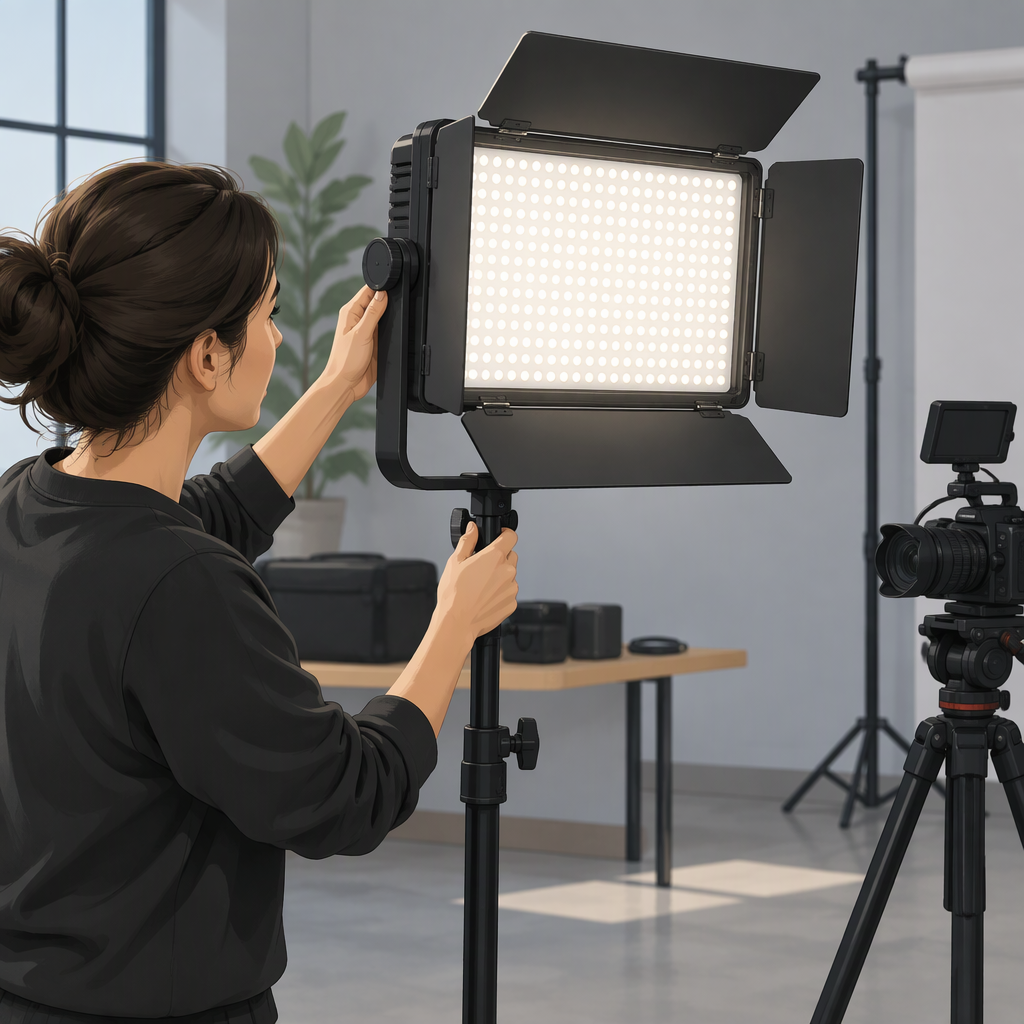
Godox Led1000bi for Filming: A Practical Fit Check
Short answer: don’t choose it from the name alone. First confirm whether the listing is for the LED1000Bi II or another version, then compare the light’s documented output and practical requirements with your subject distance, ambient light, intended role, and modifiers. Godox’s available manual documents the LED1000Bi II, but that does not establish that every listing called “LED1000Bi” is the same version. (cn.godox.com)
Start by Confirming the Exact Model
The model name is an important first check. Godox’s product page and manual identify the bicolor fixture as LED1000Bi II; the manual gives its adjustable color-temperature range as 3300K–5600K. It does not verify the specifications of a product identified only as “LED1000Bi.” Before using the specifications below to make a decision, check the label on the fixture, the listing, and the manual supplied for that exact unit. (godox.com)
If the seller or documentation does not clearly identify the version, treat its specifications as unresolved rather than assuming the “II” details apply.
The Led1000bi Ii: Documented Details That May Affect Fit
Godox’s manual lists these details for the LED1000Bi II:
| What to check | What the manual states | Why it matters |
|---|---|---|
| Color temperature | 3300K–5600K, with a stated tolerance of ±300K | Check whether that range suits the ambient light or color balance you need. The stated tolerance matters if close color matching is important. |
| Output | At 100% brightness, the manual lists 4,800 lux at 1 m and 4200K; 2,200 lux at 1 m and 3300K; and 2,600 lux at 1 m and 5600K | Use these as the manufacturer’s listed figures, not a guarantee of the light level in your scene. The manual excerpt does not fully describe the measurement setup or modifier conditions. |
| Power | Maximum 70 W; DC input is 13–16.8 V | Confirm the included adapter suits your location and setup. For battery use, the manual specifies a 14.8 V BP-L battery, purchased separately. |
| Dimming and controls | Brightness adjusts from 0% to 100%; the fixture has onboard controls. Wireless remote control is optional. | Check whether onboard adjustment is sufficient or whether you need to budget for and verify an optional control accessory. |
| Mounting and connections | The manual describes a bracket and stand-mounting hole, plus DMX connections | Confirm the mounting arrangement works with your stand and that your control setup is compatible if you intend to use DMX. |
| Listed package items | The manual lists the fixture, power adapter, power cable, and diffusion panel for the LED1000Bi II | Package contents can differ by region, seller, or bundle. Confirm the actual box contents; do not assume optional batteries or remote controls are included. |
These details come from Godox’s LED1000Bi II manual. Its output figures are stated at one meter, but the source does not give enough measurement-condition detail here to treat them as directly comparable with every independent test or real-world setup. (cn.godox.com)
Check Fit Against Your Actual Filming Setup
Before choosing the light, write down five things:
- Role: Will it be your key, fill, background, or another light?
- Distance: How far will the light be from the subject? Use the likely shooting position, not the closest position that might be possible.
- Ambient conditions: What other light is present, and how bright does your subject need to appear in the finished image?
- Color needs: Do you need to match warm indoor lighting, daylight, or another source? Is the LED1000Bi II’s documented range suitable for that task?
- Modifiers and placement: Will you use the supplied diffusion panel, add other diffusion, or need a particular mounting position? Verify any added accessory’s compatibility instead of assuming it fits.
Then compare your needs with the specifications for the exact unit. For output, use Godox’s listed one-meter figures as a reference point, but do not treat them as a promise of a particular exposure. Distance, placement, diffusion, and other setup choices affect what reaches the subject. If the required light level is critical, test the exact fixture, power source, and modifier from the intended shooting position—or arrange a return option before relying on it for a shoot.
Illustrative Example—Not a Product Test
Suppose you are considering the LED1000Bi II as a key light and plan to place it one meter from your subject. The manual lists different illuminance figures at that distance for different color temperatures: 4,800 lux at 4200K, 2,200 lux at 3300K, and 2,600 lux at 5600K, all at 100% brightness. Those figures can help frame a test, but they do not establish the exposure you will get with a particular camera, diffusion setup, room, or placement. Test the configuration you actually plan to use before deciding it meets your target.
Trade-Offs to Weigh
- Color flexibility versus output needs: The LED1000Bi II’s documented bicolor range can be useful when you need to adjust between warm and cooler light. The listed output varies by color-temperature setting, so check the figure closest to your intended setting rather than relying on a single number. (cn.godox.com)
- Plug-in power versus battery use: Godox documents DC power and a BP-L battery option, but the specified battery is purchased separately. Check the exact power accessories and regional electrical compatibility for the unit you are considering. (cn.godox.com)
- Built-in controls versus remote or DMX control: The manual describes onboard controls and DMX operation; wireless remote control is optional. Decide whether the control method you need is included or requires an accessory. (cn.godox.com)
- Diffusion versus available light: If your setup requires added diffusion or greater distance, test that arrangement. The manufacturer’s one-meter figures alone do not tell you the result with every modifier or placement.
- Version certainty versus convenience: If you cannot confirm that a listing is for the LED1000Bi II, do not use its manual to assume the listed specifications apply. Obtain the correct documentation or evaluate the exact unit directly.
Before You Choose: Checklist
- The fixture label and documentation confirm the exact model and version.
- The stated output information is relevant to your distance and color-temperature setting.
- You have tested—or can test—the intended modifier and placement if exposure is important.
- The documented color range suits the scene you need to light.
- Your power source, adapter, and any separately purchased battery meet the fixture’s requirements.
- Your stand, control method, and intended accessories are compatible with the exact unit.
- You have confirmed what the specific package includes rather than relying on a generic listing.
Decision: the Godox LED1000Bi II may fit a filming setup when its verified version, output under your intended conditions, color range, power, mounting, and control options meet your requirements. If the model identity is unclear or the required light level has not been tested in your setup, the available documentation is not enough to make a confident fit decision.