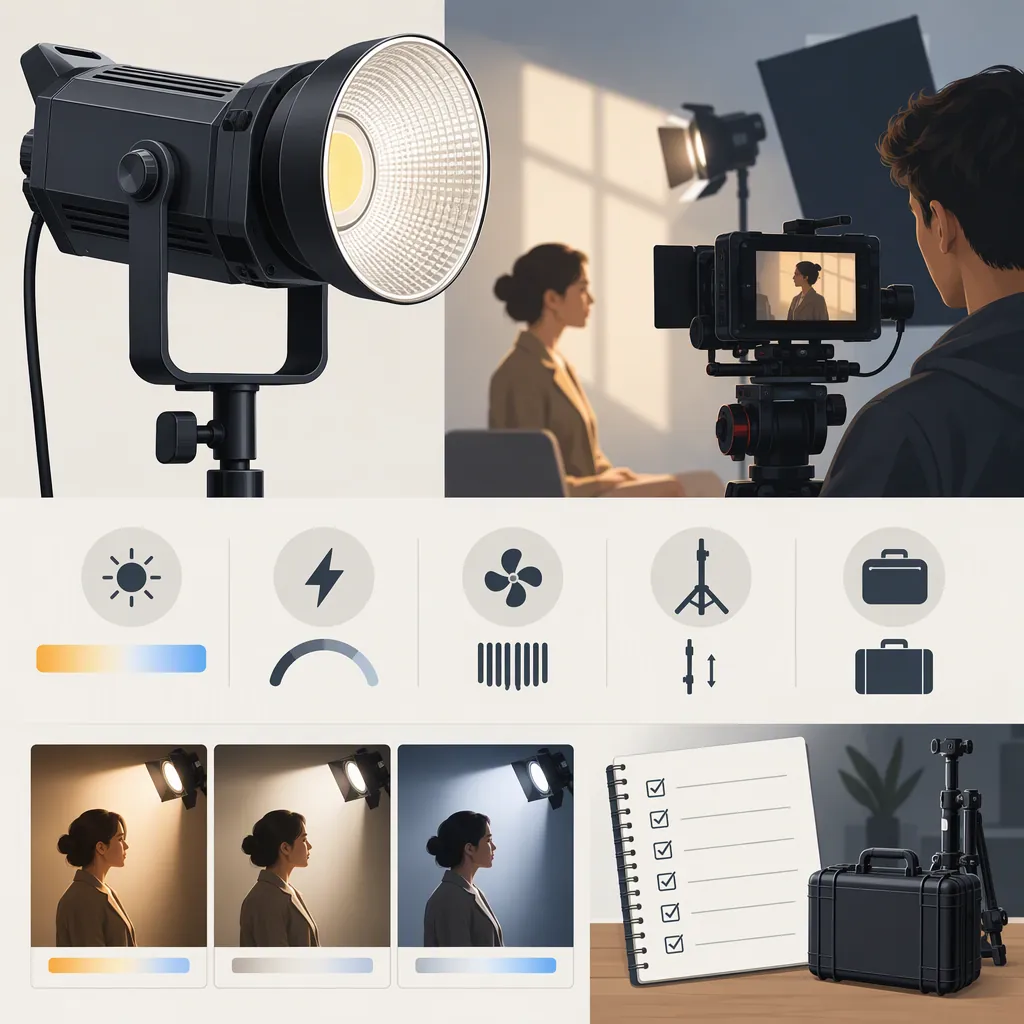
How to Evaluate a Godox 300W Led for Filming
When evaluating a Godox 300W LED for filming, start with the exact model and the complete working setup—not wattage alone. The supplied references concern the VL300, rather than the entire Godox range. One listing specifies a daylight-balanced light with an external controller; another offers a head-only unit without that controller or AC equipment. Check exposure with your intended modifier, record a sound test, and verify included components before deciding whether a particular setup fits your shoot. [src_1] [src_2]
Identify the Model and the Evidence
Treat “godox 300w led” as a starting search term, not a complete equipment specification. Both supplied references identify the Godox VL300. They do not establish the specifications of other Godox lights in the same wattage class. [src_1] [src_2]
District Camera lists the VL300 with 300 W maximum power consumption, a nominal 5600K color temperature, and continuous dimming from 0% to 100%. These are retailer-listed specifications, not independent measurements. Use them to define what needs checking rather than as proof of suitability for a particular scene. [src_1]
The available evidence consists of a retailer product page and an individual marketplace listing. There is no supplied manufacturer manual, independent photometric test, or measured acoustic test. Conclusions about real-world output, recording noise, and battery operation therefore remain limited.
Test the Intended Lighting Setup
For selection purposes, do not treat the wattage label as an exposure prediction. Instead, evaluate the fixture with the modifier, subject distance, framing, and camera settings you intend to use.
District Camera reports 77,000 lux at 1 m, but the supplied text does not clearly identify the modifier configuration behind that measurement. It is not enough to predict exposure through your chosen softbox or bounce setup. The same page lists a Bowens S-Type mount; verify the fit and support requirements of the particular modifier rather than assuming every accessory is suitable. [src_1]
A useful comparison test holds camera settings and subject position constant. Record the modifier, light-to-subject distance, and dimmer setting for each candidate. Review the result for the exposure and shadow pattern your scene needs. This is a proposed evaluation method, not a reported test of the VL300.
Lighting Comparison Test Sheet
- Exact fixture model: __________
- Modifier and mounting arrangement: __________
- Light-to-subject distance: __________
- Camera frame rate and shutter setting: __________
- Aperture, ISO, and white balance: __________
- Dimmer setting: __________
- Exposure acceptable at the intended settings: Yes / No
- Shadow pattern and spill acceptable: Yes / No
- Flicker or banding visible in a recorded clip: Yes / No
- Conditions or limitations observed: __________
Check Color and Recording Noise
District Camera describes the VL300 as daylight-balanced and lists CRI 96 and TLCI 95. These listed ratings are not a substitute for checking your subject, camera, and mixed-light scene. The supplied references do not establish an adjustable color-temperature range. [src_1] [src_2]
For a scene with practical lamps or window light, make a short recording with the intended white balance. Review skin tones or important object colors before accepting the setup.
Cooling information conflicts. District Camera specifies fan cooling, while the GearFocus listing describes a fanless design. Neither source provides measured recording-noise results. Do not infer silent operation from the marketplace description. [src_1] [src_2]
For dialogue, record room tone with the fixture operating at the intended setting and the microphone in its actual position. Evaluate the recording rather than relying only on what you hear beside the light.
Verify Power and Included Components
District Camera states that the VL300 light body is operated and powered through an external controller. It also describes dual V-mount battery plates on that controller and lists AC-adapter and external-battery power options. The supplied evidence does not establish compatible battery specifications or runtime for your planned setup. [src_1]
The GearFocus listing is explicitly head-only. Its condition notes say that the battery pack, AC unit, and controller are not included. That describes this individual listing, not every VL300 package. [src_2]
Compare complete, usable systems rather than light heads alone. Verify the controller, power supply, required cables, mounting hardware, and intended power source against documentation for the exact unit. Plan support for the modifier and any external equipment, and keep cable routing clear of walking paths.
Complete-System Verification Checklist
- Confirm the exact model and the contents of this specific package.
- Verify the required controller and power supply are present and compatible.
- Identify every cable needed between the outlet or battery, controller, and light head.
- If using batteries, verify compatibility and operating requirements from the exact model documentation.
- Check modifier attachment and suitable support for the assembled setup.
- Establish how the external equipment will be supported without loading its connectors.
- Test the complete system at the settings planned for filming.
FAQ
Does the 300W Label Establish Whether the Light Will Work for My Shoot?
No. District Camera lists 300 W maximum power consumption, but that specification does not establish exposure in your intended setup. Evaluate the light with your actual modifier, distance, and camera settings. Its listed lux figure lacks a clearly identified modifier configuration in the supplied text. [src_1]
Is the Vl300 Silent Enough for Dialogue Recording?
The supplied evidence cannot establish that. District Camera lists fan cooling, while GearFocus describes a fanless design. Neither provides measured acoustic results. Record a sound test with the actual fixture and microphone arrangement. [src_1] [src_2]
Is a Head-Only Vl300 Listing a Complete Filming-Light Setup?
Do not assume so. The supplied GearFocus listing excludes the controller, AC unit, and battery pack, while District Camera describes the light body as operated and powered through an external controller. Verify all required components for the specific unit. [src_1] [src_2]