Godox 150W Led Lights: How to Choose One for Filming
Direct Answer: Choose by Your Scene, Not by “150W” Alone
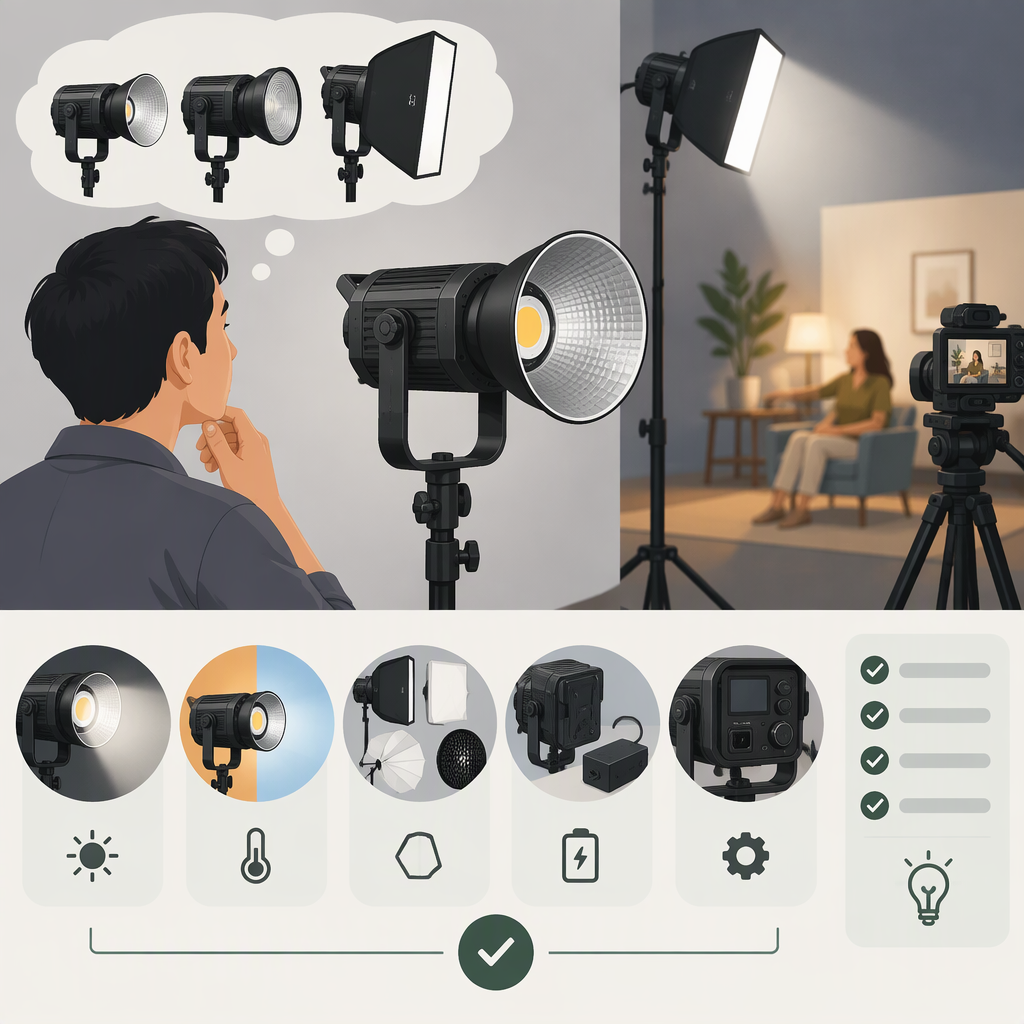
A Godox light labeled around 150W may suit your filming setup, but that number alone cannot tell you how much light will reach your subject. First identify the exact model and configuration, then compare its measured illuminance with the same reflector or modifier, color setting, and distance you expect to use. Finally, consider the size of the area to light, ambient light, color needs, power access, and whether fan noise matters.
Godox documents several distinct 150W-class options, including the SL150III and SL150IIIBi, the fanless UL150II and UL150IIBi, and the portable ML150Bi. They are not interchangeable just because their model names contain “150.” Their color features, cooling, power arrangements, and accessory systems differ. (godox.com)
First Check: Will the Light Cover Your Scene?
Look for a lux measurement—not just a wattage figure—and read the conditions attached to it. Distance, reflector or modifier, and color setting can affect the result. A measurement made with a focused reflector is not a like-for-like comparison with one made through a softbox or diffusion. For a useful comparison, seek figures measured at the same distance and with comparable light-shaping accessories and settings.
Then match that evidence to the shot:
- Subject and coverage: A close single-person shot asks for less coverage than lighting a wider area. Consider whether the light needs to cover one face, a full body, a tabletop, or a broader background.
- Distance: Note how far the fixture will be from the subject. Use output figures at a relevant distance when available; do not treat a result at one meter as a guarantee for a different setup.
- Modifier: Check the measurement conditions and confirm that the modifier fits the exact light. A modifier changes the beam and the amount of light reaching the subject.
- Ambient light: Decide whether you are adding fill to a controlled room or trying to make the subject stand out against strong existing light. The latter may call for a different output level or placement.
Godox, for example, gives the ML150Bi output as 61,054 lux with its ML-Z zoom lens reflector; the same product page gives the ML80Bi figure as 29,600 lux at 5600K and one meter. Those numbers do not establish a direct comparison with other 150W models unless their measurement conditions also match. (godox.com)
Hypothetical example: If you are filming a seated speaker in a small room, write down the planned light-to-subject distance and the softbox or reflector you intend to use. Compare output evidence for that arrangement, then check whether the fixture can cover the face and any surrounding area you want in frame. If the documentation does not give a comparable measurement for that setup, the wattage label cannot fill the gap; you would need a relevant specification or a controlled test of the actual configuration.
Which Godox 150W Model Family Should You Compare?
| If your priority is… | Model family to investigate | What the manufacturer documents | What to verify before choosing |
|---|---|---|---|
| A fixed daylight setting | SL150III | Godox lists the SL150III in its SLIII series and its manual describes the series’ Bowens mount. (godox.com) | Output under your intended modifier and distance; whether fixed daylight meets your color-matching needs. |
| Adjustable color temperature | SL150IIIBi | Godox’s manual describes this as a bi-color LED video light with adjustable color temperature. (godox.com) | The exact range and output at the color setting you plan to use; verify both in the manual for the exact model. |
| Fanless operation for sound-sensitive recording | UL150II or UL150IIBi | Godox describes the UL150II family as fanless; its product page lists Bowens mount, DMX and wireless control, and optional V-mount batteries. (godox.com) | Whether the fixed-color or bi-color version is right; required control box, battery, and accessory configuration. |
| A portable, battery-capable setup | ML150Bi | Godox lists NP-F and V-mount options through adapter plates, and specifies its Godox Mount accessory system. (godox.com) | Which batteries and adapter plates are required for your setup, and whether your existing modifiers fit the Godox Mount. |
This is a shortlist by use case, not a performance ranking. The cited manufacturer pages do not provide a single set of output measurements for all four options under identical test conditions, so they do not support declaring one universally brighter or better.
Use This Selection Checklist
- Write down the shot: subject, framing, coverage, distance, and ambient-light conditions.
- Choose the color behavior: decide whether fixed daylight is enough or whether adjustable color temperature is useful for matching other lights or the room.
- Check sound requirements: if the light will be near a microphone, verify the exact model’s cooling and quiet-mode details. “Fanless” and “quiet mode” are different claims; do not assume one model’s feature applies to another.
- Confirm power for the whole shoot: check the exact model’s AC/DC requirements and any battery, adapter, or control-box requirements. A battery option may add components that affect cost, setup, and runtime; verify the manufacturer’s details for the configuration you plan to use.
- Verify mount and modifier fit: check the mount on the light and the mount on the specific softbox, reflector, or adapter. Do not infer compatibility from brand name alone.
- Compare relevant output evidence: prefer measurements at your intended distance and with the modifier and color setting you will actually use. Keep differing conditions separate rather than ranking unlike numbers.
Bottom line: Start with the scene and the exact configuration, then use documented output and feature details to narrow the choice. A fixed-daylight SL150III, a bi-color model, a fanless UL150II variant, and a battery-capable ML150Bi address different priorities. If the documentation does not provide output measurements for your intended conditions, there is not enough evidence to say that a particular Godox 150W light will be sufficient for your shot.