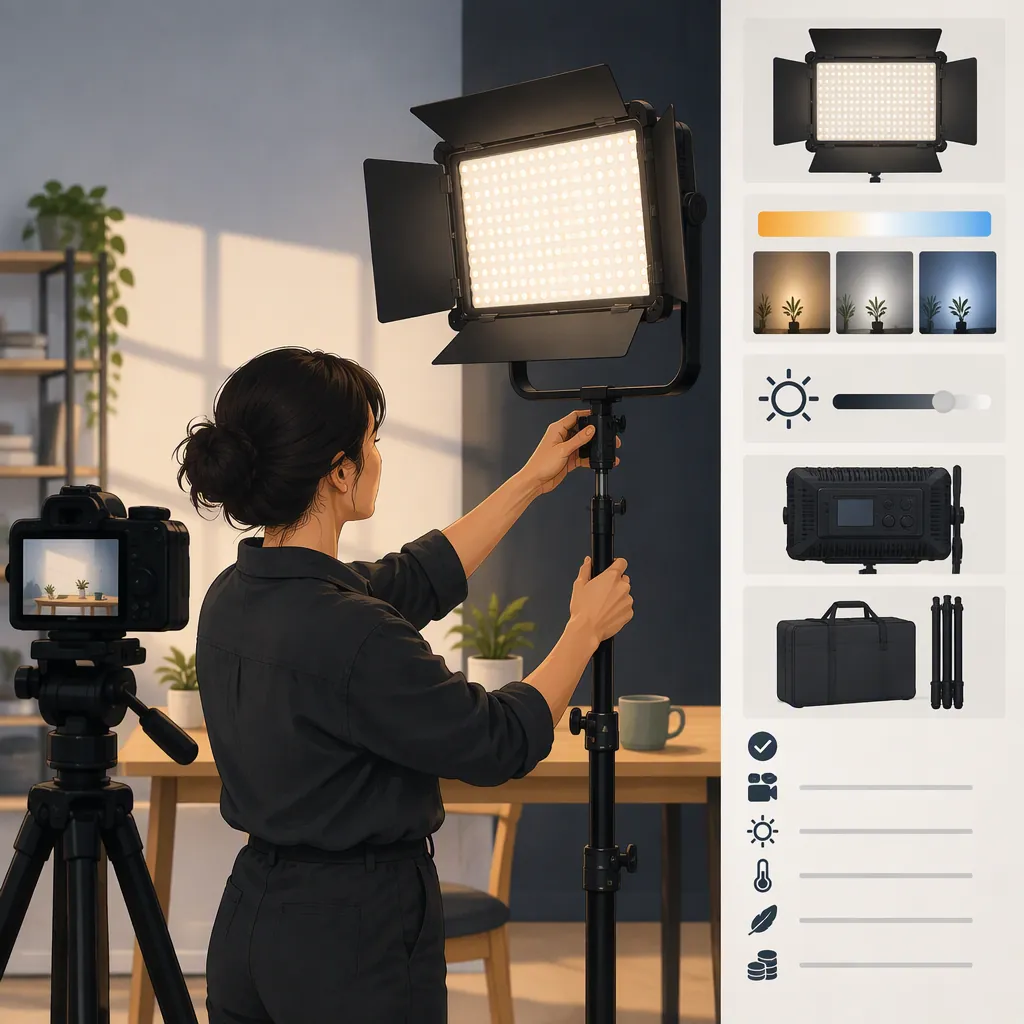
How to Choose a Godox Led 1000 Light for Filming
Choose a Godox LED 1000 by its exact model, not the family name alone. The supplied LED1000 series page lists daylight LED1000W, tungsten LED1000Y, and adjustable-color LED1000C versions. Match the version to your intended lighting setup, then check output at the relevant color temperature, dimming limits, power requirements, and camera-test results. Treat the separately listed LED1000Bi II kit as a distinct listing; the older series specifications do not establish its performance. [c1] [c2]
Identify the Exact Led1000 Model
The supplied Godox LED1000 series page distinguishes three models: LED1000W at 5600K, LED1000Y at 3300K, and LED1000C with a 3300K–5600K adjustment range. Its technical tables state a ±300K color-temperature tolerance. [c1]
A separate Walmart listing is titled “Godox LED1000Bi II / S30 LED 3-Light Kit with Stands.” That title describes a kit rather than the same individual models documented in the series table. Do not transfer specifications or accessory assumptions between these sources without confirming the exact unit. [c2]
For a daylight-oriented setup, start by evaluating the W version; for a warm-light setup, evaluate the Y version. If the planned scenes require changing color temperature within the published range, evaluate the C version. These are selection starting points, not guarantees that a light will match every window, practical lamp, or camera.
Model Identification Record
- Exact model printed on the fixture:
- Exact model in the technical documentation:
- Individual fixture or mixed kit:
- Required color-temperature setting:
- Included power supply, mounting hardware, and modifiers:
- Unresolved differences between the listing and documentation:
Compare Output at the Intended Settings
For LED1000C, the series table lists 4,400 lux at 1 meter and 4200K, but 2,200 lux at 1 meter at both 3300K and 5600K. For LED1000W and LED1000Y, it lists 4,400 lux at 1 meter. These are published figures, not independent measurements. The supplied text does not describe a complete measurement method or establish output with your chosen modifier. [c1]
The same table lists a maximum power of 70W for all three models. That is a power specification, not a basis for assuming equal usable illumination across every setting. [c1]
Compare candidate lights at the intended subject distance, color temperature, and diffusion setup. Use the camera exposure required for the scene as the acceptance criterion rather than relying on a single headline output number.
Scene Output Test
1. Set the camera to the planned frame rate, shutter setting, aperture, and ISO.
2. Place the light at the intended subject distance.
3. Select the color temperature needed for the scene.
4. Fit the intended diffusion or other compatible modifier.
5. Record whether the subject reaches the required exposure.
6. Repeat at the lowest and highest output settings needed during filming.
7. Note any setting that requires a different distance or camera exposure.
Check Dimming and Camera Compatibility
The LED1000 series table lists 10%–100% brightness adjustment for W and Y. For C, it lists 10%–100% at 3300K and 5600K, but 25%–100% from 3400K through 5500K. That distinction is relevant if a scene requires low output at an intermediate color temperature. [c1]
The Walmart kit listing advertises 0%–100% dimming, CRI 96, TLCI 98, and passive cooling. These are listing claims; they do not independently establish results for every fixture in the kit or apply to the older W, Y, and C models. [c2]
The supplied references do not establish flicker behavior at particular frame rates and shutter settings. Before accepting a light for a shoot, record test footage at the settings you will actually use. Include low-output settings, skin tones, neutral objects, and a quiet audio sample. Review the recording for banding, color shifts, and audible equipment noise rather than treating published ratings as a complete camera test.
Verify Power, Support, and Kit Contents
For the W, Y, and C models, the series table lists a 13–16.8V DC supply and a separately sold 14.8V battery described as a SONY BP-L model lithium battery. It also lists dimensions of 430 × 460 × 100mm and a net weight of 2.44kg for each model. The supplied page does not establish battery runtime. [c1]
Use the exact fixture documentation to verify battery and power-supply compatibility. Do not interpret the listed voltage alone as approval for an arbitrary battery or adapter.
Plan the stand, mounting hardware, cable routing, and modifier support as part of the setup. Verify the complete supported load against the support equipment's documentation. The Walmart reference names a kit with stands, but its supplied text does not provide a complete itemized inventory identifying every fixture and accessory. [c2]
Power and Support Checklist
- Confirm the exact approved power supply or battery model.
- Verify which power accessories are included.
- Establish required operating time through a documented specification or controlled test.
- Check the stand and mount ratings for the complete supported setup.
- Confirm modifier compatibility with the exact fixture.
- Keep cables clear of walkways and avoid strain on connectors.
- Resolve any incomplete kit inventory before planning the lighting layout.
Make the Selection with Clear Limits
Use this decision sequence: identify the exact model, choose the required color-temperature range, test exposure with the intended modifier, check low-output behavior, and verify power and support requirements.
The references document model specifications and retail listing claims, not a controlled comparison. They do not establish which version is best for your room, camera, subject, or shooting style. The LED1000 series table and the LED1000Bi II kit listing should remain separate evidence sources rather than being combined into one specification sheet. [c1] [c2]
If a critical requirement remains unverified—such as battery runtime, flicker at your recording settings, or exact kit contents—mark it as unresolved rather than assuming the family name answers it.
FAQ
Which Godox Led1000 Version Has Adjustable Color Temperature?
The supplied series page identifies LED1000C as the bicolor version, with a published range of 3300K–5600K. LED1000W is listed at 5600K and LED1000Y at 3300K. Confirm the exact model because the separate LED1000Bi II kit listing is not the same specification table. [c1] [c2]
Does Led1000c Have the Same Published Output at Every Color Temperature?
No. The series table lists 4,400 lux at 1 meter at 4200K and 2,200 lux at 1 meter at 3300K and 5600K. These published values do not establish exposure with your particular diffusion, distance, or camera settings. [c1]
Do the Supplied References Confirm Flicker-Free Filming?
No. Neither supplied reference establishes flicker performance at specified frame rates and shutter settings. Test the exact fixture at your intended recording settings and dimming levels before relying on it for a shoot. [c1] [c2]